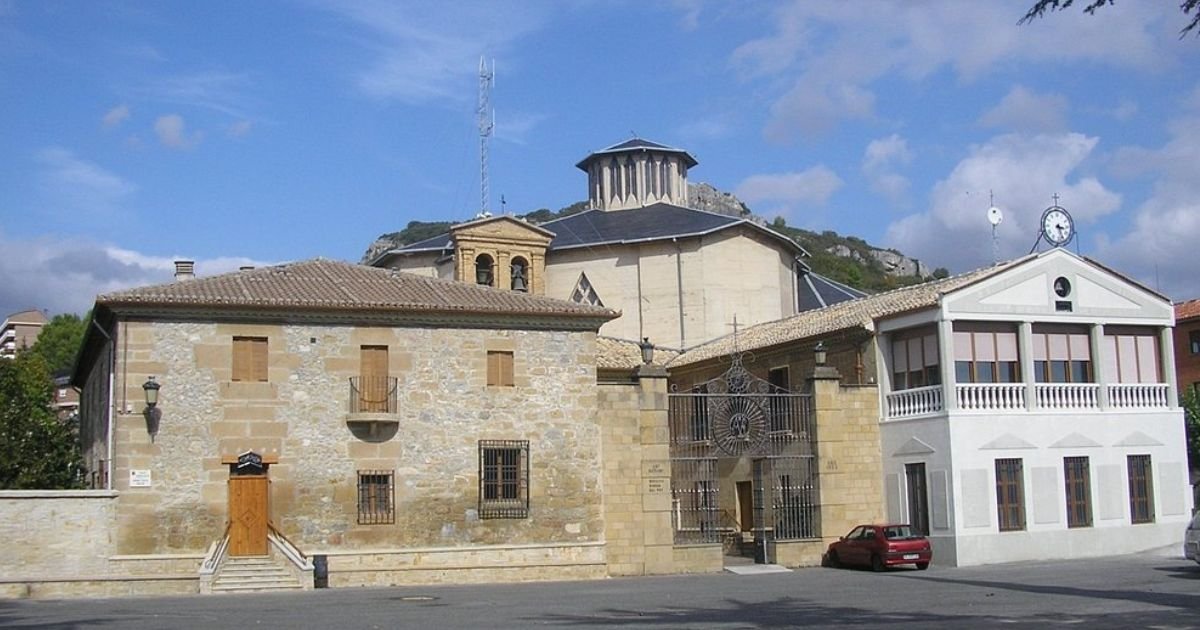


Basilica de Nuestra Senora del Puy de Estella
The Basilica de Nuestra Senora del Puy is an important, emblematic place of worship located in the lovely town of Estella, in the chartered community of Navarre, on the Camino de Santiago Frances. This basilica is dedicated to the Virgin Mary, who is the patroness of the town and its people. Its location is truly privileged, sitting on a hill directly above the neighbourhood of Lizarra, considered the original core of what is now Estella. This elevated position not only gives it a distinctive character, but also offers visitors a stunning panoramic view of the whole town. From this vantage point, one can take in the various corners of Estella, as well as the main roads connecting it to other towns and the access routes that make it easy for visitors to arrive. The basilica also offers views of the beautiful mountains surrounding the town, helping to create a setting of peace and natural beauty that complements the grandeur of this religious building. Without a doubt, the Basilica de Nuestra Senora del Puy is a place where spirituality meets nature within an urban setting steeped in history and culture.
Etymology of the Basilica de Nuestra Senora del Puy
The basilica was named after Nuestra Senora del Puy, and there are two reasons behind this choice. First, it refers to a deeply venerated devotion found in France, known as Notre-Dame du Puy in the city of Le Puy-en-Velay. This connection to a French religious tradition is highly significant and reflects the influence of that devotion in the region. Second, the name also stems from the basilica’s own geographic location, situated on high ground, which in geographic terms translates as “the height.” This elevated position is key to understanding the etymology of the term Puy, which refers to a place set on a rise. Variations of the name, such as Poyo or Pueyo, can also be found describing similarly elevated sites. Thus, the name Virgen del Puy not only ties back to the devotion venerated in France, but also reflects the actual geography of its location in Spain.
History and Legend
According to an ancient legend dating back to 1085, at a time when the new city of Estella was taking shape, a group of shepherds living in Abarzuza were drawn by the sight of certain stars that seemed to point the way, and they decided to follow this sign. Their search led them to a cave where they made a surprising discovery: an image of the Virgin with the Child. According to legend, this image had been buried in earlier times after the Moors conquered the Iberian Peninsula. On learning of this discovery, King Sancho Ramirez decided that a church should be built on the very spot where the image was found, to honour the Virgin.
Over time, this church came under royal patronage, meaning the kings held authority over it and protected it. It is known that in 1174, the Bishop of Pamplona, Pedro de Paris, made an important donation: he granted the church of El Puy to a group of sixty confraternity members of Santiago. However, this relationship of dependence with the church did not last long, as the confraternity dissolved in 1323, returning authority over the church to the crown.
For a brief period in 1482, under the reign of Francis Phoebus, the church’s status changed again. It temporarily ceased to depend directly on the crown and came under the authority of the collegiate church of San Bartolome, located at the site known as Gollano. However, years later, in 1502, the church was returned to the crown, with the Prince of Viana, Andres Phoebus of Navarre, assuming responsibility for it at that time.
Elsewhere in the history of this site, it’s worth mentioning that near the church there is a plaque commemorating a tragic event that took place in 1839. That year, several Carlist generals were executed by firing squad on the orders of General Rafael Maroto. This plaque serves as a reminder of the historical events that marked the region.
Regarding the church itself, it’s important to note that the original building, constructed on the site where the image of the Virgin was found, was eventually replaced. A Baroque-style structure was erected, though later, between 1929 and 1951, the current church was built. This new building was designed by architect Victor Eusa and represents an important architectural legacy of the area. In this way, the history and legend of this site have endured across the centuries, reflecting the region’s rich cultural and religious heritage.
Description of the Basilica de Nuestra Senora del Puy
The old basilica that once stood on this site was replaced centuries later by an impressive Baroque-style church, with a Latin-cross floor plan and a straight east end. This new church also included a small camarin attached to the main structure. The nave was covered by a barrel vault with lunettes, giving it a distinctive, light-filled character, except at the crossing, where an elegant dome rose on pendentives. On either side of the nave were side chapels connecting to both the nave and the arms of the transept, creating an interior space that invited contemplation and devotion.
Although a beautiful entrance atrium from that Baroque period still survives, the church we see today was built between 1929 and 1951. This work followed the plans of renowned Pamplona-born architect Victor Eusa, who developed two separate designs for the basilica. The first, drawn up in 1929, showed a clear influence from Secessionist models and a simpler spatial concept that was never carried out. The second design, however, completed in 1949, stood out for its greater attention to shaping space. This focus was notably reflected in the main chapel, conceived with a form resembling an ambulatory. This design became a defining theme of the building, resulting in a space that was both transparent and complex, full of nuances that made it unique.
The church’s floor plan, as well as its entire decorative scheme, is built around the shape of an eight-pointed star, a significant symbol for the town of Estella, whose name comes from the Latin “Stella,” meaning star. This detail not only adds aesthetic value to the design, but also reinforces the local identity and the church’s connection to the community. Inside the church is a venerated image of the Virgin dating from the late 13th or early 14th century. This statue is made of wood and covered in silver, giving it an extraordinary, sacred appearance. A copy of the image is also displayed inside the church, created for use during processions, allowing devotion to the Virgin to remain alive within the community.
Feast Day
The feast day of the Virgen del Puy is celebrated on May 25 and is a major event for the town. This day is special for many residents, who pay tribute to the Virgin, regarded as the patroness of Estella. During this celebration, the community takes part in various activities with fervor and devotion. Besides May 25, notable Masses are also held during the patron saint festivities, which usually take place around the first Sunday of August. These Masses honour not only Nuestra Senora del Puy, but also Saint Andrew, who holds a special place in the town’s traditions. In this way, the feast day not only highlights the religious devotion of local residents, but also brings the community together in celebrating their beliefs and traditions.