
Puente Románico de Puente la Reina
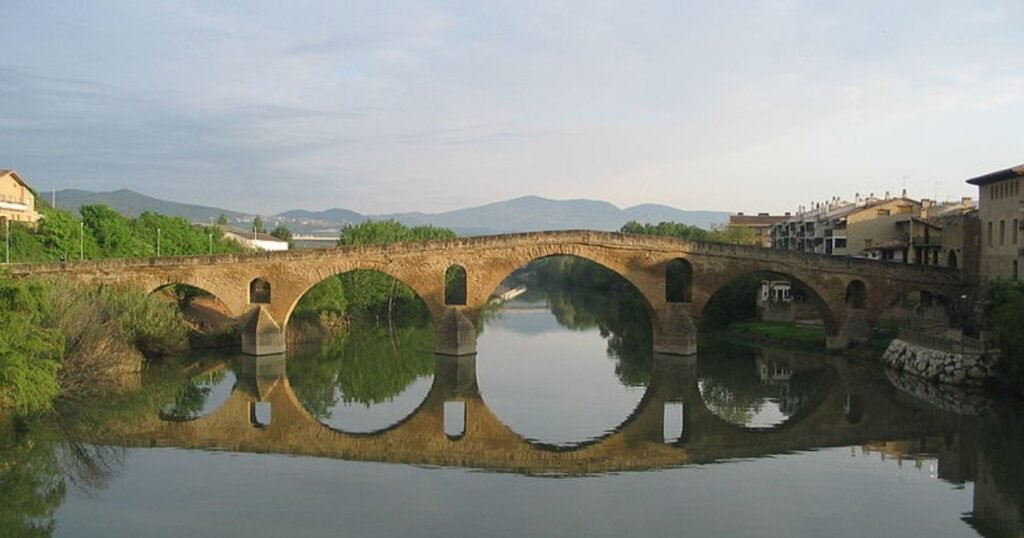
The Romanesque bridge of Puente la Reina is an impressive arched bridge spanning the Arga River in the town of the same name, Puente la Reina, in Navarra, on the Camino de Santiago Frances. This bridge is significant as a notable example of Romanesque architecture and was built in the 11th century, giving it great historical value. Its strategic location also makes it a key point for pilgrims following the French Camino de Santiago. Here, two important branches of the route meet and cross: the Navarrese branch coming from Roncesvalles and the Aragonese branch arriving from Somport. This makes the bridge not only an architectural work, but also a symbol of the region’s pilgrimage tradition.
In 1931, the bridge was officially declared a Historic-Artistic Monument, recognizing its cultural and heritage importance. It now holds the status of Asset of Cultural Interest, further highlighting its relevance to the history and culture of Navarra and Spain as a whole. This recognition allows measures to be taken to protect and preserve the bridge, ensuring future generations can appreciate its beauty and understand its historical significance.
History of the Puente Románico de Puente la Reina
The Puente de la Reina, which in turn gives its name to the town located in Navarra, Spain, was built in the 11th century on the initiative of a queen. However, the identity of this queen remains a mystery and has not been determined with certainty. Some theories suggest it may have been Muniadona of Castile, wife of Sancho Garces III of Pamplona, also known as Mayor. Another possibility is that the order to build the bridge came from her daughter-in-law, Estefania de Foix, who was married to Garcia Sanchez III of Pamplona.
Construction of the bridge took place in the mid-11th century, with the main purpose of allowing crossing of the Arga River. This bridge was essential in easing the passage of pilgrims traveling the Camino de Santiago, one of the most important pilgrimage routes of the Middle Ages. The bridge connected the towns of Pamplona and Estella, improving the infrastructure needed for travellers making this important religious and cultural journey. The work not only solved a practical transport problem but has also become a highly valued historical symbol for the region, representing the effort and dedication of those who worked on its construction.
Description of the Puente Románico de Puente la Reina
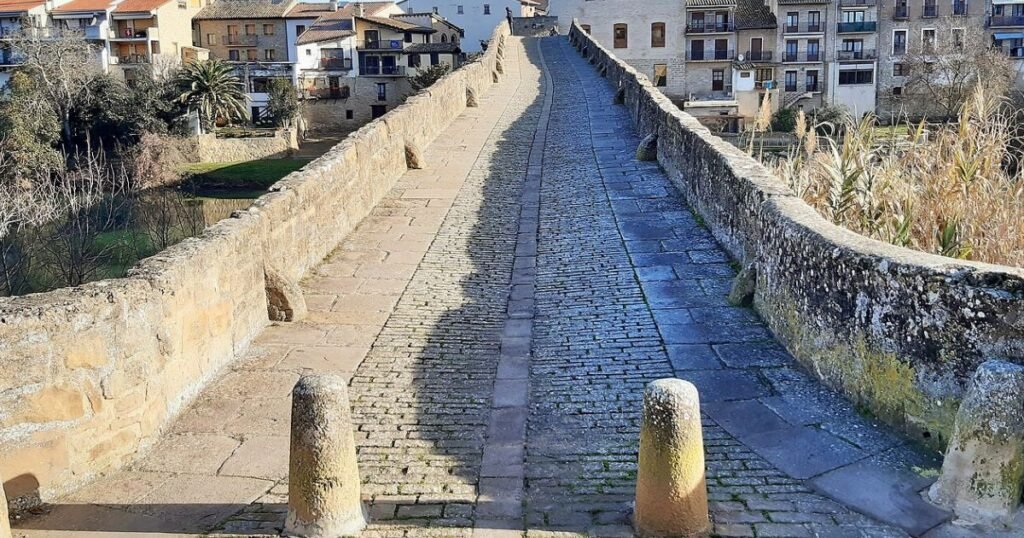
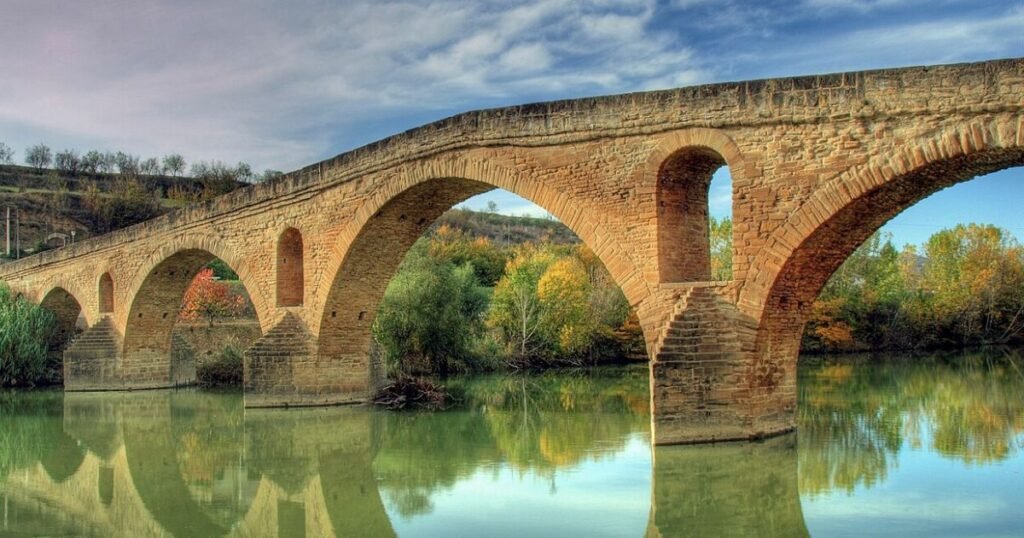
The Puente Románico de Puente la Reina has fairly impressive dimensions. The bridge is 110 metres long in total, making it a notably extensive structure for its area. The roadway of the bridge, the part used by vehicles and pedestrians, is 4 metres wide, allowing for an adequate flow of traffic. The bridge is supported by a total of seven large semicircular arches. However, it is worth noting that the westernmost arch is partially buried under the street on one side of the bridge, hiding its presence to some extent.
The bridge’s structure rests on five sturdy piers, which are essential to its stability. Each of these piers is approximately 5 metres thick, giving them great resistance against the forces acting on the bridge. To further increase the stability of this magnificent structure, the piers are reinforced with wedge-shaped cutwaters on both sides. This helps the bridge withstand the stresses placed on it, especially over time and with continuous use. Moving towards the centre of the bridge, the height of the arches can be seen to increase progressively, creating a sense of grandeur. The central arch is the largest of all, with a span of around 22 metres, giving the whole structure great presence and architectural beauty.
It is worth noting that the bridge originally had three defensive towers. These towers were strategically located, one at each end of the bridge and another in the centre. Besides their defensive role, there were also checkpoints where tolls were collected from those crossing the bridge, suggesting it played an important part in the trade routes of the time. The central tower was even more significant, as it housed an important statue of the Virgen del Puy, considered the town’s patroness, adding spiritual and cultural value to the site.
However, during the 19th century, specifically in the context of the Carlist Wars, these defensive towers were destroyed, marking a major change in the bridge’s structure and function. The statue of the Virgen del Puy, which had been an object of veneration for many, was moved to the Iglesia de San Pedro to preserve its integrity and protect it from damage. These historical events have left their mark on the bridge’s history, turning it into a site of interest not only architecturally, but also culturally and socially over the years.