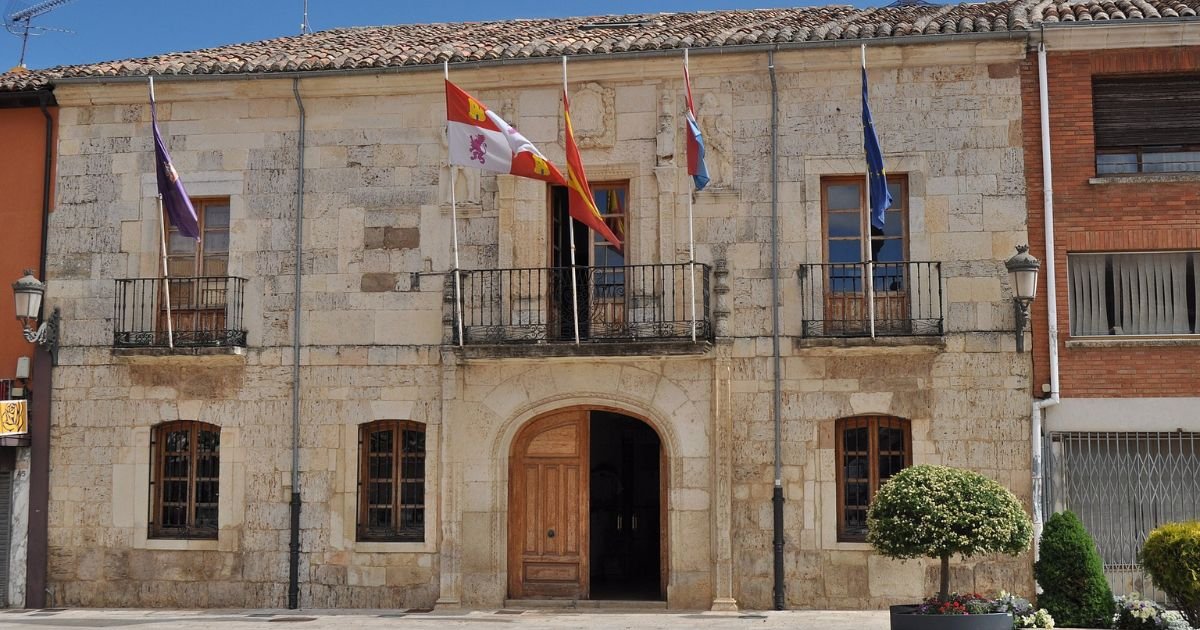

Casa Consistorial de Melgar de Fernamental
Located at the heart of the Plaza Mayor of Melgar de Fernamental, in Burgos Province, the Casa Consistorial (Town Hall) stands as one of the finest examples of Renaissance-Plateresque architecture along the Camino de Santiago Frances as it follows the route of the Via Aquitania. This historic building, constructed in the early 16th century, reflects the institutional and economic importance this town held during the Castilian Renaissance.
A Building With a Renaissance Stamp and a Symbol of Power
The Casa Consistorial was built over an earlier Plateresque palace, conceived as a symbol of authority and prestige. Its symmetrical, monumental facade displays an exquisite blend of art and structural balance. At its centre opens a large lintelled doorway topped by a central balcony, both elements joined by a set of ornamented “candelieri” pilasters typical of the Plateresque style.
The upper pilasters, identical in craftsmanship, are topped by two supporting lions holding shields engraved with the Cross of Calatrava, recalling the presence and dominance of the Order of Calatrava in this northern part of Burgos. This military and religious order held extensive holdings throughout the region, including the Monasterio de San Felix, located in the nearby Barrio de San Felices, about 15 kilometres from Melgar.
Sculpture and Symbolism on the Facade
On either side of the upper floor, the carved figures of two “armed wild men” can be seen, an iconography drawn from European imagery that reached Spain following the discovery of the Americas. These figures represent strength, vigilance and the protective spirit of the community. The same sculptural motif can be found on the facade of the Colegio de San Gregorio in Valladolid, showing the artistic connection between Melgar and the leading cultural centres of the Castilian Renaissance.
At the centre of the facade, beneath a richly carved heraldic border, the inscription “Casa Consistorial” can be read, alongside the symbol of Justice, an emblem reinforcing the building’s institutional role as the seat of local authority.
Historical Origin and Institutional Role
Although no surviving documentation confirms with certainty its architect or original sponsor, all evidence suggests that the Casa Consistorial may have been built as an administrative centre for the Order of Calatrava or as a royal town hall during the reign of the Catholic Monarchs. During this period, the Crown promoted the construction of stone town halls in chartered towns, following regulations aimed at dignifying the spaces of government and justice throughout the Kingdom of Castile.
This historical context fits with the strategic position of Melgar de Fernamental, a crucial hub of medieval trade and communication, located beside the Pisuerga River, the Camino de Santiago Frances and the ancient Roman road, the Via Aquitania, which linked Astorga with Bordeaux.
A Civic Centre on the Camino de Santiago
Over the centuries, the Casa Consistorial has continued to serve as the administrative and social heart of Melgar de Fernamental, housing the town council and hosting public events and civic celebrations. Its location on the Plaza Mayor, surrounded by arcades, traditional shops and noble houses, makes it a gathering place for locals, pilgrims and visitors alike.
The harmony of its architecture, the solidity of its sandstone and the delicacy of its reliefs place it among the most notable town halls in the province of Burgos, a testament to the splendor of a town that for centuries was a required stop for merchants, nobles and pilgrims on their way to Compostela.
Historical Legacy Along the Via Aquitania
Today, the Casa Consistorial de Melgar de Fernamental forms part of the rich heritage tied to the Camino de Santiago Frances along the Via Aquitania, a route crossing the Odra-Pisuerga region. Its monumental presence recalls the importance of civic organization in the towns of Castile and León, where stone and art served to express the strength of the community.
The building’s carefully preserved facade invites travellers to pause, take in its sculptural details, and discover within them the story of a town that stood as a symbol of power, justice and hospitality in Renaissance Castile.