


What to see in Torres del Río?
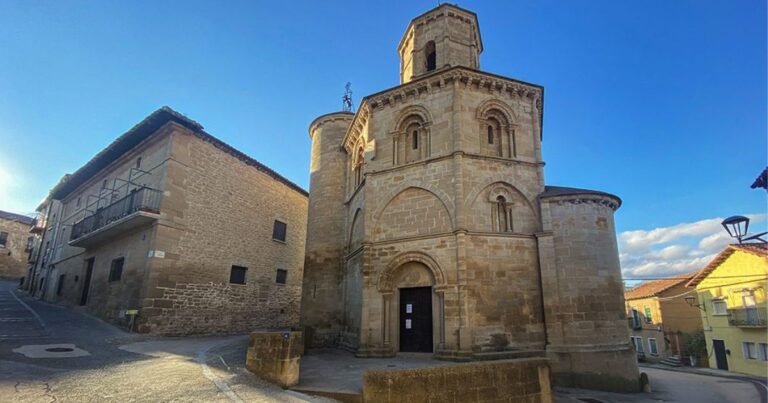
History of Torres del Río
Torres del Río lies halfway between Los Arcos and Viana, on the Camino Frances leading to the Cathedral of Santiago in Santiago de Compostela, walked by pilgrims for centuries. The houses climb a slope facing the hill of Sansol, with good views over the valley. Its history predates the arrival of the Muslims: a kilometre away, towards Logroño, remains of a Roman farming estate, pottery and a carved stone have been found.
After the Muslim invasion the area came under their control, until it was recovered after the conquest of Monjardín. Once in Christian hands a monastery was founded here, known as “Justa Illo Kamino”, “beside the Camino”, which Jimeno Galíndez gave to the monastery of Irache in 1109.
In 1172 Pope Alexander III placed the monastery of Santa María la Real de Irache (Irache Monastery) and its abbot Viviano under his protection, and confirmed its possessions, among them the town of “Turres” with all its belongings. That papal backing strengthened the place’s weight during the Middle Ages.
The pilgrim Aymeric Picaud also speaks of Torres in the 12th century, in the Codex Calixtinus: he warns that the waters of the river Linares were poisonous. The reputation lasted for centuries, because in 1381 another pilgrim, Geofroi de Buletot, was still advising in his diary to beware of the «bad and poisonous rivers, such as that of Torres de Sansol» on the way to Santiago de Compostela.
In 1341 the town council placed itself under the king’s lordship in exchange for being governed by the fuero of Viguera, an agreement later confirmed by Philip III of Navarre. The documents also mention residents such as Alvar Díaz de Medrano, son of Juan Martínez de Medrano, and land sales such as the irrigated land of La Monjía, which the monastery of Iranzu bought from Torres and Sansol in 1492.
In the disputes between Henry IV of Castile and John II of Aragon, an arbitration ruling by Louis XI of France left the town in Castilian hands. It remained so from 1463 to 1753, almost three centuries, although Torres continued to be governed by Navarrese fueros and to look economically towards Navarra, an example of how complicated life on the border could be.
In the war against Napoleon, on 19 or 20 November 1809, a battle was fought here between a French column under Colonel Belloc, with some 800 infantry and 80 horsemen, and the guerrillas of Francisco Xavier Mina, with about 500 men, joined by the band of “Cuevillas” and volunteers from Torres, Sansol and Los Arcos. The band of the “Marquesito” was also nearby, but did not join the fighting.
At nightfall the French, fearing that the “Marquesito” would join in, withdrew to a height near Los Arcos and lit fires to simulate a camp. Mina advanced in the dark to surprise them, but when he arrived he found only the fires: the enemy had slipped away. He chased them as far as the outskirts of Estella without catching them.
Shortly afterwards, on 13 June 1811, the feast of Corpus Christi, French troops shot the vicar of Torres, Don Juan Miguel de Aramendia, one of the saddest episodes of those years.
Until 1916 the village was simply called Torres. That year, with the reform intended to avoid repeated names among municipalities, it officially became Torres del Río.
Torres del Río facts
| Country | Spain | |
|---|---|---|
| Autonomous community | Navarra | |
| Province | Navarra | |
| Merindad | Estella | |
| District | Estella Occidental | |
| Judicial district | Estella | |
| Mancomunidad | Montejurra | |
| Location | 42°33′10″N 2°16′10″W | |
| Elevation | 480 m | |
| Area | 12.81 km² | |
| Population | 117 inhab. (2023) | |
| Density | 9.99 inhab./km² | |
| Predominant language | Non-Basque-speaking area | |
| Postal code | 31229 | |
| Telephone prefix | 948 | |
| Website | torresdelrio.es | |