Camino Frances Stage Route: Puente la Reina – Estella (22.6 km)
This stage of the Camino de Santiago Frances runs from Puente la Reina to Estella over about 22.6 kilometers of gentle rolling ground through vineyards, grain fields and olive groves. It is a moderately difficult day with no major climbs, but with two treasures that make it unforgettable: the hilltop village of Cirauqui and one of the best-preserved stretches of Roman road on the entire Camino. At the end waits Estella-Lizarra, one of the great monumental cities of the pilgrim route.
KM 0

Puente la Reina
Cross the Romanesque bridge and leave Puente la Reina along Calle Mayor. After a stretch alongside the NA-1110 road and the Arga river, the Camino turns off to the right, climbing on tracks between vineyards and olive groves toward Maneru.
5.1 km

Mañeru
A village of cobbled streets with manor houses bearing coats of arms and the neoclassical-fronted Church of San Pedro. The route crosses it and continues on rolling farm tracks, with Cirauqui already visible, perched on its hill.
7.9 km
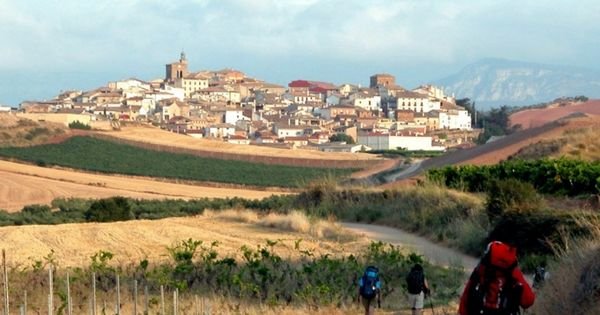
Cirauqui
Cirauqui — “nest of vipers” in Basque — is climbed via steep streets and stone archways up to the Church of San Roman and its multi-lobed doorway. The village is left behind on an original stretch of Roman road and a medieval bridge over the Rio Salado, the same river whose waters the Codex Calixtinus warned against drinking. A series of short climbs follows along the old Roman road.
13.4 km

Lorca
A hamlet with a fountain, bar and albergue next to the Church of San Salvador. Leaving it, the route crosses the Rio Salado and faces the final stretch, flat at first with a few rises, toward Villatuerta.
17.6 km

Villatuerta
The Gothic Church of the Asuncion, with a 14th-century doorway. The route leaves by crossing the Iranzu river on a medieval bridge and passes the Ermita de San Miguel before tackling the last kilometers into Estella.
22.6 km

Estella
Enter Estella-Lizarra through the San Miguel district and the medieval old town. Founded in 1090 along the Camino, it preserves the Palacio de los Reyes de Navarra — the only Romanesque civil palace in Navarre — the Church of San Pedro de la Rua with its cloister, the Church of San Miguel, and one of the best-preserved Jewish quarters in northern Spain.
Puente la Reina – Estella: Complete Guide
Stage Profile: Distance, Elevation and Difficulty
Distance: 22.6 km. Walking time: 5 h – 5 h 30 min. Elevation change: about +370 m of climbing and –380 m of descent. Difficulty: moderate. There is no single mountain pass, but the ground never really rests: it is a constant up and down on dirt tracks through farmland, vineyards and olive groves, and the short climbs add up. Two points to watch: the cobbled descent from Cirauqui on the Roman road, very slippery in the rain, and a few small stream crossings. By bike it is an accessible stage except for the Roman road section, where it is best to dismount.
The Roman Road and the Rio Salado
Between Cirauqui and Lorca the Camino follows one of the best-preserved stretches of Roman road on the entire pilgrim route: fitted paving stones, the remains of a Roman bridge, and a medieval bridge over the Rio Salado. That stream gave its name to a famous passage in the 12th-century Codex Calixtinus: Aymeric Picaud warned pilgrims not to drink its water or let their animals drink it, and told how two men from Navarre would sharpen their knives on the bank, waiting for the horses to die so they could skin them. Today the crossing holds no danger, but the name and the road are still there.
What to See: Monuments and Heritage
In Puente la Reina, before setting off, the Iglesia del Crucifijo and the Iglesia de Santiago, and the famous Romanesque bridge. Maneru preserves Baroque manor houses with coats of arms and the Church of San Pedro. Cirauqui is a hilltop lookout village with its medieval layout intact, home to the Church of San Roman (13th century) and its lobed archivolt doorway with Mudejar influence. In Villatuerta, the Gothic Church of the Asuncion and the Ermita de San Miguel. And Estella is almost an open-air museum: the Palacio de los Reyes de Navarra (the only Romanesque civil palace in Navarre), the Church of San Pedro de la Rua with its cloister and doorway, the Church of San Miguel with a masterful tympanum, the Iglesia del Santo Sepulcro, the Puente de la Carcel, and the old Jewish quarter.
A Bit of History
Estella — Lizarra in Basque — was founded in 1090 by King Sancho Ramirez specifically to serve the Camino, drawing Frankish merchants and craftsmen who settled in the San Martin quarter. It went on to mint its own coinage and host sessions of the Cortes of the Kingdom of Navarre. The Codex Calixtinus describes it as a city “rich in good bread and excellent wine, meat and fish, and full of every happiness.” Centuries later it became the unofficial capital of Carlism during the 19th-century wars. The Roman road on this stage is a reminder that, long before the Camino, the road linking Astorga with Bordeaux already ran through here.
Local Food
We are still in Navarre, with its Ribera pantry: asparagus, piquillo peppers, artichokes and vegetable menestra, plus lamb chilindron, river trout, and Idiazabal cheese. Estella has a good tradition of pastry shops and pintxo bars around Plaza de los Fueros. To drink, reds and roses from the Navarra D.O. And the following morning, right after setting off on Stage 6, the wine fountain at the Monastery of Irache awaits, courtesy of the winery of the same name.
Practical Tips
Set aside some time for Puente la Reina before setting off: its bridge and churches deserve it. Watch out on the Cirauqui descent: the paving stones of the Roman road get very slippery in the rain; go down slowly, and walk your bike if cycling. There are fountains and bars in Maneru, Cirauqui, Lorca and Villatuerta, so there is no need to carry much water. Estella has every service and several albergues; it is a good place to rest for half a day and visit the historic center. If you continue, plan to stop at the Irache wine fountain early in the day: it is usually accessible from 8:00 am to 8:00 pm.
Services and Accommodation by Village
Listings published in our guide for the villages on this stage. Maneru, Lorca and Villatuerta do not yet have accommodation or heritage listings in the guide.
Puente la Reina
Hostels
- Hostel de los Padres Reparadores
- Hostel Estrella Guía Puente la Reina
- Hostel Gares Puente la Reina
- Hostel Puente
- Hostel Santiago Apóstol Puente la Reina
Accommodation
Churches
Cirauqui
Churches
Estella
Hostels
- Hostel Ágora Hostel Estella
- Hostel Alda Estella Hostel
- Hostel Capuchinos Rocamador Estella
- Hostel de Peregrinos de Estella
- Hostel Inn de Curtidores Estella
- Hostel Parroquial Saint Michael the Archangel
Accommodation
- Guesthouse Cristina Estella
- Guesthouse La Rúa Estella
- Hotel Yerri Estella
- Guesthouse Buen Camino Estella
- Guesthouse Ibai Ega Estella
Churches