María Magdalena
María Magdalena (in Hebrew: מרים המגדלית; in Ancient Greek: Μαρία ἡ Μαγδαληνή) is mentioned, both in the canonical New Testament and in various apocryphal gospels, as a distinguished disciple of Jesus of Nazareth.
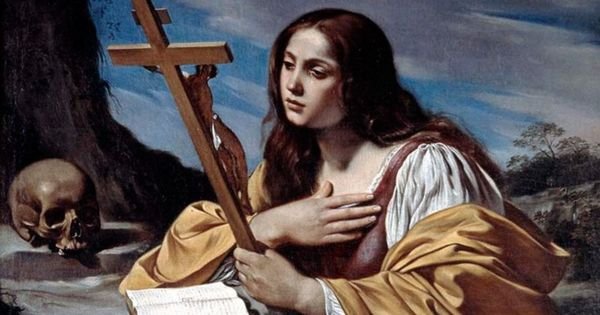
Her name refers to her place of origin: Magdala, a town on the western shore of the Sea of Tiberias and a village near Capernaum. She is considered a saint by the Catholic Church, the Orthodox Church and the Anglican Communion, which celebrate her feast day on 22 July. She holds special importance for the gnostic currents of Christianity. In 1988, Pope John Paul II referred to her in the letter Mulieris Dignitatem as the «apostle of the apostles», and on 10 June 2016, the Congregation for Divine Worship and the Discipline of the Sacraments issued a decree raising the memorial of Saint María Magdalena to the rank of feast in the General Roman Calendar, at the express wish of Pope Francis.
María Magdalena in the New Testament
Information about María Magdalena in the canonical gospels is scarce. She is mentioned in connection with five different events:
- According to the Gospel of Luke, María Magdalena hosted and materially provided for Jesus and his disciples during his preaching in Galilee. It is added that she had previously been healed by Jesus: «Along with him were the Twelve and some women who had been healed of evil spirits and diseases: Mary (called Magdalene) from whom seven demons had come out» Luke 8:1-2.
- According to the Gospels of Mark, Matthew and John, she was present at the crucifixion of Jesus.
- She was present at the burial and saw where Jesus was laid, according to Matthew 27:61 and Mark 15:47. She is mentioned alongside Mary the mother of James the Less.
- Together with other women, she was the first witness of the resurrection, according to a tradition on which all four gospels agree. She then reported the news to Peter and the other apostles.
- According to an account found only in the Gospel of John, she witnessed an appearance of the risen Jesus.
Veneration of María Magdalena
Vézelay
The first place in France known to have had a cult of María Magdalena was the town of Vézelay, in Burgundy. Although the temple at Vézelay initially appears to have been dedicated to the Virgin Mary rather than María Magdalena, for some reason the monks decided that the abbey was the burial place of María Magdalena, and pilgrimages to her tomb at Vézelay are attested from at least 1030. On 27 April 1050, a papal bull of Pope Leo IX officially placed Vézelay Abbey under the patronage of María Magdalena. Jacobus de Voragine relates the official version of the transfer of the saint’s relics from her tomb in the oratory of Saint Maximin in Aix-en-Provence to the newly founded abbey of Vézelay, in 771. The Saint Maximin of this legend is a figure combining traits of the historical bishop Maximinus with the Maximinus who, according to legend, accompanied María Magdalena, Martha and Lazarus to Provence.
Saint-Maximin
A later cult that attracted numerous pilgrims began when the body of María Magdalena was officially discovered, on 9 September 1279, at Saint-Maximin-la-Sainte-Baume, Provence, by the then Prince of Salerno, future King Charles II of Naples. A large Dominican monastery in Gothic style was built at that location, one of the most important in the south of France.
In 1600, the supposed relics were placed in a sarcophagus commissioned by Pope Clement VIII, but the skull was kept separately, in a reliquary. The relics were desecrated during the French Revolution. In 1814 the temple was restored and the saint’s skull was recovered, which is venerated there to this day.
María Magdalena and other Catholic female saints
María Magdalena was a source of inspiration for two of the most important mystics and Doctors of the Church in Catholicism: Saint Teresa of Ávila, who said she had received spiritual help from the Magdalene, and Saint Thérèse of Lisieux, who admired the profound love recounted in the Gospel in which María Magdalena thinks of serving the one she loves; thus, Thérèse decided to devote her life to the one she loved most: Jesus of Nazareth. In 1894 she wrote: «Jesus has defended us in the person of María Magdalena».
Santa María Magdalena
| Canonisation | Immemorial cult |
|---|---|
| Feast day | 22 July |
| Attributes | Long hair, skull, perfume flask, and embracing the feet of the crucified Christ |
| Venerated in | all churches that recognise the veneration of the saints |
| Patronage | Hairdressers, Viana, Anguiano and Arahal |
| Shrine | Basilica of Saint-Maximin-la-Sainte-Baume |
| Personal information | |
| Name | María Magdalena (in Hebrew, מרים המגדלית) |
| Birth | c. 1st century, Magdala (Judea) |
| Death | 1st century, Ephesus? |
See also:
