Saturnino de Tolosa
San Saturnino de Tolosa (d. c. 257, Tolosa, Gaul), also called Serenín, Sernin, or Cernin, was a Roman missionary who preached in Gaul, the Pyrenees, and the Iberian Peninsula.
He was the first bishop of Tolosa (present-day Toulouse), where he was martyred by pagans according to the Acts of Surius, although other accounts, known as the Acts of San Saturnino, place him in the 1st century.
Life of San Saturnino
According to the Acts of Surius, Saturnino preached in Aquitaine during the consulship of Gratus and Decius, in the 3rd century. In Tolosa he converted Honesto, who joined him in his missionary work; in Carcassonne, the prefect Rufino imprisoned them, but they were freed by an angel. Honesto went to preach in Pompaelo (present-day Pamplona). After debating with the pagan senator Firmo, he sent for Saturnino. Saturnino and Honesto converted and baptised several pagans of the city, among them Firmo and his wife (baptised by Saturnino) and their son, Fermín, who would later himself become bishop of Amiens.
Martyrdom of San Saturnino
The Passio Saturnini recounts that Saturnino, having been appointed bishop, arrived in Toulouse (France) in the year 250, under the Roman consulship of Decius and Gratus. At that time there were still very few Christian communities in Gaul, and Saturnino arrived to preach and convert the citizens of that place.
In the city there was a temple built by the Romans and consecrated to their god Jupiter Capitolinus. Saturnino had to pass in front of that temple every day to reach a small oratory where he carried out his teaching. It seems that for some time Jupiter remained silent in the face of the petitions of those who believed in him, and a rumour began to spread that Bishop Saturnino was responsible for this.
The crowd became agitated over this and one day lay in wait for him; as he passed by, surrounding him threateningly, they demanded that he perform the sacrifice of a bull to the Roman god. Upon his refusal, enraged, they tied the bishop to the bull that was to be sacrificed and goaded it to run down the steps of the Capitol. Saturnino’s body was torn apart over the course of the animal’s stampede. When the frenzied run ended, his remains lay abandoned there until some pious women gathered them and buried them in a very deep grave.
A century later, his tomb was discovered and a small chapel was built there to house his relics. Over time that chapel was lost, along with its memory; later, one of his successors found the site again.
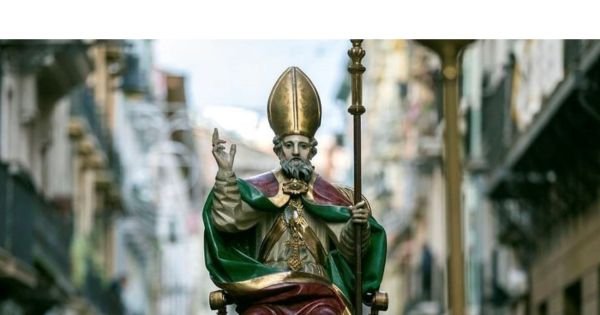
Reliable historical evidence of his cult in Pamplona (Navarra) dates from the late 11th century, when numerous Frankish settlers arrived and built a church dedicated to him; around it grew one of the city’s three main quarters, known as the Burgo de San Serenín or Burgo de San Cernin. In front of the door of that church there is a bronze plate covering a well. It is said that San Saturnino baptised the first Christians of Pamplona with water from that well, including San Fermín.
His feast day is celebrated on 29 November. He is the patron saint of the Spanish towns of Pamplona, San Sadurní de Noya, San Saturnino de Osormot, Sant Sadurní de l’Heura, Montornès del Vallès, Montmajor, Artajona and Ventosa (La Rioja).
San Saturnino
See also:

