Mary (Mother of Jesus)
Mary (in Aramaic, מרים, ‘Mariam’), mother of Jesus of Nazareth, was a Jewish woman from Nazareth in Galilee who, according to various New Testament passages from the Gospel of Matthew, the Gospel of Luke and the Acts of the Apostles, as well as various apocryphal texts such as the Protoevangelium of James, lived between the late 1st century BC and the mid-1st century AD.
Mary’s presence is attested by the main currents of early Christianity that eventually formed the biblical canon: first, allusively, in Pauline Christianity, and later, with greater emphasis, in Synoptic and Johannine Christianity, where she is considered a distinguished figure, unique in more than one sense, a singular participant in a key moment in the History of Salvation — the incarnation of Jesus Christ — and a co-participant in two others: the crucifixion and death of Jesus, and the formation of the first praying Christian community immediately before the coming of the Holy Spirit at Pentecost.
The Gospel of Matthew and the Gospel of Luke present Mary as a young virgin when, at the Annunciation, she learned that she was with child through the work of the Holy Spirit, without the involvement of a man. For this reason, she is often called the «Virgin Mary», or simply «the Virgin», in the Catholic, Orthodox and Coptic Churches, in the Anglican Communion and in other Christian denominations.
In the Catholic Church she is attributed powers of intercession before Jesus Christ, following Saint Irenaeus of Lyon (2nd century) and the account in the Gospel of John of her role at the wedding at Cana. In the Churches mentioned above, devotion to her is expressed in various ways, ranging from dogmatic and doctrinal Marian statements to prayers dedicated to her, and titles by which she is identified, such as «Mother of God», or its corresponding Greek term, «Theotokos», the latter attributed to her early on at the Council of Ephesus in 431. She is also called the «Blessed Virgin Mary».
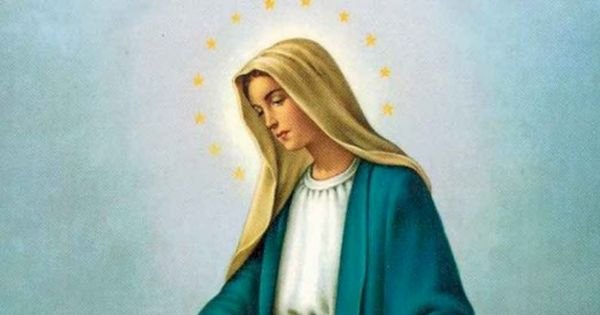
The Name of Mary
Mary is a name known in the Tanakh or Old Testament as it was the name of the sister of Moses and Aaron, originally written as Mīryam. The Septuagint mentions it from the Aramaic form Mariám (Mαριαμ); the change in the first vowel reflects the current pronunciation, that of the Aramaic spoken in Palestine before the birth of Christ. In the Greek text of the New Testament, in the Septuagint version, the name used was Mariam; Mary is the Hellenised form of the word.
Although in the Middle Ages more pious than exact meanings were sought for it, based on current archaeological findings, “Highness” or “Exalted One” are the meanings closest to the name of Hebrew origin. The Latin epithet Stella Maris was applied to Mary based on a passage from the Old Testament, arising from a transcription error attributed to Eusebius of Caesarea and Jerome. Indeed, the former read Maryam as mar-yam (מר-ים) “drop of the sea”, based on מר mar, an uncommon biblical word for “drop”, and ים yam “sea”. Saint Jerome adopted this interpretation and translated the name into Latin as stilla maris, “drop of the sea”, but at a later stage a copyist transcribed it as stella maris, “star of the sea”, and this transcription error became widespread.
Santa María la Mayor
Mary of Nazareth / Mother of God / Blessed Virgin Mary / Our Lady / Santa María la Mayor
See also: