Esteban
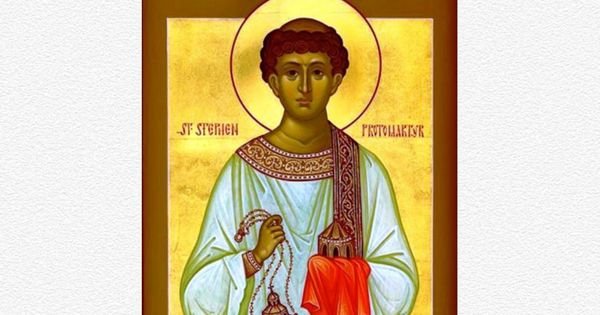
Esteban (in Greek: Στέφανος [Stephanos] ‘crown’) was a deacon of the early Church of Jerusalem and protomartyr (one of the first martyrs) of Christianity. He earned the enmity of several synagogues for his teachings.
At his trial, Esteban gave a long speech criticising the Jewish authorities who were judging him. He was condemned to death by stoning. His martyrdom was witnessed by Saulo of Tarsus, a Pharisee who, later, became a follower of Jesus.
The only source of information about Esteban is the book Acts of the Apostles in the New Testament of the Bible.
Martyrdom of San Esteban
San Esteban is first mentioned in the book Acts of the Apostles as one of the seven deacons chosen by the apostles to distribute food and charity among the poorest members of the early church community. According to Orthodox belief, he was the most important of them all, which is why he is called archdeacon.
Like another deacon, Nicolás de Antioquía, he is mentioned as being a Jewish convert, so it is believed that Esteban was born a Jew, although nothing else is known about his earlier life. These deacons were chosen because of dissatisfaction among the Hellenic Jews (of Greek origin and Greek-speaking), who felt that the widows of their group were treated worse than Hebrew Jews in the distribution of community funds. Since the name «Stephanos» is Greek, it has been assumed that he was one of these Hellenic Jews. The text says that Esteban was «full of faith and of the Holy Spirit». Those chosen by the Hellenic Jews were Esteban, Próspero, Nicanor, Timón, Pármenas and Nicolás de Antioquía. They were presented to the apostles who, after praying, laid hands on them. It is later said that Esteban performed some miracles before the people.
Some Jews from Cyrene, Alexandria, Cilicia and Asia who were gathered in a synagogue of freedmen debated with Esteban. According to the Acts of the Apostles, they could not refute his arguments, so they bribed some witnesses to say that Esteban had blasphemed against Moses and against God. Because of this, «they stirred up the people, the elders and the scribes» and seized Esteban and brought him before the Sanhedrin, gathered in the Temple of Jerusalem. The false witnesses then accused him of having said that he would change the customs of Moses and that Jesus would destroy the Temple of Jerusalem. The book of Acts says that at that moment the members of the Sanhedrin looked at Esteban and saw «his face like the face of an angel».
Speech before the Sanhedrin
Esteban gave a lengthy speech before the Sanhedrin. He went on to speak of Abraham, of his descendants and of how José ended up in Egypt. He then spoke of how José became advisor to the pharaoh, of how the following pharaohs enslaved the Jewish people, of the life of Moses and of his conversation with God. In the story of Moses, he recounted when that prophet was lost on the mountain and the Israelites told his brother Aaron to make a God to guide them through the desert. With this he sought to point out the disobedience of the people of Israel towards God. He then spoke of the building of the sacred tabernacle that Moses made following God’s instructions, and of the temple built by Salomón. In the speech he said that God had indicated that he lived in heaven and on earth and not only in a building, referring to the temple.
The book of Acts says that Esteban appealed to the scriptures to show that Jesus did not disobey the rules God gave to Moses, but rather duly fulfilled them.
The speech ended with the following words:
You stiff-necked people, uncircumcised in heart and ears, you always resist the Holy Spirit. As your fathers did, so do you. Which of the prophets did your fathers not persecute? They killed those who foretold the coming of the Righteous One, whom you have now betrayed and murdered; you who received the law as delivered by angels, and did not keep it.
Stoning of San Esteban
After this statement, the members of the Sanhedrin could not contain their anger. However, Esteban looked up and cried out to the Sanhedrin that he saw the heavens opened and the Son of Man (Jesus, recently executed) seated at the right hand of God. This was such a great blasphemy to them that they seized Esteban, led him outside the city, to a designated place, and stoned him.
At that time the Jews permitted the death penalty by stoning in cases of blasphemy. The witnesses, whose duty it was to cast the first stones, laid their cloaks on the ground so they could do so, at the feet of «a young man named Saulo», who would later become known as the apostle Pablo. Esteban prayed to God to receive his spirit and to forgive his killers, knelt down and fell dead. Saulo approved of Esteban’s death.
Analysis of San Esteban’s speech
Of the many speeches found in Acts of the Apostles, Esteban’s speech to the Sanhedrin is the longest. It seems unlikely that such a long speech could have been reproduced exactly in the text of Acts just as it was actually delivered. In response to this objection, some biblical scholars have said that the speech is intended to show Esteban’s characteristic personality.
It has also been observed that there are several differences between the account of the history of the Israelites and the scriptures in which these stories appear; for example, Esteban says that the tomb of Jacob was in Shechem, but the book of Genesis says that Jacob’s tomb was in the Machpelah of Hebron. There are at least five discrepancies of this kind identified by scholars, while others are disputed and may be the subject of theological debate.
Some theologians suggest that these discrepancies may arise because those ancient Jewish traditions were not included in the scriptures, or because they may not have been widely known among those who were not scribes. There are many parallels between Esteban’s story in Acts and that of Jesus in the gospels. Both performed miracles, both were tried by the Sanhedrin and both prayed asking for their killers to be forgiven. This has raised suspicions that the author of Acts emphasised this to portray him as holy and to encourage people to follow Christ’s example, or that he invented some (or all) of these events. The criticism of traditional Jewish belief and practice in Esteban’s speech is very strong. For example, when he says that God does not live in a place «made by human hands», referring to the temple, he is using the biblical description that defines idols. Many scholars agree that in doing this, Esteban was seeking to convince all the members of the assembly that Jesus Christ is Lord and that, therefore, anything they did against him or his teachings, they did against their own faith.
Some have said that the speech is anti-Jewish. The priest and comparative religion scholar S.G.F. Brandon wrote: «The anti-Jewish polemic of this text reflects the attitude of the author of Acts».
Tomb and relics of San Esteban
The book of Acts says that «devout men buried Esteban and made great lamentation over him», although it does not say where he was buried.
In the year 415 AD a priest named Lucian reportedly had a dream in which it was revealed to him that Esteban’s remains were at Beit Jimal. After that, the martyr’s relics were carried in procession to the abbey of Hagia Maria on 26 December 415. This day became the feast day of San Esteban. In 439, the relics were moved to a new church north of the Damascus Gate of the walls of Jerusalem. That church was built by the empress Aelia Eudocia in honour of San Esteban. That church was destroyed in the 12th century. In the 20th century, French Catholics built the Basilica of San Esteban on the site.
The Crusaders initially called the main gate on the north side of Jerusalem the «Gate of San Esteban» (in Latin Porta Sancti Stephani), given its proximity to the site of San Esteban’s martyrdom, marked by the Church and by the monastery built by the empress Eudocia.
At the end of the Crusader period another tradition is documented, following the disappearance of the Byzantine church: since Christian peregrinos were forbidden from approaching the northern gate of the walls, which had a military presence, the name «Gate of San Esteban» was transferred to the eastern gate, then still accessible, which bears that name to this day.
The protomartyr’s relics were later taken to Rome by pope Pelagius II during the construction of the Basilica of San Lorenzo Extramuros. The relics were buried next to the tomb of San Lorenzo the Martyr, located inside the basilica. According to The Golden Legend, Lorenzo’s remains miraculously moved to one side of the chamber to make room for those of Esteban.
In his work The City of God, San Agustín described several miracles that occurred when part of San Esteban’s relics were taken to North Africa.
Part of San Esteban’s right arm is kept in a reliquary at the Trinity Lavra of St. Sergius monastery, in Russia.
The supposed relics of San Esteban taken to Menorca in 418 gave rise to religious fanaticism led by Bishop Severus which manifested itself in the persecution of the island’s Jews and their total conversion to Christianity.
San Esteban
| Greek name | Stephanos (Greek |
|---|---|
| Birth | Unknown |
| Death | 34 AD, Jerusalem, Judea, Roman Empire |
| Cause of death | Stoning |
| Burial | Basilica of San Lorenzo Extramuros |
| Religion | Christianity |
| Occupation | Deacon |
| Positions held | Disciple |
| Canonisation | Miracle worker and saint |
| Feast day | – 26 December (Roman rite) – 3 August Invention of S. Esteban - 27 December (Byzantine) – 9 January (Malabar and Syro-Malankara) – 25 December (Armenian) – 7 January (Armenian Catholic) |
| Attributes | – Palm of martyrdom, deacon’s vestments, stone. |
| Venerated in | Catholic Church |
| Patronage | Calzada del Coto, Villamoros de Mansilla, Serbia, deacons, Menorca, Ordal, etc. |
See also:

