San Vicente – Vicente de Huesca
Vicente de Huesca, also known as San Vicente Mártir (Huesca – Valencia, c. 304), was an Aragonese clergyman, deacon to San Valero of Zaragoza. He was denounced and imprisoned under Diocletian, and so the Church venerates him as San Vicente Mártir.
According to tradition, Vicente was accused because of his preaching of the faith, due to a speech impediment affecting Bishop Valero.
The persecution in Hispania
A bloody persecution of Christians began, decreed by the emperors Diocletian and Maximian. In March 303 the first imperial edict to this effect was published, enforced by the prefect Publius Datianus, who came from Rome and remained on the Peninsula for two years, persecuting the Christian population with fanaticism and cruelty. Publius Datianus arrived in Hispania via Girona, where he entrusted the enforcement of the imperial decrees to the judge Rufinus, before moving on to Barcelona and then Zaragoza.
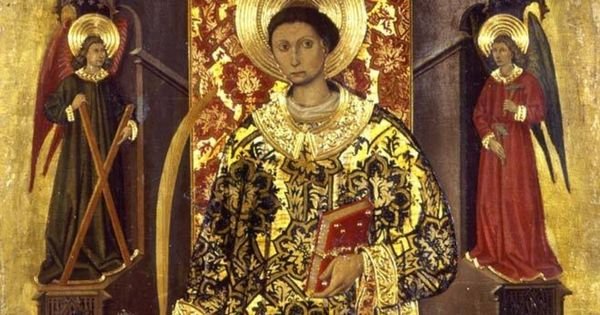
Valero and Vicente were arrested in the year 303 by order of the prefect Publius Datianus, and taken to Valencia. Valero was sentenced to exile and Vicente suffered martyrdom. His death occurred on an uncertain date —tradition assigns it to 22 January— in the year 304 or 305. According to legend, he converted his executioner before dying.
Vicente’s body was moved, in the same century as his martyrdom, to a basilica outside the city walls, next to a Christian suburb, known as San Vicente de la Roqueta, which maintained his cult throughout the Islamic period, with various Christian owners documented, such as the Monastery of San Juan de la Peña or Poblet. The cult dedicated to him during the period of Muslim rule is one of the clearest pieces of evidence for the existence of a substantial Christian Mozarabic population.
Martyrdom of San Vicente de Huesca
He was placed on a St. Andrew’s cross and then on the rack, where his bones were broken, he was whipped, and his flesh was torn open with steel hooks. But, unable to break his resistance, Publius Datianus then ordered that he be flayed and placed on a grill over hot coals. He was later thrown into a dungeon, where he died. His body was abandoned on a rubbish heap, where it was defended by a raven against the threat of a wolf. Another, more widespread version relates that the body was thrown into the Turia river in a hide weighted with a millstone, but it was washed back to the shore and buried on the outskirts of Valencia, later being moved to Lisbon, where his remains rest in the cathedral.
The relic of San Vicente’s arm
One arrived on 16 October 1970 at Valencia Cathedral, donated by a family from Padua. According to forensic studies, it belongs to a young man, shows burns on the skin, and dates back to the 4th century.
It is kept in a chapel of Valencia Cathedral; it was carried in procession on Thursday, 22 January 2004, just as it was when the holy year was inaugurated. This will happen again in a hundred years.
The other is in Braga Cathedral..
Iconography and cult of San Vicente
He usually appears in paintings wearing the vestments of his rank, accompanied by a raven or tied to a millstone. These symbols refer to his long and brutal martyrdom.
He is the patron saint of Lisbon, of the municipality of Valverde de la Virgen (Province of León), of the town of Ardanaz de Egüés, Sigüenza, Corbera, Lucena del Puerto, Guadassuar, Laujar de Andarax, Molina de Segura, San Vicente del Monte, San Vicente de la Barquera, Graíces, San Vicente de Alcántara (Badajoz), Paredes de Escalona (Toledo), Zalamea la Real, of the Italian city of Vicenza, of San Vicente de Cañete, in the province of the same name in Lima, of Los Realejos (Tenerife), where it also holds the privilege of being the only image of the martyr saint in the whole Canary Islands archipelago, with a feast day held every 22 January since 1609 by vow of the former council of Realejo de Abajo after the end of the plague of London, attended by the town council — one of the oldest civic-religious processions in the Canary Islands, in thanks to the co-patron San Vicente Mártir — and of wine merchants and vinegar makers. His feast day is celebrated on 22 January.
In the city of Valencia, besides being its patron saint, San Vicente Mártir is also the patron of the Guild of Tailors and Dressmakers. Valencia’s patronal festivities are celebrated on 22 January.
San Vicente is the patron of the Order of Deacons of the Diocese of Bergamo (Italy).
He is also the patron saint in the Mexican towns of San Vicente Tancuayalab, in San Luis Potosí, and San Vicente Chicoloapan, in the State of Mexico.
San Vicente
| Birth name | Vincentiusla |
|---|---|
| Birth | 3rd century, Huesca |
| Death | c. 304, Valencia |
| Cause of death | Burned at the stake |
| Student of | Valero de Zaragoza |
| Occupation | Deacon |
| Canonisation | Saint |
| Feast day | 22 January |
| Attributes | Vestments of his rank, accompanied by a saltire cross, holding a millstone and sometimes accompanied by a raven. |
| Venerated in | Catholic Church |
| Patronage | Valencia, Valverde de la Virgen, Lisbon, Huesca, Sigüenza, Laujar de Andarax, Sojasa (Aragón, Spain), Lucena del Puerto, Zalamea la Real, Molina de Segura, Valencia Guadassuar, Los Realejos, Tenerife (Canary Islands) San Vicente de Alcántara, Vicenza, San Vicente de la Sonsierra, San Vicente del Monte, Sant Vicenç de Castellet, San Vicente Chicoloapan (Mexico), wine merchants and vinegar makers, tailors and dressmakers, Order of Deacons of the Diocese of Bergamo (Italy). |
| Criminal charge(s) | sedition |
See also:
