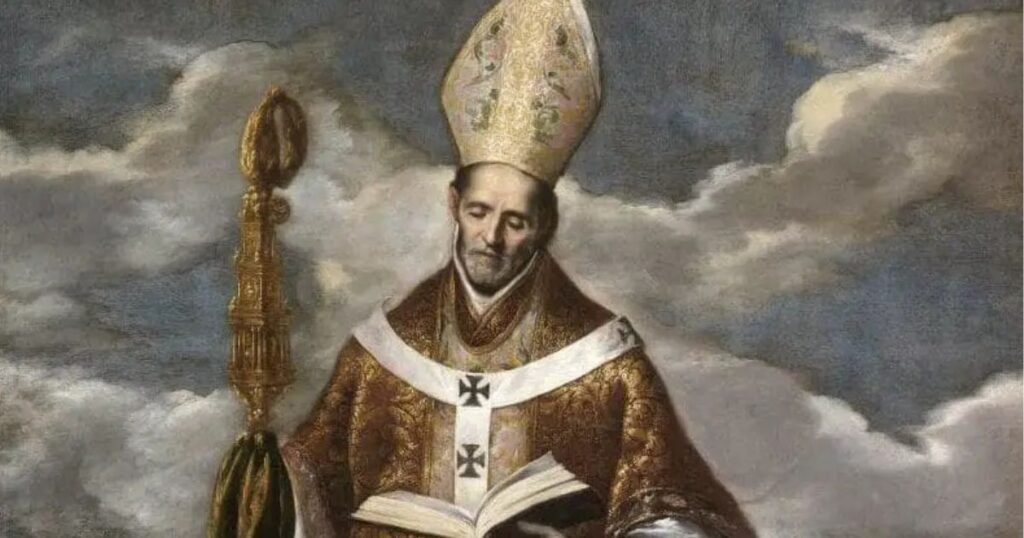
San Ildefonso de Toledo
San Ildefonso de Toledo (c. 607–667) stands as one of the most influential figures of Hispano-Visigothic Christianity. Archbishop of Toledo between 657 and 667, his theological, liturgical and pastoral legacy established the city as the spiritual centre of the Visigothic Kingdom. His Marian devotion and his defence of the perpetual virginity of Mary made him a doctrinal reference and a symbol of identity for later generations.
Origins and Formation of San Ildefonso
Born in Toledo into a noble Visigothic family, Ildefonso was the nephew of Bishop Eugenio III. From an early age he showed an inclination towards religious life, entering the monastery of Agali, on the outskirts of the city, against his parents’ wishes. There he received a solid formation, influenced by the Isidorian school of Seville, and was ordained deacon around the year 630 by Bishop Eladio of Toledo.
Abbot and Archbishop of Toledo
After years of monastic life, Ildefonso was elected abbot of the monastery of Agali. In the year 657, upon the death of his uncle Eugenio III, he was appointed Archbishop of Toledo by King Recesvinto, despite his initial resistance. During his episcopate, he actively took part in the Eighth and Ninth Councils of Toledo, and promoted liturgical and doctrinal unity across the peninsula.
Marian Theology and Works of San Ildefonso
San Ildefonso’s Marian devotion is reflected in his most notable work: De virginitate Sanctae Mariae contra tres infideles. In this treatise, he defends the virginity of Mary before, during and after childbirth, refuting the doctrines of Jovinian, Helvidius and an anonymous Jewish author. This writing is regarded as the most important Marian monument of Hispanic patristic literature.
Other notable works include:
- Liber de cognitione baptismi: a pastoral exposition on baptism and Christian initiation.
- De progressu spiritualis deserti: an allegory of the spiritual path following baptism.
- De viris illustribus: a continuation of the catalogue of ecclesiastical writers begun by San Isidoro.
These works show his deep knowledge of the patristic tradition and his skill in conveying it to the people.
Liturgical Contributions
San Ildefonso played a crucial role in shaping the Hispanic liturgy. At the Tenth Council of Toledo (656), he proposed celebrating the feast of the Incarnation on 18 December, eight days before Christmas, in order to reinforce the doctrine of Mary’s divine motherhood against Arianism. He is also credited with liturgical compositions and reforms to the Mass and office of this feast.
The Miracle of the Chasuble
One of the most famous traditions associated with San Ildefonso is the apparition of the Virgin Mary in the church of Santa Leocadia. According to the account, on 18 December 665, while Ildefonso and his clergy were singing hymns in honour of the Virgin, she appeared to him and gave him a chasuble as a token of gratitude for his defence of her virginity. This miracle cemented his title of “Chaplain of the Virgin” and reinforced Marian devotion in Toledo.
Patronages and Cult
San Ildefonso is venerated as patron saint in various towns across Spain, including Toledo, Zamora, Mairena del Aljarafe, Peligros and Collado Mediano, among others. His feast day is celebrated on 23 January with religious and cultural events commemorating his legacy. In Toledo, his figure is a symbol of identity and spirituality, and his influence endures in the liturgy and in popular devotion.
Legacy and Relevance
San Ildefonso de Toledo left an indelible mark on the history of the Church in Hispania. His defence of the virginity of Mary, his liturgical contributions and his pastoral leadership consolidated Catholic orthodoxy during a period of doctrinal tension. His figure remains an object of study and veneration, and his legacy continues to inspire the faithful and scholars alike.
San Ildefonso
The life and work of San Ildefonso de Toledo represent a fundamental pillar in the consolidation of Christianity on the Iberian Peninsula. His profound love for the Virgin Mary, his commitment to doctrinal unity and his spiritual leadership make him a model of holiness and scholarship. His legacy endures in the liturgy, theology and popular devotion, reaffirming his place as one of the great Fathers of the Church in the West.