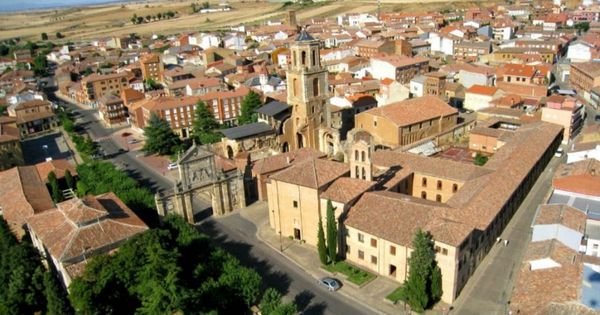
San Juan de Sahagún, O.E.S.A. (Sahagún, 24 June 1430 – Salamanca, 11 June 1479), was a Spanish Augustinian priest and hermit, canonised by the Catholic Church.
Biography of San Juan de Sahagún
His given name was Juan González del Castrillo. He was the eldest of seven siblings, the son of Juan González del Castrillo and Sancha Martínez, a well-off couple. He received his early education at the Real Monasterio de San Benito in Sahagún. After taking the tonsure, the first of the clerical grades, he won the protection of the Bishop of Burgos, Alfonso de Cartagena, who oversaw his education in the city of Burgos and appointed him canon secretary of Burgos Cathedral.
Tomás Cámara y Castro, Bishop of Salamanca between 1885 and 1904, published a biography of San Juan de Sahagún in 1891 entitled Vida de San Juan de Sahagún del Orden de San Agustín, patrono de Salamanca (Salamanca, Imprenta Calatrava, 1891).
Life in Salamanca of San Juan de Sahagún
After being a student at the Colegio Mayor de San Bartolomé, he became an Augustinian friar at the convent this Order had in Salamanca.
He was known for his involvement in the life of the city, and his greatest achievement was pacifying the feud between two factions of noble families who had been fighting in Salamanca for forty years, with violent deaths on both sides (the Plaza de los Bandos in Salamanca commemorates these events).
Two miracles of his are remembered in Salamanca: chronicles tell that a boy fell into a deep well, but Juan threw down his cingulum, which reached far enough for the boy to grasp it. The saint then made the water level rise until the boy reached the surface. The miracle is commemorated in the name of the street where it happened: Pozo Amarillo. The other miracle tells that a fierce bull had escaped through the streets of Salamanca, spreading terror. Juan stopped it and calmed it by saying: “Tente, necio” (“Stop, fool”). The street where this happened is now called Tentenecio.
It is said that his prayers freed Salamanca from an outbreak of typhus. He died a violent death. It is said that a commander in the city had a mistress. Upon hearing Juan de Sahagún’s sermons in the church of San Blas, he decided to leave her, and she, spurned, threatened to take San Juan’s life before the year was out. Some say she had the saint’s food poisoned. Others say she hired an assassin to stab him with a poisoned blade. Either way, he died of poisoning at the age of 50.
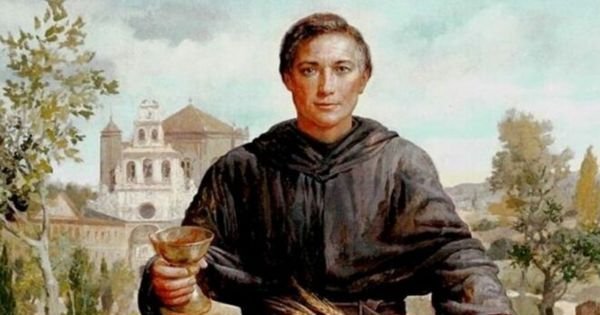
His remains now lie in the New Cathedral of Salamanca, although relics of his are kept in Sahagún and in several other places around the world.
Canonisation of San Juan de Sahagún
He was beatified by Pope Clement VIII in 1601. He was canonised by Pope Alexander VIII in 1691, and his feast day is celebrated on 12 June. He is the patron saint of both the town of Sahagún and of Salamanca. He has been the patron saint of Salamanca since 1868, and of his hometown Sahagún, which gives him his surname.
San Juan de Sahagún is also the patron saint of the Colombian city of Sahagún.
Related links
- The Church of San Juan de Sahagún in Sahagún is built on the site of the family home. Next to it stands the headquarters of the Hermandad de San Juan de Sahagún (Brotherhood of San Juan de Sahagún).
- In Burgos Cathedral there is a chapel dedicated to San Juan de Sahagún.
- In Salamanca, near the Plaza Mayor, stands the Church of San Juan de Sahagún.
- Salamanca (Spain)
- Sahagún (Provincia de León, Spain)
- Sahagún (Colombia)
San Juan de Sahagún
See also:

Church of San Juan de Sahagún