Sahagún
Sahagún is a Spanish municipality and town located in the Province of León, in the autonomous community of Castile and León. It sits between the Cea and Valderaduey rivers, in the Tierra de Sahagún comarca, on the Camino Frances, which it shares with nearby municipalities such as Cea, Grajal de Campos, and Calzada del Coto. It is also the seat of the judicial district in the area.
Accommodation in Sahagún
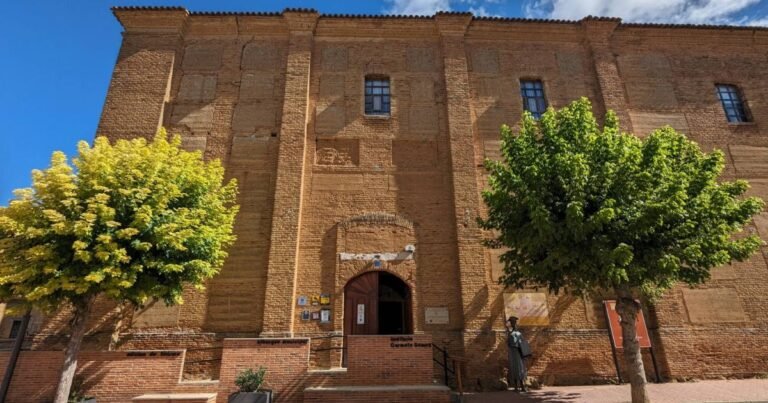

Sahagún
The town arose on the plains where the Cea and Valderaduey rivers meet, initially near a sanctuary dedicated to the martyrs Facundo and Primitivo. Its importance grew in the 11th century with the arrival of the Order of Cluny and the granting of the charter by King Alfonso VI of León. During the reign of Alfonso VI, Sahagún grew stronger thanks to its support for the Way of St James and the adoption of Cluniac rites over Visigothic ones, which boosted trade and expanded the town’s influence over a wide territory. Throughout the Middle Ages it retained its importance until it began to decline gradually, worsened by the Mendizábal disentailment. In 1931, Sahagún was the second Spanish town to proclaim the Second Republic, after Éibar.
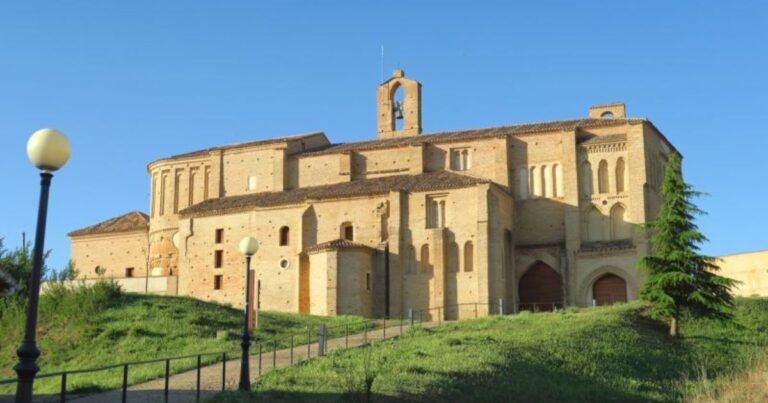
The town attracts national and international tourism thanks to its historical and monumental heritage, as well as various festivities held throughout the year, notably Holy Week. Among its most notable monuments are the Church of San Lorenzo, the Church of San Tirso, the Sanctuary of the Virgen Peregrina, and the ruins of the Royal Monastery of San Benito, all considered Cultural Heritage.
This rich cultural legacy is further enriched by being a stop on the Camino de Santiago and by forming part of the Federation of Cluniac Sites. In 2015, when Unesco approved the extension of the Camino de Santiago in Spain to «Caminos de Santiago de Compostela: Camino Frances and Routes of Northern Spain», Sahagún was included in the document as an associated element, further reinforcing its historical and cultural relevance.
Camino Frances: Sahagún
The Camino Frances is the best-known pilgrimage route to the Cathedral of Santiago in the city of Santiago de Compostela. Throughout history, it has been the preferred route both in the Middle Ages and today. Every month of the year, it is common to see pilgrims walking it. Since ancient times, Sahagún has been a vital stopping point on this route, even mentioned in the Codex Calixtinus.
In this town, we find different accommodation options for pilgrims. The Albergue de Peregrinos Cluny, located in the Church of La Trinidad, is one of them. There is also the privately run Viatoris hostel, and the hostel of the Benedictine Sisters. At all these places, the pilgrim’s credential is stamped, marking their journey.
What to see in Sahagún?
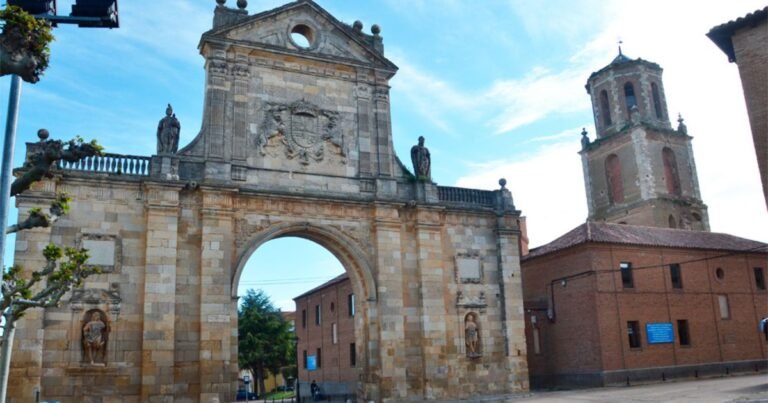
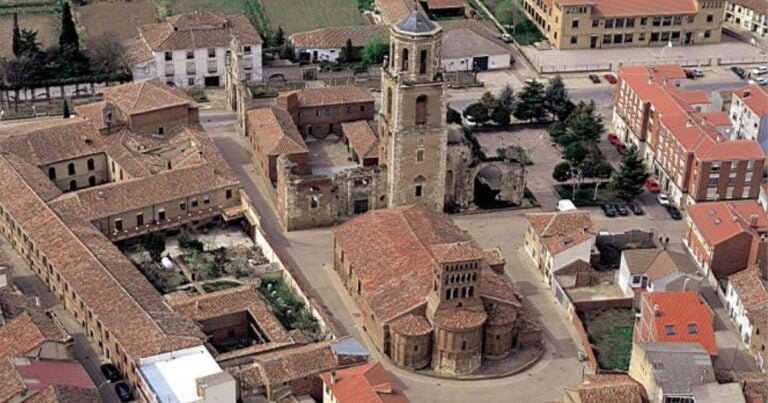
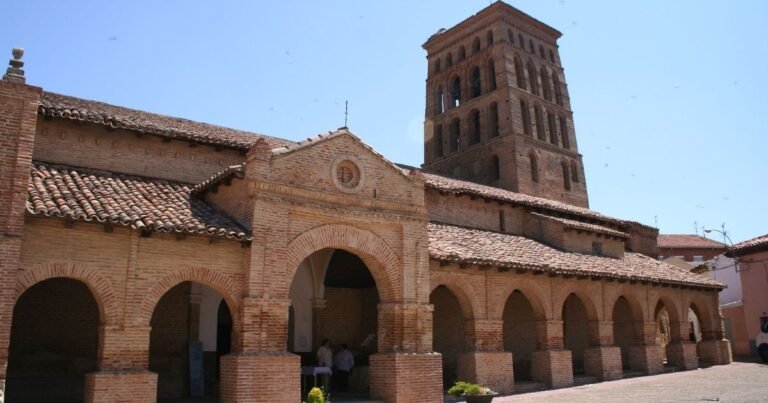
Toponymy of Sahagún
The toponymy of this town originates from the place where the remains of the saints Facundo and Primitivo were buried around the year 304. Christian devotion knew them as Domnos Sanctos, meaning “Holy Lords“. These two brothers were discovered as followers of the Christian faith during the persecution of Christians under the Roman Empire. They were martyred, beheaded, and their remains thrown into the Cea river. Over time, this site became a common destination for Christians, as miracles were believed to occur there frequently. On the site where they were buried, a temple was built in their honour, mentioned in various sources as “Sanctus Facundus“, “Sanct Fagunt“, and “Sant Fagun“. Over time, “Safagun” evolved into “Sahagún” as the sound of the “f” softened into an aspirated “h” and then disappeared, giving rise to the town’s current name.
History of Sahagún
Founding origin of Sahagún
Before the medieval foundation, in the vicinity of Sahagún stood the Roman way-station of Camala, on the Via I linking Legio with Italy. This town began near a monastery dedicated to the saints Facundo and Primitivo. These saints were children of San Marcelo and Santa Nonia, and had ten martyred siblings. They were Roman soldiers who converted to Christianity and suffered persecution and martyrdom, being thrown into the Cea river. Followers of the faith gathered their bodies and built a primitive sanctuary (Domnos Sanctos) in honour of both, before the 9th century. This site was destroyed several times by the Moors, and after its reconstruction and the founding of the Royal Monastery of San Benito, King Alfonso III the Great handed it over in the year 872 to monks from Córdoba, who revitalised monastic life there.
11th century
In 1085, Alfonso VI granted a charter to what was then the town of San Facundo. The monastery grew stronger in the 11th century, especially during the reign of Alfonso VI.
After being defeated by his elder brother Sancho, Alfonso VI was forced to join the Benedictine order at the Monastery, thanks to the intervention of his sister Urraca. Later, Alfonso VI fled the monastery and took refuge in Toledo, which at the time was under the rule of Al-Mu’tamid. After Sancho’s death during the siege of Zamora, where Urraca resided, Alfonso managed to become king of the three kingdoms. Later, after marrying Constance of Burgundy, Alfonso VI may have decided to establish the Roman rite on the Iberian Peninsula (instead of the Hispanic rite), as suggested by the rising Order of Cluny. This new rite was fully established in the year 1081 under Abbot Bernard, who came from France and was appointed Archbishop of Toledo by the Pope in 1086, Toledo being the primatial see of Hispania.
On 25 November 1085, Alfonso VI granted the Abbot and the town an advantageous charter, with laws and exemptions for those who wished to settle in the new town of San Facundo. This led to notable growth of both the monastery and the town; its importance became such that it came to be called the “Spanish Cluny”, under whose influence one of the most prominent boroughs of the Late Middle Ages in Spain was formed.
The town became a notable cultural centre, where men of various races and cultures lived side by side, from Frankish and other foreign merchants to Mudejars and Jews. At times, tensions between different social groups, such as burghers and craftsmen, led to conflicts. The protests of the burghers of San Facundo against abusive abbatial power are emblematic in the Kingdom of León, both for their significance and for the information available about them.
12th century
The 12th century marked the height of both the town and the monastery. Some of the most notable events of this period are recorded in the Anonymous Chronicles, the first covering from the founding until 1117, and the second recounting the burgher revolts that took place between 1237 and 1255.
Among the most significant milestones mentioned is the grant to the burghers, by Abbot Don Diego (1087-1110), of a privilege allowing them to build a wall around the town, as well as the right to mint coinage, at least from 1116.
Burghers of various trades and origins gathered in the town, such as blacksmiths, carpenters, tailors, furriers, shoemakers, sculptors, as well as individuals versed in various arts and crafts, and also people from various foreign provinces and kingdoms, such as Gascons, Burgundians, English, Germans, Normans, Lombards, and many other traders of various foreign nations and languages. In this way, King Alfonso populated the town and turned it into a place of considerable standing.
13th century onward
Over time, the importance of the monastery grew, extending its influence over almost a hundred monasteries, convents, and churches, from the Cantabrian coast to the province of Segovia.
Furthermore, thanks to Clement VI, in 1347 the monastery was granted the privilege of having its own university. Sahagún had a university college (sometimes confused with a university) by a bull of Benedict XIII in August 1403. The University as an institution was established by a papal bull of Clement VII in May 1534, offering programmes in Liberal Arts, Theology, Canon Law, and a chair of music; although, due to infrastructure issues, it did not begin operating until the 1570s. In December 1616 it was moved to the Benedictine monastery of Santa María la Real de Irache (Navarra), by a bull of Paul V in December 1615. Its importance reached such a point that it exchanged honours with the University of Salamanca and sent professors to the University of Alcalá.
The initial population of Sahagún did not fall below 8,000. It was called a town, not a city, because it was a non-episcopal jurisdiction, although barely 50 years after its founding charter it is estimated to have had 12,000 inhabitants.
Over the centuries, the decline of Sahagún and its monastery was gradual, worsened by the Mendizábal disentailment, which practically ended the religious component of the town that had existed since the time of Alfonso VI.
In 1808, during the Peninsular War, the Battle of Sahagún took place near the town, pitting British and French cavalry against each other, resulting in a British victory. In 2008 the battle’s second centenary was commemorated with a symbolic re-enactment performed by actors.
In the 20th century, Sahagún was the second town to proclaim the Second Republic, in the early hours of 13-14 April 1931, an event for which it received the title of “Muy Ejemplar Ciudad” (Most Exemplary City) from the republican government.
The gastronomy of Sahagún
The town of Sahagún is mainly distinguished by its leek, a vegetable characteristic of the region, grown in the fields near the Cea river and believed to have been introduced by the Cluniac monks. This product is protected by the Puerro de Sahagún quality mark.
Besides the leek, other traditional foods of the area include frog legs, snails, beans, roast lamb, lentils, and chickpeas. As for desserts, notable ones include Amarguillos de Sahagún, Canutillos de Crema, Galletas de Hierro, and orejuelas. Local gastronomy is rich in flavours and culinary traditions that reflect the history and ingredients of the area.
Sahagún
| Country | Spain | |
|---|---|---|
| • Autonomous community | Castile and León | |
| • Province | Provincia de León | |
| • Comarca | Tierra de Sahagún | |
| • Judicial district | Sahagún | |
| • Association of Municipalities | Sahagún-Villada | |
| Location | 42°22′16″N 5°01′59″W | |
| • Elevation | 813 m | |
| Area | 123,64 km² | |
| Settlements | Arenillas de Valderaduey, Celada de Cea, Galleguillos de Campos, Joara, Riosequillo, Sahagún, San Martín de la Cueza, San Pedro de las Dueñas, Sotillo de Cea, Villalebrín y Villalmán | |
| Population | 2,456 inhab. (2023) | |
| • Density | 21 inhab./km² | |
| Demonym | sahagunense, sahagunés, sahagunesa | |
| Postal code | 24320 | |
| Dialling code | 987 | |
| Patron saint | San Juan de Sahagún (12 de junio) | |
| Patroness | Virgen Peregrina | |
| Website | www.aytosahagun.es | |