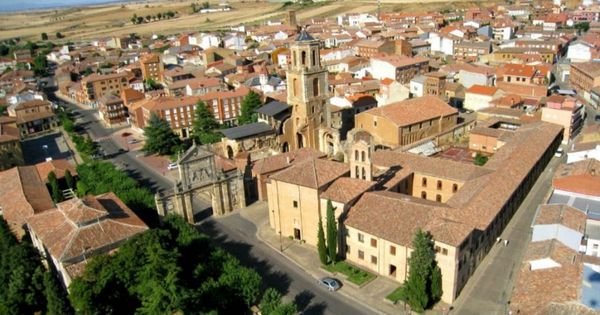
Virgen Peregrina – Camino de Santiago Francés
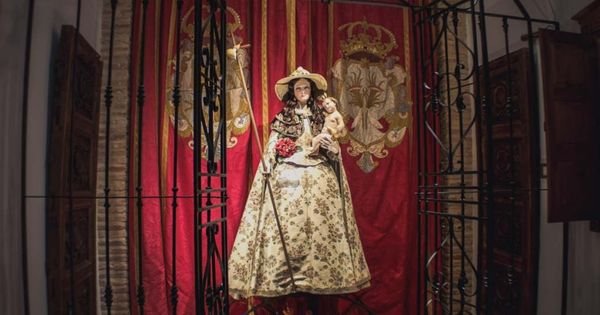
The Virgen Peregrina is a dressed image (imagen de vestir), by the sculptor Luisa Roldán, carved in wood and polychromed, measuring 135 cm, and dating from around 1687.
Only the head and hands are carved; the rest is a mannequin frame. She carries in her arms a naked Christ Child that is an entire sculpture in its own right. It is kept in the Museum of the Benedictine Mothers in the town of Sahagún in the Province of León (Spain).
It comes from the Franciscan Convent that once stood at the entrance to this town. From the late 17th century it was the convent’s titular image, and from the mid-18th century it became patroness of the town.
Virgen Peregrina: History of an Acquisition
A series of fortuitous events led the friars of this convent to come into possession of a carving of such artistic value from the distant lands of Andalusia. In the last third of the 17th century the convent was in a state of decline, with little activity. In 1683 Friar Francisco Salmerón, who held the post of guardian, had the idea of bringing to Sahagún the missionary college that was then located near Sepúlveda, in the lands of Segovia. The commissary general authorised the proposal, and in this way the convent of Sahagún was able to emerge from its dormancy.
Years later, Father Salmerón was appointed visitor general of the Franciscan provinces in Andalusia. He made the journey in 1687 accompanied by Friar Antonio González (the convent’s new guardian) and Friar Felipe (secretary of the seminary). Friar Felipe had the opportunity to visit the then-famous workshop of the sculptor Pedro Roldán, and there he saw (still unassembled) the head and hands belonging to the figure of a Virgin, along with a Christ Child intended to complete it, all the work of Luisa Roldán, the sculptor’s daughter.
Friar Felipe thought that image would be ideal for placing on the high altar of the convent of Sahagún, to be contemplated and venerated by the missionary seminarians who trained there. But for the time being he had to give up the idea of acquiring it, owing to its high cost. The problem was solved thanks to a wealthy merchant who generously stepped in, buying the work of art and giving it to the Franciscans. In this way the image arrived at the convent, where on 2 July 1688 a solemn ceremony was held in its honour. It became so popular and beloved among the faithful that in 1744 the friars built a camarín (a shrine chamber) in a special chapel for its display.
In 1758, the Sacred Congregation of Rites proclaimed the Virgen Peregrina as Patroness of Sahagún. The convent’s history continued as usual until the time of the Spanish War of Independence, and later the confiscations (desamortizaciones). The Virgin’s chapel and camarín gradually deteriorated and lost prominence; it became necessary to move the image to the Church of San Juan de Sahagún, which had a congregation, and later to the Church of San Lorenzo, until the final decision was made to take it to a safe place: the museum of the Benedictine Mothers of Sahagún, where it now holds a place of honour and receives the appropriate care, both as a religious symbol and as a work of art of great quality.
Description of the Virgen Peregrina
It is a dressed image, meaning only the head and hands are carved, in addition to the accompanying figure of the Child. It depicts a young Mary holding her son in her left arm. The Child is a complete, fully carved figure, exquisitely worked, tilting his little head toward his mother while his right arm reaches up to embrace her neck. Its polychromy is of great quality, as is its sheen and finish. The Peregrina’s eyes are glass, and her hair and eyelashes are made of natural hair. The hair was donated by a young girl suffering from leukaemia, a great devotee of the image, to whom she had entrusted herself. She died at the age of 14.
The garments are also finely crafted. She wears a blouse with a lace collar and cuffs, a lace veil, a bodice or jacket with sleeves, a skirt and a mantle of rich silk fabric embroidered with plant motifs. The shoulder cape (esclavina) is of velvet and is likewise embroidered. To display her character as a pilgrim Virgin, she carries the attributes of the staff and the scallop shells. The staff (or pilgrim’s staff) is made of silver and topped with a cross. As an additional ornament, a scallop shell, also of silver, hangs from it. Pilgrim shells are embroidered onto the shoulder cape. From her waist hangs a small, flat silver bag as a symbol of the pilgrims’ satchel.
Following the tradition of very famous and venerated images, over time the faithful donated an entire trousseau of jewels (rings, earrings, brooches, crowns), garments and mantles. On her feast day she is adorned with numerous valuable pieces of jewellery donated over the years, and today, out of popular devotion. At certain times of the year, she is dressed as a pilgrim, in an outfit different from her “queen’s” attire, wearing a wide-brimmed hat with flowers instead of the silver crown, a wooden staff instead of a silver one, and no jewellery at all.
In 2013 the image of the Virgin was restored, with work focused on the condition of the fingers, almost all of which had been broken due to the image’s travels in recent years. The original colour of the face was also restored.
The Marian image, together with its accessories, belongs to the Brotherhood of the Virgen Peregrina, although in recent years the Sahagún town council has been collaborating with the brotherhood to achieve wider recognition for the image.
Spread of the Image of the Virgen Peregrina
Such was the fame the image acquired that it was soon reproduced in copies and engravings, one of which is preserved in the Provincial Historical Archive of Valladolid, whose author was Ventura de Ágreda, around the middle of the 18th century. From this engraving, painted copies were made, which Spanish missionaries carried to the Americas.
See also: