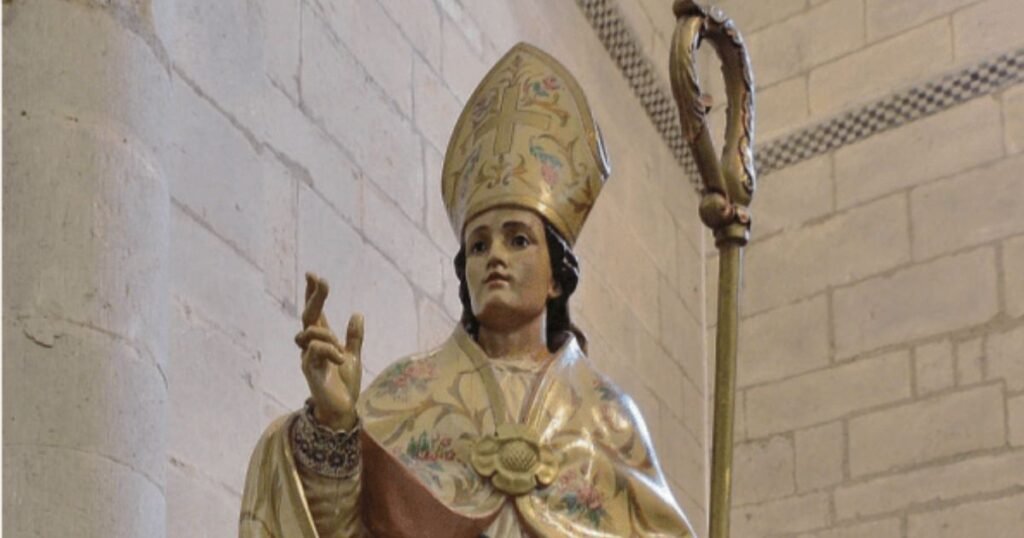
Prudencio was born in Armentia, in the province of Álava, and died in El Burgo de Osma, in the province of Soria, on 28 April. During his life he stood out as an anchorite and cleric, devoting himself to an existence of prayer and deep reflection. Over the course of his career, he attained the important position of bishop of Tarazona, where he had a significant impact on his community.
Since the mid-17th century, Prudencio has been recognised as the patron saint of the province of Álava, underscoring the importance of his legacy in that region. His feast day, celebrated on 28 April, is a special occasion for his devotees, who remember his life and his contributions to the faith and the community. On this date, many gather to pay homage to his memory and reflect on his life of spiritual dedication and service to others.
Life of San Prudencio
The hermitage of San Saturio has a very interesting history, as it was built on the very site where Prudencio is said to have been a disciple of an important saint named Saturio. This connection between the two is fundamental to understanding Prudencio’s life and legacy. However, it should be mentioned that various ancient documents contain some confusing references to other saints also named Prudencio, which can cause some confusion as to exactly who is being referred to.
One of the oldest breviaries found, the Breviary of Tarazona, mentions Prudencio, although not everything the document says is accepted as entirely accurate, because in some cases he is confused with a Prudencio who was a poet. It is important to note that this poet Prudencio is considered a different person and has no relation to the Prudencio who was a disciple of Saturio.
Information about Prudencio’s life is fairly limited, and it is not known exactly in which years he lived. Various dates are proposed, ranging from the late fourth century to the late sixth century, which shows that historians have had difficulty establishing a clear chronology. As for Saturio, his teacher, it is estimated that he was born around the year 493. If this date is correct, it would imply that Prudencio was born in the mid-sixth century, although, as already mentioned, the lack of precise information can lead to different interpretations of his life and era.
Youth of San Prudencio
He was born and spent his childhood in a small town called Armentia, which belongs to the province of Álava and today forms part of the city of Vitoria. At the age of 15, he decided to withdraw from everyday life and became an anchorite, seeking a life of solitude and reflection near what we know today as the city of Soria. This location lies alongside the Duero River, where he began to live according to the principles of ascetic life. During this period, he had as his teacher an important figure named Saturio, who is recognised today as the patron saint of the city of Soria.
The young anchorite remained there for a total of seven years, devoting himself to meditation and the pursuit of profound spiritual experiences. After those years of retreat, he decided to move to Calahorra, which was at that time an important city with a large diocese. In Calahorra, it was said that there was a considerable number of people who practised idolatry, that is, who worshipped false gods instead of the one true God.
His stay in Calahorra was not brief, as he devoted himself to evangelising and sharing his faith with the people who lived there. It is said that he managed to convert many people and also performed numerous miraculous healings, which led a large number of the sick to come to him seeking help and healing. However, the fame he began to acquire through his miracles became overwhelming for him, and as a result he decided to flee to a place called Tarazona in order to distance himself somewhat from the attention he was receiving. It is believed that during his time in these regions, the conversions and evangelising work may have taken place in the mountainous area of Cameros. This is because many of the idolaters who were expelled from the cities to which they once belonged sought refuge in small villages, where this young man may have continued his important work of conversion.
San Prudencio’s stay in Tarazona
After spending some time in his religious career, he was admitted as a cleric in the cathedral of Tarazona. In his first days in this position, his main responsibility was to look after the maintenance of the temple, making sure everything was in order and in good condition. Over time, his dedication and effort were recognised and he came to be appointed archdeacon, a position that granted him greater responsibilities and a higher level of respect within the religious community.
Later, after the death of the bishop of Tarazona, Prudencio was proposed as a candidate to fill the vacancy left by the previous bishop. His career within the cathedral and his commitment to the church did not go unnoticed, and he was eventually consecrated as bishop. This appointment represented a great honour for him and also a new stage in his life, in which he would have the opportunity to lead and serve the community of Tarazona in a more significant way.
Mediator in Osma
During that historical period, in the nearby diocese of Osma, strong disagreements and conflicts were taking place between the bishopric and the clergy, generating considerable tension within the religious community. Due to this complicated situation, Prudencio was chosen to act as a mediator with the aim of resolving the disputes and finding a suitable solution. His task was not easy, as he had to listen to the different positions and concerns of both parties and seek an understanding that could lead to reconciliation. In the end, after much effort and dedication, he managed to secure an agreement between them, which brought significant relief. However, having fulfilled this important mission, he fell seriously ill, an illness that proved fatal, leaving everyone in a state of mourning and reflection on his crucial role in resolving conflicts.
Burial of San Prudencio
When Prudencio died in the town of Osma, he was outside his own diocese, which caused some confusion and disagreement among the members of the clergy about the most appropriate place for his burial. Because of the fame Prudencio had attained during his life, thanks to the numerous miracles attributed to him, the decision of where his body would rest became a matter of great interest and controversy. According to legend, the situation was resolved in a rather peculiar way. Prudencio’s body was placed on the saddle of his horse, which had been his companion during his life, and the animal was allowed to walk freely along the road.
The horse, acting in an almost magical way, stopped after covering a distance of six leagues, approximately 30 kilometres, in the direction of the city of Logroño. It was at that exact spot that it was decided Prudencio would be buried. This site is identified today as a cave located on the slopes of Mount Laturce, within the present-day municipality of Clavijo, in the region of La Rioja.
Over time, on the very site of his burial, a church dedicated to San Vicente Mártir was built, a place of devotion and remembrance. According to what Friar Gaspar Coronel mentions, from the year 1025 onward this church came to be known as the monastery of San Prudencio de Monte Laturce. This designation would be confirmed by the granting of a privilege awarded by Sancho III the Great. However, the historian García Turza points out that the first reference to the monastery was found in a document dated between 1011 and 1021, which in turn is linked to an interpolation of an earlier document from the year 880.
Relics of San Prudencio
From the twelfth century onward, various disputes arose between the monks living in the monastery of Monte Laturce and those living in Nájera. These disputes centred on the exact location of the Saint’s relics, which were the object of great reverence and devotion. Although there is some confusion on this subject, largely due to the existence of numerous documents that have turned out to be forgeries, the most credible version is that García Sánchez III decided to move the relics of San Prudencio. This transfer would have taken place around the year 1040, when he founded the Monasterio de Santa María la Real de Nájera. His intention in carrying out this transfer was to honour the new foundation of the monastery, leaving in Monte Laturce only the head and a couple of minor bones of San Prudencio.
It has also been considered possible that García Sánchez I may have carried out an earlier transfer of the relics in the year 954, although this is less well documented. Although some researchers have tried to show that the relics never left Monte Laturce, there are reasons to suggest that the state of the monastery in the late tenth century was not the best. According to the accounts of Yepes, it is known that in the year 950 the population of monks at Monte Laturce was very low. In fact, there were only a few monks, since Abbot Adica and six other monks found themselves obliged to submit to Abbot Dulquito, who was in charge of the monastery of Albelda. In this context, they offered him not only their monastery, but also the people who lived there and all their possessions.
For this reason, it seems quite reasonable to imagine that, to prevent the relics from being left abandoned and forgotten in a desolate place with so few monks to care for them, they were moved at some point to another, more suitable site. The protection and reverence of relics were of the utmost importance at that time, and ensuring their safekeeping in a more active place with more monks would have been a sensible and logical decision.
Sanctification of San Prudencio
By the mid-eighth century he was already recognised and regarded as a holy figure within the community. This recognition is evidenced in an ancient document forming part of a cartulary belonging to the Monastery of San Millán de la Cogolla. This cartulary, a kind of record of the monastery’s history and events, is dated 24 April of the year 759. The mention of his sainthood in this document is an important sign of his influence and veneration during that time.