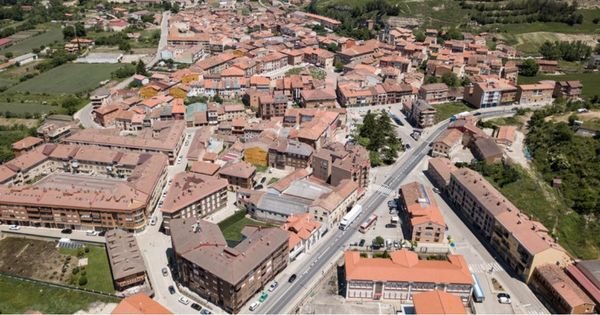
Vitores de Cerezo
San Vitores or San Víctor de Cerezo (Cerezo de Río Tirón, Province of Burgos, c. 800 — Quintanilla de las Dueñas, c. 850) was a Spanish Catholic martyr. His feast day is celebrated on 26 August.
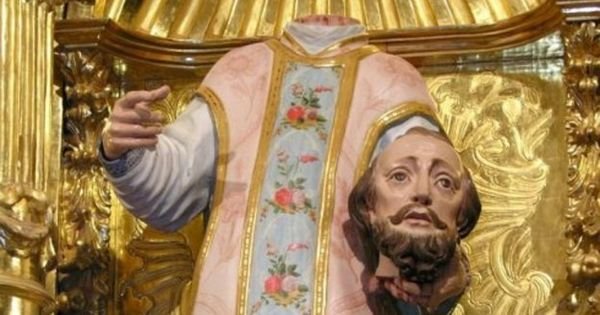
It is believed that the name “Vitores”, by which he is known today, was given to him gradually over the two centuries following his martyrdom, deriving from the Latin word “victoria” and/or “vítores” (celebration or festivity).
Biography of San Vitores
Origins and activity of San Vitores
San Víctor was born in the Burgos town of Cerezo de Río Tirón in the early 9th century. After being ordained he became a priest at the church of Santa María de Villalba in his home town, during a Muslim offensive in the area in the 9th century. Because of the historical period he lived through, he witnessed many believers from his town converting to the invaders’ Islam.
After feeling a call to a more spiritual life, he became a hermit, settling in a cave he carved out himself near Oña. After 7 years of isolation, according to tradition he received the apparition of an angel, and set off for his home town, which was then under siege by Muslim forces. Through his preaching he managed to encourage many Christian defenders of the region and convert just as many Muslim attackers, among them Coloma, daughter of the king of Gaza and future martyr saint.
Martyrdom of San Vitores
A target the invaders sought to bring down, he was captured while heading to Quintanilla de las Dueñas to preach. In front of that town, as he encouraged Christians to resist without converting to Islam, he was crucified. On the third day, still alive and continuing to preach, he was taken down from the cross and beheaded.
Tradition has it that after being beheaded, Vitores rose from the ground, picked up his head, blessed his executioners and headed towards the town of Cerezo, causing his executioners to convert to Catholicism. Back in the town he continued preaching and performing miracles until he went to a cave in Cubillas, near Cerezo, to die there. His drive in evangelisation and in keeping Catholicism alive in the towns of the area made him a driving force of the Reconquista .
Iconography of San Vitores
San Vitores is depicted in several ways:
- As a priest carrying his head in his hands, a clear allusion to the way he was martyred.
- Wearing a dark-coloured tunic instead of typical priestly vestments (and with his head in his hands), representing his years as a hermit or his travels through the area where he preached.
- With the cross, a symbol of his preaching.
- With a palm in his hand, a symbol of martyrdom.
Veneration of San Vitores
The martyr’s remains were buried in a stone tomb in a small cave near Cubillas (Cerezo de Río Tirón), where he was said to have died. Later, in the 15th century, they were moved to a convent that the Constables of Castile had built in his honour, in the town of Fresno del Río Tirón, where they were placed in a chest in a place of honour within the convent. This was first occupied by Dominicans and later by Franciscans, who were forced to abandon the convent after the Mendizábal Confiscation. It has been uninhabited ever since, although it has been renovated recently.
The fact that his tomb was located on the Camino Frances helped his devotion spread. It has extended to other places in the provinces of Burgos, La Rioja, Álava, Cantabria, Segovia, Palencia, Orense and the Province of A Coruña. In this way, San Vitores is patron saint, besides his home town, of Oña, Zorraquín, Bárcena de Pienza, Belorado, Huerta de Arriba, Villoviado and the Barrio San Vitores of the town of Frías in Burgos; Casalarreina and Zorraquín in La Rioja; Berzosilla in Palencia; Grajera in Segovia; and other localities, especially in Galicia.
In addition, for centuries, many neighbouring villages, both in La Rioja and in the Province of Burgos, have made a pilgrimage in May to honour San Vitores at what is now the former convent. Some of these villages have lost the custom, and it is kept up in only a few, such as Leiva, which goes on the first Saturday of May; Tormantos, Fresno de Río Tirón, Redecilla del Campo, Quintanilla San García, Castildelgado and Cerezo de Río Tirón, depending on available dates.
San Vitores
See also: