Route of the Camino Frances stage: Carrión de los Condes – Ledigos (23.4 km)
This stage of the Camino de Santiago Frances runs from Carrión de los Condes to Ledigos along the loneliest stretch of the whole route: seventeen kilometres in a dead-straight line along the old Roman road, without a single village, bar or fountain, until Calzadilla de la Cueza.
KM 0
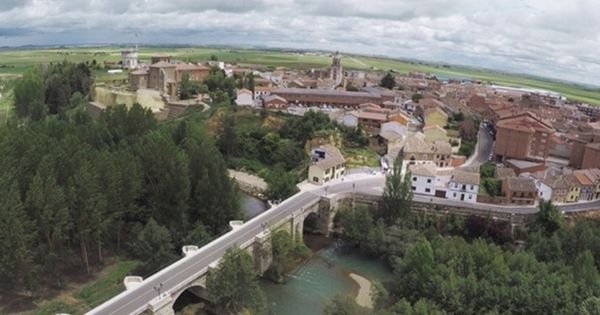
Carrión de los Condes
You cross the Carrión river beside the Monasterio de San Zoilo and, after a couple of kilometres on road, the Camino joins the Vía Aquitana, the old Roman road that linked Bordeaux with Astorga: a seventeen-kilometre dirt straight without a single village, bar or fountain.
17.3 km

Calzadilla de la Cueza
After the long straight, Calzadilla suddenly appears in a shallow valley. It has the church of San Martín, a fountain, a bar and a hostel: the first possible stop since Carrión. Halfway along the previous stretch lie the ruins of the hospital of Santa María de las Tiendas.
23.4 km

Ledigos
An adobe village with the church of Santiago, which holds three depictions of the Apostle: as pilgrim, knight and apostle. It has a couple of hostels and a bar.
Carrión de los Condes – Ledigos: complete guide
Stage profile: distance, elevation and difficulty
Distance: 23.4 km. Walking time: 5 h – 5 h 45 min. Elevation: negligible (+120 m / –110 m). Difficulty: medium. The terrain doesn’t count for much, but the stage is defined by one unique stretch: 17 kilometres in a straight line along the Roman road, with no villages or services, the longest stretch without water on the entire Camino Frances. It’s more a mental challenge than a physical one. By bike it rolls easily, but it’s just as long and exposed.
The Vía Aquitana: walking on Rome
The Vía Aquitana linked Bordeaux (Burdigala) with Astorga (Asturica Augusta) to move troops, tin and gold. The Camino de Santiago inherited its course along this stretch, one of the best preserved on the Peninsula: a two-thousand-year-old straight line crossing the sea of grain of Tierra de Campos. To handle the monotony well, it helps to settle into a steady pace, stop counting kilometres, and walk with company or in silence, depending on the day.
What to see: monuments and heritage
In Carrión de los Condes, the Monasterio de San Zoilo and the churches of Santiago and Santa María del Camino. Along the way, the ruins of the hospital of Santa María de las Tiendas, run by the Order of Santiago. And in Ledigos, the church of Santiago with its three images of the Apostle. Otherwise, this is a stage of landscape: endless wheat fields and huge sky.
A little history
In the Middle Ages, the few hospitals along the straight —such as that of Santa María de las Tiendas, also known as the “Hospital de Don Gonzalo”— were lifelines in an empty stretch feared for its lack of help. Long before them, the Roman road had already spent centuries channelling traffic between Gaul and the north-west of the Peninsula. The very name of Calzadilla de la Cueza refers to that road.
Food and drink
Still in Palencia: roast lechazo, garlic soup, menestra and morcilla. Calzadilla and Ledigos both have simple pilgrim menus. Bring fruit and nuts for the straight, where you’ll find nothing at all.
Practical tips
Leave Carrión with two litres of water per person and food with you: there’s nothing guaranteed until Calzadilla de la Cueza (17.3 km). In season there’s often a snack van halfway along, but don’t count on it. Set off early and avoid the middle hours of sun. If there’s a headwind that day, pace yourself: the straight stretch can feel endless.
Services and accommodation by town
Listings published in our guide for the towns on this stage.
Carrión de los Condes
Hostels
- Albergue de las Hermanas Filipenses
- Albergue del Convento de Santa Clara
- Albergue Espíritu Santo Carrión de los Condes
- Albergue Santa María del Camino Carrión de los Condes
Accommodation
Churches
- Iglesia de Nuestra Señora de Belén
- Iglesia de San Andrés Apóstol
- Iglesia de Santa María del Camino
- Iglesia de Santiago Carrión de los Condes
Calzadilla de la Cueza
Hostels
Churches
Ledigos
Churches