San Froilán – Froilán de León
San Froilán (Lugo, 833 – León, 904) is a saint of the Catholic Church, patron saint of the Provincia de Lugo, of the diocese of León and of the municipality of Valverde de la Virgen.
San Froilán was born in Lugo around the year 832. While still very young he left his father’s house to live as a hermit in the mountains of O Cebreiro and El Bierzo. He felt compelled by God to leave his retreat and devote himself entirely to preaching in the regions of Galicia and León.
San Froilán
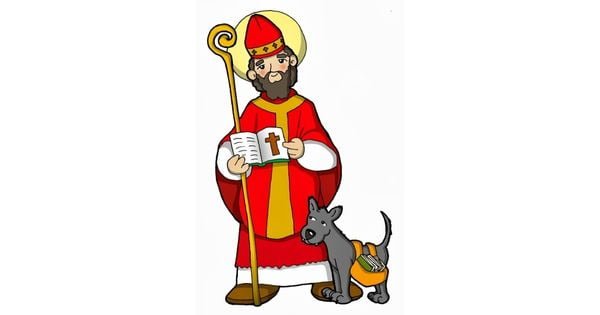
It is during this time that, according to legend, the episode of the wolf devouring his donkey takes place. Commanded by the saint, the fierce animal, like a meek lamb, carried the saddlebags of books that always accompanied San Froilán on his apostolic journeys.
He met San Atilano, a monk like himself, and together they shared the ministry of preaching and the task of reforming and founding many monasteries.
The people demanded him as bishop for the see of León. Much against his own will, he was consecrated as such at the age of 68.
After a fruitful pontificate, he died in the odour of sanctity at the age of 73.
The people immediately venerated him as a saint and his fame spread throughout the Church.
He is the patron saint of the dioceses of León and Lugo and titular of the Lugo parish that bears his name. Born just outside the walls of Lugo, one of the baroque churches of the old town is dedicated to him, and he also has a chapel in the Catedral de Santa María de Lugo. His remains are kept in a chest on the high altar of the Catedral de León. His name is also mentioned in cryptographic characters (Visigothic notarial cipher) in the margins of folios 128v and 149r of the León Antiphonary. He is commemorated on 5 October, although the festivities begin the Saturday before.
Roman Martyrology
In León, a city of Hispania, commemoration of San Froilán, bishop, who was first a hermit and later, ordained bishop, evangelised the regions freed from the yoke of the Muslims, spreading monastic life and distinguishing himself through his charity towards the poor.
Life of San Froilán
A short biography survives, copied in Visigothic minuscule by the deacon Juan, his contemporary. That copy dates from the year 920, fifteen years after his death. The author is unknown. Despite its laconic style, one can attempt to reconstruct the fundamental features of his life and character, although it contains legendary accretions common to accounts of the lives of saints in the Middle Ages.
He was born in the city of Lugo, in the Regueiro dos Hortos, in the year 833, the son of the counts of Lugo, and lived the life of a student until, at around the age of 18, he prepared for the priesthood according to the customs of the time.
Froilán, the hermit
His spiritual life entered a crisis and he became a hermit, withdrawing, it seems, to a cave in Ruitelán in Vega de Valcarce, El Bierzo (now a hermitage). Meanwhile, the Mozarabic revolts broke out in Muslim Spain. It was the year 850, and in Córdoba the martyrology began to flourish again with the solemn rite of blood:
Among the purple roses of this long springtime of martyrdom were, among others, the priest Perfecto, beheaded on the day of the Moorish Easter; the learned monk Isaac, decapitated and hung from a stake; the young Sancho, crucified; the two virgins Columba and Pomposa, and the most famous of all, the blessed Eulogio, that eager maker of martyrs, whose head was severed with a single blow of the scimitar, at three in the afternoon on Saturday 11 March 859. Perhaps the powerful voice of this innocent blood echoed among the mountains where Froilán was hiding and drove him to organise a crusade. Perhaps, in his intimate dialogue with God, he felt the call to an active life.
His biographer tells us, with the naivety of our epic songs and, no doubt, imitating the beginnings of the preaching of Isaiah, that the young hermit was troubled by doubt as to whether he should remain any longer in that solitude.
To free himself from this uncertainty, he put himself to a trial by fire. If God suspended the laws of nature, it would be a clear sign of His divine will:
Froilán put burning embers into his mouth. The fire did not cause him the slightest burn. God had spoken. From the mountains he threw himself into the villages to spread among men another fire that burned within him.
Over the years, his life was marked by different events that gradually shaped his destiny — perhaps one of the most important being his meeting with the Mozarabic priest of Tarazona, Atilano, with whom he undertook a monastic life and the reform of eremitic life, seeking only his own perfection and union with God. They withdrew to the most rugged part of the mountains of León, Mount Cucurrino (today known as Mount Corueño or Mount Curueño).
But whole villages followed him to his solitary cell. Along with the crowds came magnates and bishops eager to hear his word. Among his listeners numerous followers arose, captivated by his example. Faced with their insistent pleas, he was forced to go down to the city of Viseu. There he built his first monastery, which he would soon fill with 300 monks. It was the beginning of a new stage: founder of monasteries.
San Froilán, Founder of Monasteries
His fame crossed the mountains of León and reached the ears of Alfonso III in Oviedo, the capital. The king sent messengers ordering him to come to his court.
He was chosen for the enormous work of repopulation that his father, Ordoño I, had begun. The borders of the Asturian-Leonese kingdom reached, in the south, as far as the line of the Duero.
The border areas on both sides of the river were depopulated and devastated by the Asturian kings. Military tactics demanded it so. But the border had to be pushed further south. To that end, in the area north of the Duero it was necessary to rebuild the destroyed settlements and put the abandoned lands back into use. No force was more cohesive in giving life to these royal concerns than the colonising action of the monasteries.
The king understood this fully and granted the monk broad powers to visit all his domains and build monasteries under whose protection the new settlements could take shelter. These human groupings, thus formed, constituted a political unit whose head was the abbot, and whose agents and teachers were the monks, who taught the arts of peace and instilled the crusading spirit in the war of the Reconquest.
Froilán once again put his capacity for initiative into action and set out to travel the lands of the kingdom. His combative attitude led him to found two great monasteries near the border, a few kilometres from Zamora.
The first was that of San Salvador de Tábara, where 600 monks of both sexes gathered. It was one of those monasteries called double monasteries, where the nuns, though strictly separated, had the advantage of priestly assistance and of protection in case of invasion.
This was one of the most famous monasteries for the refined art of its scriptorium. The weight of time, indifferent to human endeavours, has not allowed us to see, in its stone reality, the architecture of this foundation. But, fortunately, a codex from its scriptorium partially preserves it for us. On the last folio appears the tower of the monastery, tall and made of stone, of polychrome ashlar masonry, with horseshoe-arched windows. On the roof, two graceful little towers each with a bell. On either side of the last windows, two projecting balconies look out over the horizon. Three men climb the tower by ladders, and another rings the bells by pulling a rope. Attached to the tower is the scriptorium. A parchment-maker is shown seated on a stool cutting parchment with large scissors. In an adjoining room are the monk Sénior, a copyist, and Emeterio, scribe and painter, favourite disciple of Magio. Magio was the most notable cultural glory of the monastery of Tábara. A contemporary of Froilán in his childhood, he raised the art of illumination to marvellous heights — a chaste, spiritual art, restful to the eyes, and one that moves the soul to lofty reflection.
The second monastery, according to the aforementioned biographer, he built on a high and pleasant site beside the waters of the river Esla, apparently near Moreruela (Zamora). His biographer adds only one further remark to this laconic account: ..there gathered there 200 monks devoted to the asceticism of the regular life.
Bishop of León
In the year 900, the bishop of León, Vicente, died, and the people asked the king that Froilán be the new bishop.
He was appointed bishop on the day of Pentecost (19 May) in the year 900; that same day his inseparable and holy friend Atilano also received episcopal consecration as Bishop of Zamora.
The Church of León, which was dedicated, according to a donation from that time, “to the lords, saints, glorious and, after God, most powerful patrons Santa María Virgen, Queen of Heaven, and San Cipriano, bishop and martyr”, now received with acclaim as bishop the one who would be its patron saint to this day. The ceremonies were witnessed by the king and the entire court of the time, which gives an idea of the importance of the figure of San Froilán in that era.
Five years later he died in León, on 5 October, and was buried in the Catedral de León, the old church of Santa María, in a sumptuous tomb built for himself by Alfonso III of Asturias.
Legend of San Froilán
Tradition has it that the depiction of the patron saint accompanied by a wolf may stem from an encounter he had with one of them during one of his many pilgrimages.
It is said that one morning, while San Froilán was praying and absorbed in his devotions, a hungry wolf appeared, which saw in the saint’s donkey an appetising meal. Pouncing on it, it began to devour it, at which moment the saint found it, and with his gaze he left the wolf cowering and fearful, while he spoke to it of love and peace.
This is how San Froilán managed to rid the wolf of its fear of man and of fire, taking it into his service to carry the saddlebags for him around the world. From then on, the wolf always walked at his side, close to his right leg.
San Froilán
| Born | 833, Lugo (Spain) |
|---|---|
| Died | 904 |
| Religion | Catholic Church |
| Occupation | Priest |
| Positions held | Bishop of León |
| Canonisation | Saint |
| Feast day | 5 October |
See also: