
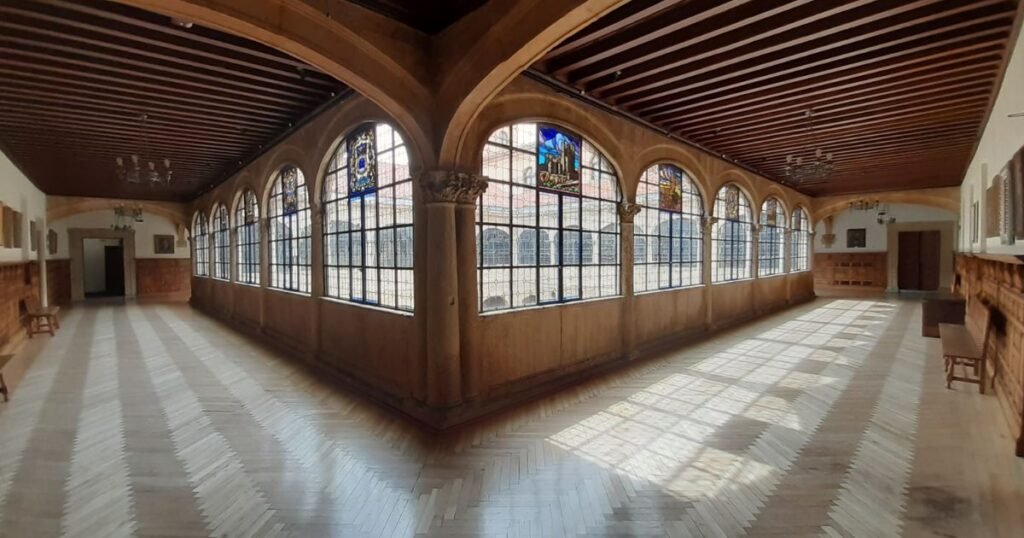
Palacio de los Guzmanes in Leon
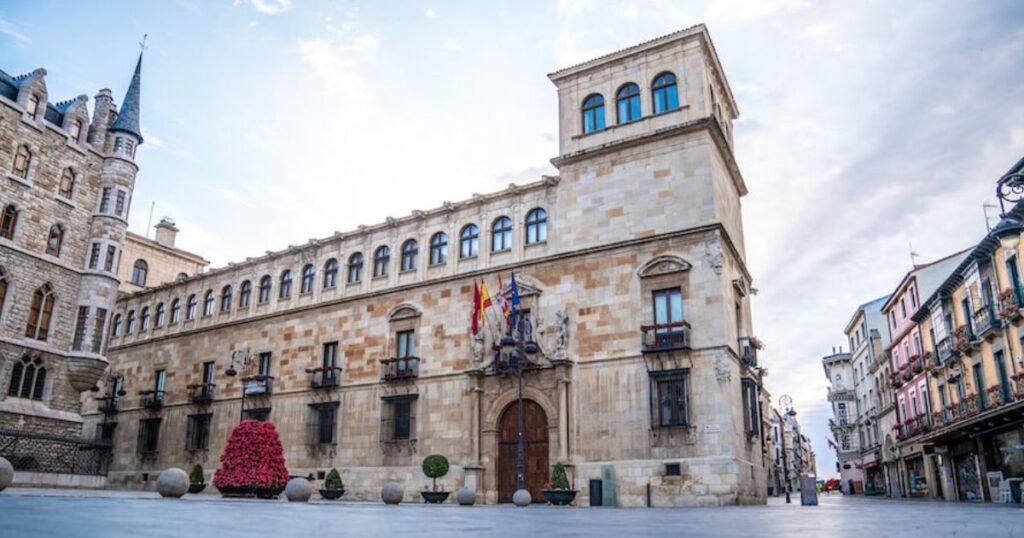
The Palacio de los Guzmanes, located in the city of Leon, Leon Province, is one of the architectural gems of the Spanish Renaissance. This building, which now houses the seat of the Provincial Council of Leon, stands out for its imposing facade, its interior courtyard and its rich history dating back to the 16th century.
Origins and Construction of the Palacio de los Guzmanes
Construction of the palace began in 1559, commissioned by Don Ramiro Nunez de Guzman, a member of one of Leon’s most influential families. The design was created by the renowned architect Rodrigo Gil de Hontanon, known for his work on the New Cathedral of Salamanca and other iconic works of the Spanish Renaissance. Construction was carried out by Juan de Ribero Rada, who also contributed elements to the original design.
The palace was conceived as a noble residence reflecting the power and influence of the Guzman family. Its strategic location on Plaza de San Marcelo, next to Casa Botines, gave it prominent visibility within the urban setting.
Architecture of the Palacio de los Guzmanes
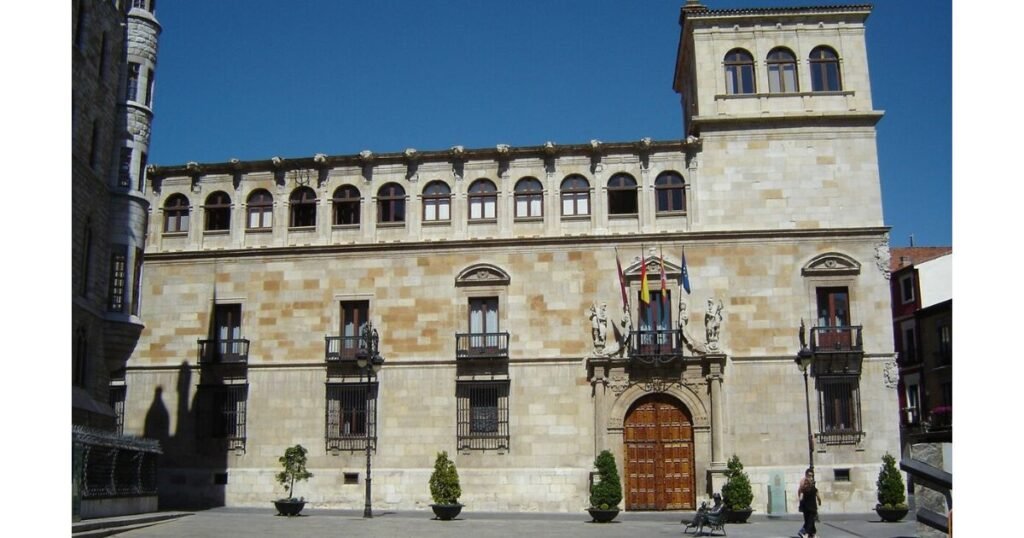
The Palacio de los Guzmanes has a trapezoidal floor plan arranged around an interior courtyard and is flanked by towers at its four corners. Its main facade, notably horizontal in design, is divided into three levels separated by string courses. The lower level features barred windows; the central section has balconies topped with triangular and semicircular pediments; and the upper level has a gallery of round arches separated by Corinthian pilasters. Gargoyles crown the ensemble above these.
The main entrance, off-centre in keeping with medieval Spanish tradition, consists of a round arch framed by Ionic columns supporting an entablature with a balcony topped by a decorated triangular pediment. On either side, two warriors bear the coats of arms of the Guzman family.
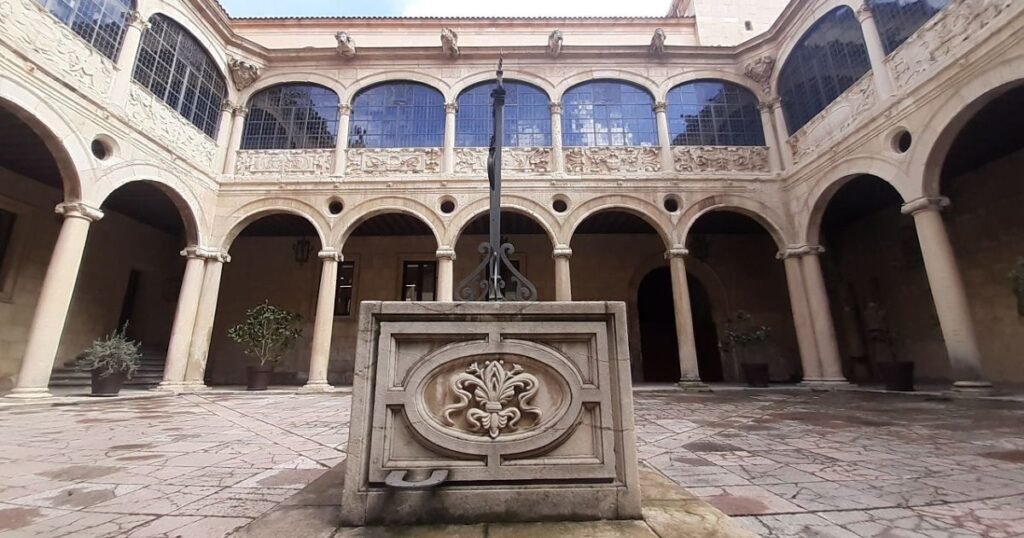
The interior courtyard, over two floors, has segmental arches resting on Ionic columns with profiled capitals on the ground floor, and basket-handle arches on Corinthian columns on the upper floor. The parapets are carved with the Guzman coats of arms, and the openings are fitted with stained glass. Gargoyles similar to those on the facade crown the ensemble.
Restorations and Later Uses
At the end of the 16th century, work on the palace was interrupted, leaving it unfinished. Despite this, it became the city’s main residence and hosted Philip III and Margaret of Austria in 1602. In the following centuries, however, the palace ceased to be regularly inhabited and began to deteriorate.
In the 19th century, the Provincial Government rented part of the building to house its offices, carrying out partial repairs. In 1881, the Provincial Council of Leon purchased the building from the Counts of Penaranda de Bracamonte. Various interventions were later carried out to adapt it to its new functions and restore its original appearance.
Among the most notable renovations are the reconstruction of the towers in 1892, following the model of palace towers used by Gil de Hontanon in Salamanca, and the installation of a heating system in 1930. In the 1960s and 1970s, the building was completed under the direction of architect Felipe Moreno Medrano, expanding and finishing it following the original design.
Visits and Access to the Palacio de los Guzmanes
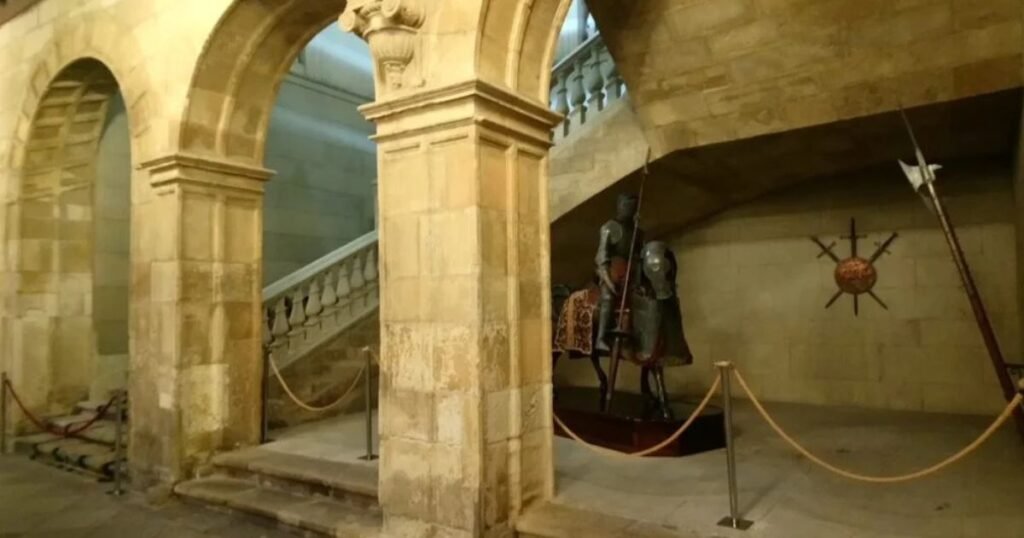
The Palacio de los Guzmanes is currently the seat of the Provincial Council of Leon and is open to the public for visits. For individual visits, it is essential to sign up on the same day, on the sheets provided for this purpose at the palace entrance. These sheets are available starting fifteen minutes before the first morning visit.
Palacio de los Guzmanes
The Palacio de los Guzmanes is a living testament to the Renaissance in Leon and a must-visit for those wishing to learn about the history and architecture of the city. Its imposing structure, rich ornamentation and historical significance make it one of the city’s most notable monuments.
For more information about the Palacio de los Guzmanes, visit the official website of the Provincial Council of Leon