Larrasoaña
Larrasoaña is an old village and council, today part of the Chartered Community of Navarre, belonging to the municipality of Esteríbar.
Accommodation in Larrasoaña
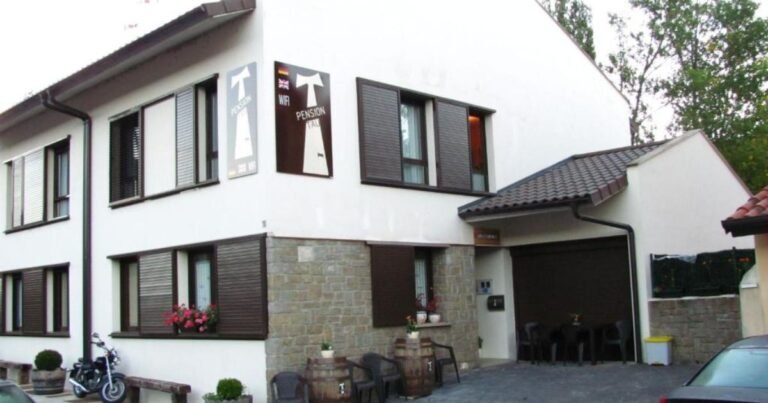

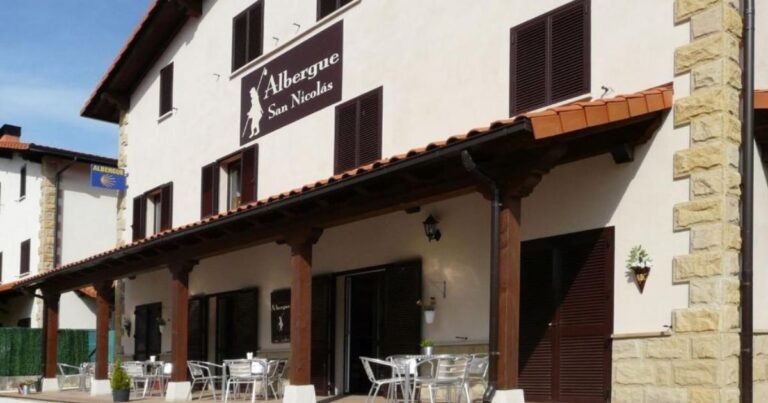
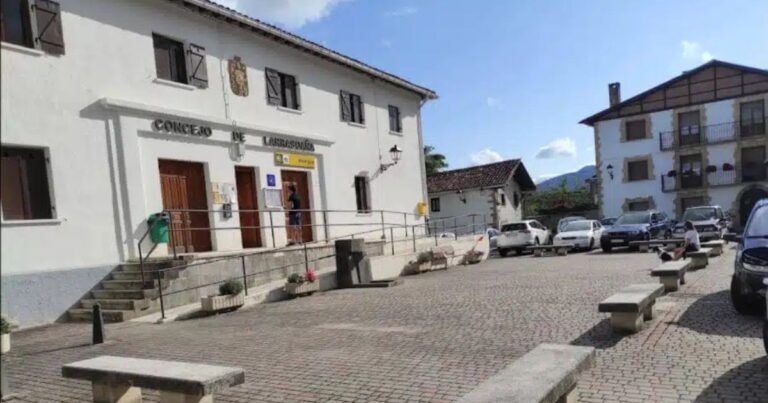
Hostels in Larrasoaña
History of Larrasoaña
The origin of the village of Larrasoaña dates back to an important religious site known as the monastery of San Agustín de Larrasoaña, founded at some point in the 10th century. This monastery played a significant role in the region’s history and was later incorporated into the renowned monastery of Leyre during the 11th century. Near the monastery, in an area known as the plain of Iriberri, a group of settlers from France, known as francos, established themselves. This group received a special privilege from Sancho VI the Wise in 1174, which included the charter (fuero) of Pamplona, granting them certain rights and freedoms. Thus, the new village formed by these settlers took the name Larrasoaña in the 13th century, becoming an established settlement.
From 1319 onward, records show Larrasoaña’s participation in the meetings of the Cortes (the Navarrese parliament), specifically in the Universities’ arm, where matters relevant to the community were discussed. In 1329, the village hosted one of these important meetings, at which the oath was defined that King Philip III and Queen Joan II would have to take days later as part of their royal duties.
Over time, however, by 1427 Larrasoaña had lost its bourgeois character, even though its inhabitants were still formally considered francos. Most of the people living there were engaged mainly in agriculture, reflecting a shift in the population’s economic activities. After the devastating Black Death epidemic, which affected many towns during the 14th century, Larrasoaña’s population fell sharply, with just 18 hearths (fuegos) recorded in 1366. Over time this figure rose to 31 hearths in 1427 and later to 47 hearths in 1553.
Trade and relations with France declined significantly, which may have contributed to the village’s periods of stagnation and decline well into the 18th century. Throughout this time, records show the population remained low, with 31 hearths in 1646, 34 in 1678, falling to 27 in 1726. However, during the 18th century there was notable demographic growth, reaching a total of 205 inhabitants in 1786. Despite this increase, the population began to decline again until the mid-19th century, with figures showing 193 inhabitants in 1824 and a drop to 147 inhabitants in 1857.
An important event in Larrasoaña’s history took place on 26 March 1823, when Santos Ladrón de Cegama, during the Royalist War of 1821-1823, inflicted a harsh defeat on a constitutionalist column at this location. This military action forced the survivors to seek refuge in Pamplona, triggering a series of events that would change the political dynamics of the time.
Larrasoaña continued to exist as an independent municipality until 1928. That year, it lost its autonomous status and was incorporated into the present-day municipality of Esteríbar, becoming part of a larger community that reflects the region’s evolution over the centuries.
What to see in Larrasoaña?
- La Parroquia de San Nicolás de Bari es de nave única con cabecera recta y torre, conservando elementos góticos.

- El Puente de Larrasoaña o Puente de los Bandidos es un puente medieval del siglo XIV sobre el río Arga.
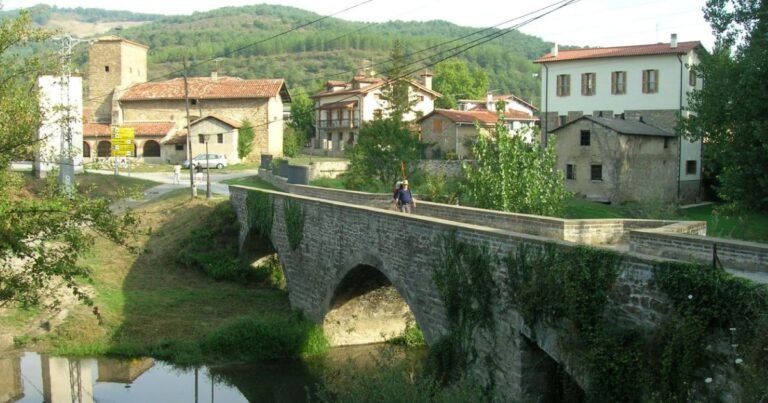
- Ermita y Hospital de Santiago: es un antiguo edificio que era parte de la cillería de la colegiata de Roncesvalles. Este edificio tiene una planta rectangular que está sostenida por cinco pares de contrafuertes, lo que le da una estructura muy sólida y distintiva. La forma en que están dispuestas las casas alrededor de esta ermita y hospital es típica de los pueblos que se encuentran a lo largo del Camino de Santiago, que es una ruta de peregrinación muy importante. A ambos lados de la calzada se pueden observar diversas casas, algunas de las cuales tienen orígenes medievales que se pueden identificar por el diseño de sus ventanas y otros elementos arquitectónicos. También hay casas que muestran características del siglo XVIII, como los aleros y la labra de sillares que adornan sus fachadas. En la actualidad, todavía se puede ver una casa en particular al salir hacia Zubiri, que tiene un hermoso blasón en su fachada, lo que indica su importancia histórica.
- Ermita y Hospital de San Blas: tiene una historia documentada que se remonta a un archivo del obispado de Pamplona, donde se menciona un documento fechado en 1695. Este documento revela que el hospital contaba con una casa y tierras que se mantenían gracias a las limosnas de los cofrades y los vecinos del área. En este lugar, había una beata, que era una mujer muy devota, una religiosa o un casero que se encargaba de proporcionar refugio a los peregrinos que pasaban por allí. El hospital tenía como objetivo ofrecer un lugar seguro y acogedor para los viajeros que emprendían su camino en dirección a la Catedral de Santiago en la ciudad de Santiago de Compostela. Sin embargo, en el año 1640, se registró que sólo había tres camas disponibles en este hospital, lo que muestra que su capacidad era bastante limitada. Con el paso del tiempo, la actividad de este hospital comenzó a declinar debido a problemas de gestión de recursos, que comenzaron en el año 1604, lo que afectó su funcionamiento y su importancia para los peregrinos que transitaban por la región.