Nuestra Señora del Puy
Nuestra Señora del Puy, also known as Santa María del Puy, is a Marian devotion deeply rooted in the history and culture of Estella, a town in the Chartered Community of Navarre, on the Camino Frances. Her devotion, dating back to medieval times, is linked to legends, miracles and an exceptional artistic heritage that draws believers and historians alike.
Origin and Legend of Nuestra Señora del Puy
The Apparition in the 11th Century
The story of Nuestra Señora del Puy dates back to the year 1085, when shepherds from the nearby village of Abárzuza, tending their flocks on a hillside, witnessed a mysterious shower of stars that seemed to descend upon a cave hidden among the scrub. Intrigued, they approached the spot and discovered an image of the Virgin Mary holding the Christ Child. This discovery marked the beginning of a devotion that would turn Estella into a major Marian centre.
Legend has it that King Sancho Ramírez, on learning of the discovery, tried to move the image to the Iglesia de San Pedro in Lizarra. However, during the procession, the image became immovable at a specific spot, which was interpreted as a divine wish for it to remain near its original location. This wonder established the Puy hill as a sacred site.
An Image Hidden by History
Some historians suggest the image was hidden during the Muslim invasion in the 8th century to protect it from possible looting. The hypothesis of a Visigothic origin adds still more mystery and historical relevance to the account. Alternatively, this devotion has been linked to French pilgrims who are thought to have brought with them veneration of the Virgen de Le Puy en Velay, a similar devotion along the Camino de Santiago.
The Basílica de Nuestra Señora del Puy: A Space of Faith and Architecture
A Modern Building with an Ancient History
The current Basílica de Nuestra Señora del Puy was built between 1930 and 1952, designed by the Navarrese architect Víctor Eusa. However, it stands on the same site as an earlier church, documented since the 12th century. That baroque-style building was demolished to make way for the contemporary structure, and older architectural traces were lost in the process.
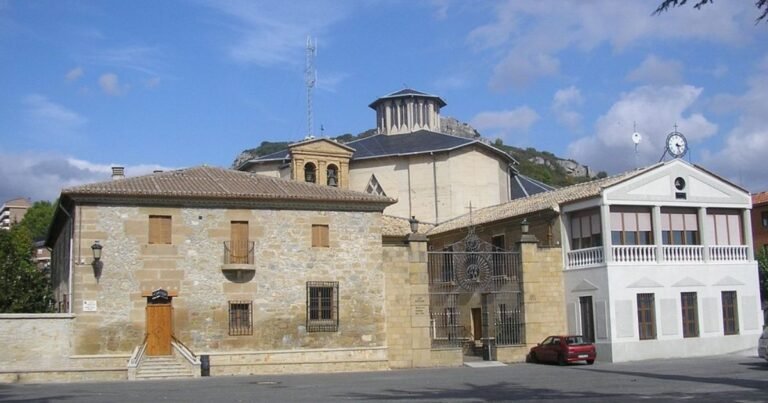

Despite its modern construction, the basilica retains the essence of a space devoted to Marian veneration over the centuries. Its strategic position atop Estella symbolises its protective character and its spiritual connection to the heavens.
Canonical Coronation and Festivities
On 25 May 1958, Nuestra Señora del Puy was canonically crowned, becoming firmly established as patroness of Estella. Since then, this date has been celebrated with fervour in the town, marking the main day of its patronal festivities. This liturgical act not only underscored the Virgin’s importance to local spirituality but also strengthened the community’s cultural and religious bond with its patroness.
The Image of Nuestra Señora del Puy: A Treasure of Gothic Art
Characteristics of the Carving
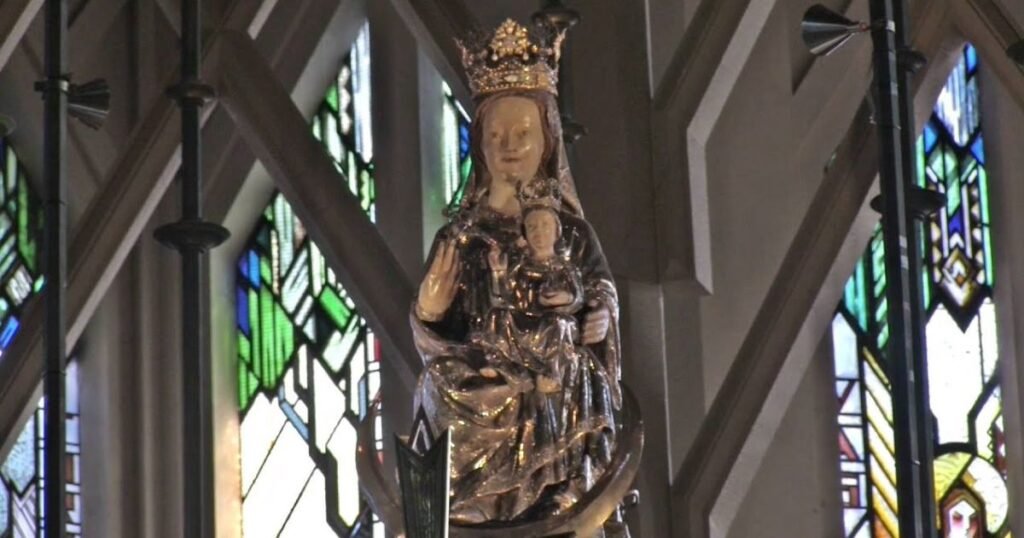
The image of Nuestra Señora del Puy is a Gothic masterpiece, created between 1300 and 1320. Standing roughly one metre tall, the polychrome wood carving features a silver overlay that heightens its sacred character. The Virgin is depicted seated on a small footstool, holding the Christ Child on her left knee.
The Virgin’s face, oval and serene, reveals the influence of the French courtly style, softened by a touch of sweetness and humanity that makes it unique. The Christ Child adopts a gesture of blessing, highlighting the maternal and protective character of the figure.
Alterations and Restorations
The carving has undergone various restorations over the centuries, documented in the sanctuary’s “Libro Becerro” (register book). In the 16th century, the flesh-toned areas were repainted and part of the silver overlay renewed. Later, in the 17th and 18th centuries, the custom of dressing the image was introduced, which altered the original position of the Christ Child.
Despite these interventions, the artistic essence of the image has remained intact, cementing its place as a religious and cultural icon of Navarra.
Popular Devotion and Associated Traditions
The “Bajadas” of the Virgin
One of the most significant traditions surrounding Nuestra Señora del Puy is the “bajadas” (descents) of the image, which began in 1631 in response to a plague epidemic. On these occasions, the image was carried to various parishes in Estella, where novenas and masses were held to implore her protection. Today, these processions form part of the town’s festivities, underlining the Virgin’s role as an intercessor in times of need.
Pilgrimages to the Basilica
Devotion to the Virgen del Puy is not confined to Estella; it extends across the whole district. Numerous villages hold pilgrimages during April and May, notably those of Cirauqui, Oteiza, Villatuerta and Abárzuza. These pilgrimages are expressions of collective faith, strengthening the ties between the local communities and their patroness.
Influence of Nuestra Señora del Puy on Local Culture
Iconography and Spread of the Devotion
The Virgen del Puy has been the subject of a great many artistic reproductions, from paintings to small devotional images for the home. In the 17th century, her likeness was so sought after that more than 300 copies were distributed in cities such as Pamplona, Tarazona and Seville, as well as in Flanders.
Legends Shared with Le Puy en Velay
The relationship between Nuestra Señora del Puy and the French devotion of Le Puy en Velay is evident in the similarities of their history and veneration. This connection reinforces the importance of the Camino de Santiago as a vehicle for cultural and spiritual exchange in medieval Europe.