Next Holy Year of Santiago: 2027
25 July 2027 falls on a Sunday. The Holy Door of the Cathedral of Santiago will open on 31 December 2026 and stay open all year.
What the Holy Year of Santiago is (Ano Santo Xacobeo in Galician)
The Holy Year of Santiago, also called the Jacobean Holy Year, Xacobeo in Galicia (Año Santo Jacobeo / Ano Santo Xacobeo) or Compostela Holy Year, is the Catholic jubilee year dedicated to Saint James the Greater and his tomb in Santiago de Compostela. It is celebrated only in the years when 25 July, the feast of Saint James, falls on a Sunday. Because of leap years, that happens in a regular 6-5-6-11 cycle (with exceptional gaps of 7 or 12 years when the last year of a century is not a leap year), so there are fourteen Holy Years in every century.
During that year the Cathedral of Santiago de Compostela opens the Holy Door, which stays walled up the rest of the time, and pilgrims who reach the Apostle’s tomb can obtain the plenary indulgence, the jubilee. The last Holy Year was 2021, exceptionally extended into 2022 because of the pandemic; the next one is 2027.
When is the next Holy Year of Santiago (Xacobeo)?
The next Holy Year of Santiago is 2027. Just look at the calendar: 25 July 2026 is a Saturday and 25 July 2027 is a Sunday. Since the Compostela jubilee is only celebrated when the feast of the Apostle falls on a Sunday, 2027 will be a Holy Year (Xacobeo 2027). It is the first one after the long eleven-year gap that separates 2021 from 2027 in the 6-5-6-11 cycle.
Last
2021–2022
Extended to two years because of COVID-19, as had already happened in 1937–1938.
Next
2027
Holy Door opened on 31 December 2026; closed on 31 December 2027.
After that
2032 and 2038
Then 2049, 2055, 2060 and 2066, following the 6-5-6-11 cycle.
By tradition, the Archbishop of Santiago opens the Holy Door with a silver hammer on the afternoon of 31 December of the previous year and closes it again on 31 December of the Holy Year. 2027 also comes six years after the last jubilee, so pilgrim numbers comparable to 2004 and 2010 are expected: if you plan to walk the Camino Frances in a Holy Year, book your accommodation well in advance, especially on the last 100 km from Sarria.
Only when 25 July, the feast of Saint James, falls on a Sunday does the Cathedral of Santiago open its Holy Door. So decreed Callixtus II in 1122, and Alexander III confirmed it in perpetuity.
Origin of the Holy Year
What does the word “Jacobean” mean?
Jacobean (Spanish jacobeo) means “relating to the Apostle Saint James”. It comes from the Latin Iacobus (Jacob, James), the Apostle’s name, from which “Santiago” also derives (Sanctus Iacobus, “Sant Iago”). That is why the Camino de Santiago is called the Jacobean route or Jacobean pilgrimage, and the Apostle’s jubilee year the Jacobean Holy Year. The Spanish Royal Academy dictionary defines jacobeo with exactly that meaning: “belonging or relating to the Apostle Saint James”.
What is “Xacobeo” in Galician?
Xacobeo is simply the Galician form of jacobeo: in Galician, James is Santiago or Xacobe, and the Holy Year is called Ano Santo Xacobeo. Since 1993 the Galician regional government (Xunta de Galicia) has also used “Xacobeo” as the name of its official cultural and tourism programme for each Holy Year (Xacobeo 93, Xacobeo 99, Xacobeo 2004, Xacobeo 2010, Xacobeo 21-22), with concerts, exhibitions and improvements along the routes. So the Holy Year of Santiago and the Xacobeo are exactly the same thing: the Compostela jubilee, named in Spanish or in Galician. There are not two different celebrations.
What is the difference between a Jubilee Year and the Holy Year of Santiago?
A Jubilee Year (or Holy Year) is any year in which the Catholic Church grants a plenary indulgence to the faithful who meet certain conditions. The best known is the Roman Jubilee, held ordinarily every 25 years (most recently in 2025), which the Pope can also call on extraordinary occasions. Other places have their own jubilees: Caravaca de la Cruz every seven years, or Santo Toribio de Liébana whenever 16 April falls on a Sunday.
The Holy Year of Santiago is the specific jubilee year of Santiago de Compostela: it is celebrated only when 25 July falls on a Sunday, and the jubilee is gained at the Apostle’s tomb. In other words, every Holy Year of Santiago is a Jubilee Year, but not every Jubilee Year is a Holy Year of Santiago. Moreover, while the Roman jubilee depends on a papal proclamation, the Compostela one has been perpetual since the bull Regis aeterni and recurs automatically with the calendar.
What is celebrated in a Holy Year: the Holy Door and the jubilee

During every Holy Year, the indulgence is granted to all the faithful who voluntarily fulfil the following conditions:
- Visit the tomb of the Apostle Saint James in the Cathedral of Santiago de Compostela, or any other sacred place in the city, during the Holy Year.
- Make some form of pilgrimage, such as walking at least 100 km to Santiago de Compostela, or travelling on horseback, by bicycle or in a wheelchair, with the intention of reaching the Apostle’s tomb.
- Receive the sacraments of confession and communion.
- Pray for the intentions of the Pope.
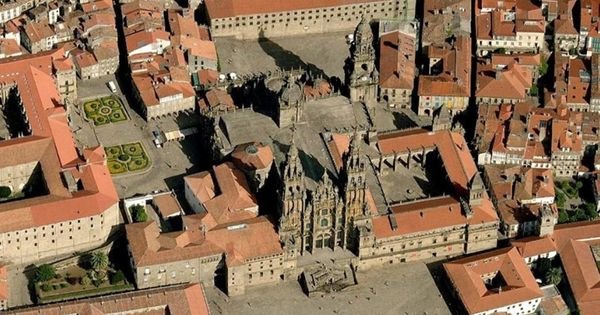
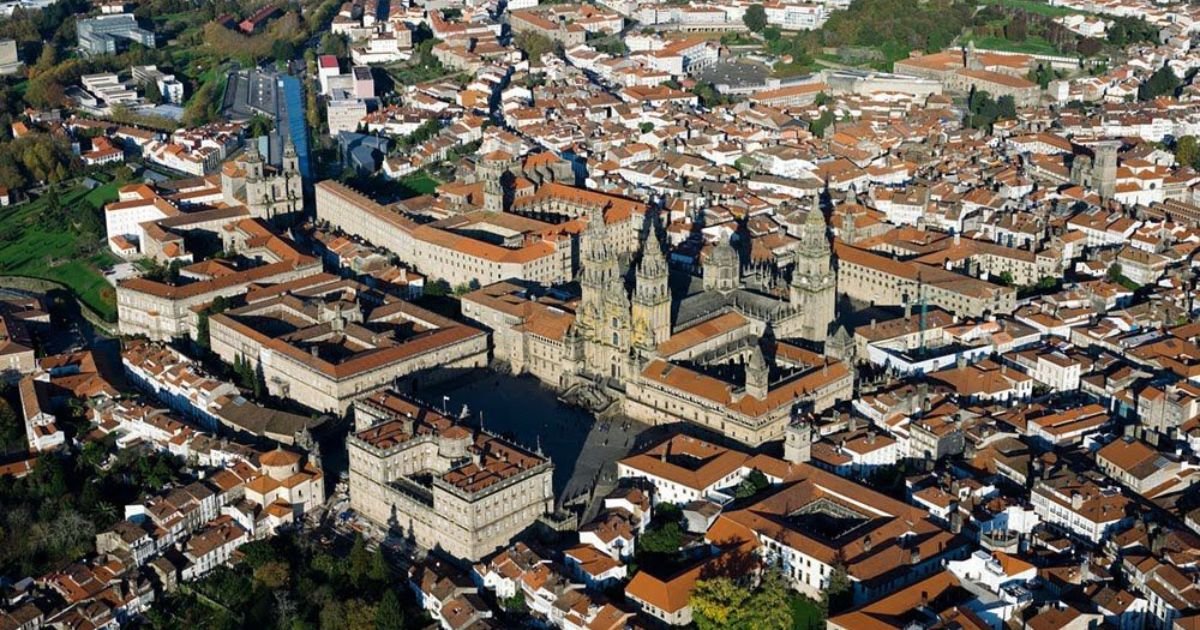
These conditions were established to encourage penance, reflection and prayer during the Holy Year. It is also customary during the Holy Year to enter the Cathedral of Santiago de Compostela through the Holy Door, which opens onto Praza da Quintana and is only opened on this solemn occasion.
Through the mediation of the Church, the jubilee grants the faithful who fulfil these conditions the grace of the plenary indulgence, the complete remission of the temporal punishment due for their sins. According to Catholic doctrine, this indulgence does not forgive the guilt of sin but frees the sinner from the temporal punishment that remains after the sin has been forgiven in the sacrament of confession. Taking part in the Holy Year is therefore seen as an opportunity to renew one’s faith and relationship with God, as well as to obtain the grace of the plenary indulgence.
Past and future Holy Years of Santiago: the full list
These are all the Jacobean Holy Years of the 20th and 21st centuries. Already celebrated: 1909, 1915, 1920, 1926, 1937–1938, 1943, 1948, 1954, 1965, 1971, 1976, 1982, 1993, 1999, 2004, 2010 and 2021–2022. Coming up: 2027, 2032, 2038, 2049, 2055, 2060, 2066, 2077, 2083, 2088 and 2094. In the table, each row moves forward 28 years (a full calendar cycle) and each column shows the gap between one Holy Year and the next.
| +11 | +6 | +5 | +6 | |
|---|---|---|---|---|
| +28 | 1909 (+12) | 1915 | 1920 | 1926 |
| +28 | 1937 – 1938 | 1943 | 1948 | 1954 |
| +28 | 1965 | 1971 | 1976 | 1982 |
| +28 | 1993 | 1999 | 2004 | 2010 |
| +28 | 2021 – 2022 | 2027 | 2032 | 2038 |
| +28 | 2049 | 2055 | 2060 | 2066 |
| +28 | 2077 | 2083 | 2088 | 2094 |
The 6-5-6-11 sequence of Holy Years in the 19th, 20th and 21st centuries results from the combination of the leap-year rhythm and the seven-day week. If there were no leap years, there would be a Holy Year every seven years. However, because years divisible by 100 are only leap years if they are also divisible by 400, gaps of seven or twelve years between two consecutive Holy Years can occur at the turn of a century.
Bear in mind that any change in the sequence of leap years automatically alters the cadence of Holy Years. This happened with the Gregorian reform of 1582 and can therefore also happen in century years that are not multiples of 400.
The table is accurate for the 20th and 21st centuries, because the year 2000 was a leap year. In the following centuries the cadence will change, since 2100, 2200 and 2300 will not be leap years (they are divisible by 100 but not by 400). The COVID-19 health crisis meant that the Holy Year was celebrated over two consecutive years (2021–2022), something that had only happened before in 1937–1938, during the Spanish Civil War.
The last Holy Year of the 21st century will be 2094; the first of the 22nd century will be 2106 (12 years later) and the next 2117 (11 years later), so the 6-5-6-11 cadence of the previous two centuries will be broken. The same happened at the turn of the 19th to the 20th century: the last Holy Year of the 19th century was 1897 and the first of the 20th was 1909, twelve years later, because 1900 was not a leap year.
History of the Holy Year of Santiago
Pope Callixtus II established the Compostela Jubilee Holy Year in 1122 for the year 1126, having himself been a pilgrim to Santiago de Compostela while Archbishop of Vienne in France.
On 27 February 1120, the bull Omnipotentis Dispositione raised Santiago de Compostela to archiepiscopal rank, transferring the metropolitan see of Mérida there, thus fulfilling the wishes of Diego Gelmírez, bishop of Compostela between 1100 and 1139, with the consent of King Alfonso VII of León (the Emperor), whose uncle Callixtus II was through the marriage of his brother Raymond of Burgundy to the infanta Urraca of León and Castile, daughter of Alfonso VI of León.
In 1122, as the last stone of the cathedral of Santiago was being laid, Callixtus II granted the privilege of celebrating the Holy Year of Santiago regularly from 1126 onwards, whenever the feast of Saint James, 25 July, fell on a Sunday, so that pilgrims could gain the same graces in Compostela as were granted in Rome during the jubilee years, which there tended to coincide every twenty-five years.
The privilege of Callixtus II was reaffirmed and extended by other popes, including Eugene III and Anastasius IV. In 1178, Alexander III declared in the bull Regis aeterni, dated 25 July, that the privilege would be perpetual and placed the Holy Year of Santiago on a par with those of Rome and Jerusalem.
These provisions had a great impact in the Middle Ages, contributing significantly to the growth of pilgrimages from all over Europe along the Camino de Santiago.
The most recent Holy Years of Santiago were those of 1993, 1999, 2004, 2010 and 2021. The last of these, coming eleven years after the previous one, was exceptionally extended until 31 December 2022 because of the COVID-19 pandemic; Pope Francis approved the extension, as announced by the nuncio Bernardito Auza.
It was the second time in history that the Holy Year was celebrated over two consecutive years. The first had been during the Spanish Civil War, when the Holy Year of 1937 was also extended throughout 1938 at the request of the Compostela prelate Tomás Muniz de Pablos, granted by Pope Pius XI.
See also: