The Camino de Santiago, one of the most important and ancient pilgrimages in the world, has been walked by millions of people over the centuries. This journey is not only a physical challenge, but also a unique spiritual and cultural experience. On finishing the route, many pilgrims seek to obtain the Compostela, a document certifying their effort and devotion. In this article, we take an in-depth look at what the Compostela is, its history, the requirements for obtaining it, and why it is such a special recognition for pilgrims.
History and Meaning of the Compostela
The Origin of the Pilgrimage and the Creation of the Compostela
The pilgrimage to the tomb of the Apostle Saint James in the Cathedral of Santiago in the city of Santiago de Compostela began to gain popularity in the 9th and 10th centuries, when the apostle’s tomb was discovered. Since then, millions of people have walked the various routes leading to Santiago in search of a spiritual and religious connection.
As pilgrimages grew, the need arose to validate these journeys according to established religious norms. Originally, pilgrims used scallop shells, a symbol associated with Saint James, to certify their journey. However, because these could easily be faked, church authorities decided to create an official document: the Compostela. This document, first issued in the 13th century, became the official certificate confirming completion of the pilgrimage.
The Compostela in the Middle Ages and Its Evolution
In the Middle Ages, the Compostela not only served as proof of the pilgrimage, but also granted pilgrims certain privileges. For example, those who reached Santiago with their Compostela could receive free lodging at the Hospital Real, an institution founded by the Catholic Monarchs in the 16th century, which later became the Hostal de los Reyes Catolicos. This hospital offered three days of free lodging to pilgrims who presented the Compostela, a tradition that has left its mark on the culture of the Camino.
Over time, the importance of the Compostela has remained, although its uses and meanings have evolved. Today, the Compostela is still a document of great spiritual value, and obtaining it is the final goal of many pilgrims who walk the Camino de Santiago.
What Is Written on the Compostela?
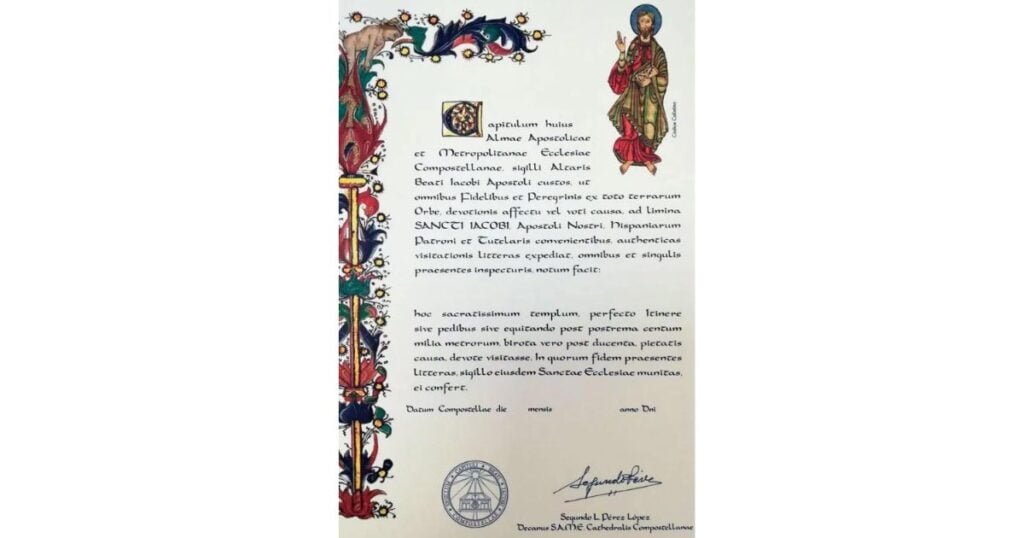
This is the text that appears on the Compostela (original Latin, with an English translation below):
Capitulum huius Almæ Apostolicæ et Metropolitanæ Ecclesiæ Compostellanæ, sigilli Altaris Beati Iacobi Apostoli custos, ut omnibus Fidelibus et Peregrinis ex toto terrarum Orbe, devotionis affectu vel voti causa, ad limina Sancti Iacobi, Apostoli Nostri, Hispaniarum Patroni et Tutelaris convenientibus, authenticas visitationis litteras expediat, omnibus et singulis præsentes inspecturis, notum facit:
…
hoc sacratissimus templum, perfecto Itinere sive pedibus sive equitando post postrema centum milia metrorum, birota vero post ducenta, pietatis causa, devote visitasse.
In quorum fidem præsentes litteras, sigillo eiusdem Sanctæ Ecclesiæ munitas, ei confert.
Datum Compostellæ die (…) mensis (…) anno Dni (…).
The Chapter of this Holy Apostolic and Metropolitan Cathedral Church of Compostela, keeper of the seal of the Altar of the Apostle Saint James, hereby certifies to all who read this document that, to all the Faithful and pilgrims arriving from every corner of the Earth, out of devotion or in fulfilment of a vow or promise, who make the pilgrimage to the Tomb of the Apostle, Our Patron and Protector of the Spains:
…
has devoutly and in a Christian spirit visited this most sacred temple, having completed, on foot or on horseback, the last hundred kilometres, or by bicycle the last two hundred, in a Christian spirit.
In witness whereof, I hereby deliver this document, endorsed with the seal of this same Holy Church.
Given at Compostela, on the (…) day of the month of (…), in the Year of Our Lord (…).
Requirements to Obtain the Compostela
What Do You Need to Obtain the Compostela?
Obtaining the Compostela is not simply a matter of completing the Camino de Santiago. There are certain requirements that must be met to receive this treasured document.
- Motivación Espiritual o Religiosa: Para recibir la Compostela, los peregrinos deben realizar el Camino con motivos religiosos, espirituales o de búsqueda interior. Si la motivación es puramente cultural, deportiva o recreativa, no se otorgará la Compostela.
- Distancia Recorrida: Los peregrinos deben completar al menos 100 kilómetros a pie o a caballo, o 200 kilómetros en bicicleta. Estas distancias deben recorrerse por rutas oficiales del Camino de Santiago.
- Credencial del Peregrino: Es fundamental portar la Credencial del Peregrino, un documento que debe ser sellado en cada etapa del Camino. Los sellos deben provenir de iglesias, albergues, ayuntamientos, o incluso cafeterías y otros establecimientos a lo largo de la ruta. Es necesario obtener al menos dos sellos por día en los últimos 100 o 200 kilómetros, dependiendo del medio de transporte.
- Ruta y Orden de las Etapas: Es posible completar el Camino en varias etapas, siempre y cuando se respeten el orden geográfico y cronológico. Esto significa que los peregrinos pueden realizar el Camino en diferentes periodos de tiempo, pero deben retomar el recorrido en el mismo punto donde lo dejaron la última vez.
The Importance of the Pilgrim Credential
The Pilgrim Credential is an essential document for anyone wishing to obtain the Compostela. This spiritual passport lets pilgrims record their journey, having it stamped at the places they pass through. It is not only proof of the distance covered, but also a keepsake of every stage of the Camino.
The Credential must be properly stamped, and the stamps must clearly show the place and date. This confirms that the pilgrim has covered the required distance and has followed a coherent route. On arriving in Santiago, this credential is presented at the Pilgrim’s Office to verify the route and obtain the Compostela.
Collecting the Compostela: Where and How
The Collection Process in Santiago de Compostela
Once they have completed the Camino de Santiago, pilgrims should head to the Pilgrim’s Welcome Office, located on Rua das Carretas, near the Cathedral of Santiago. Here, they can request the Compostela by presenting their Pilgrim Credential.
The process for collecting the Compostela usually includes the following steps:
- Preregistro en Línea: Para agilizar el proceso, los peregrinos pueden preregistrarse en línea antes de llegar a la Oficina del Peregrino. Este registro previo asigna un código QR que facilita el acceso a la oficina y reduce los tiempos de espera.
- Verificación de la Credencial: Una vez en la oficina, el personal revisará la Credencial del Peregrino para asegurarse de que cumple con los requisitos. Esto incluye la revisión de los sellos, las fechas, y la coherencia de la ruta seguida.
- Emisión de la Compostela: Si todo está en orden, se emitirá la Compostela en nombre del peregrino. Este documento es completamente gratuito y se presenta en un formato impreso, con el nombre del peregrino escrito en latín.
Dirección:
15705, Santiago de Compostela
A Coruna – SPAIN
Phone: +34 981 568 846
E-mail: oficinadelperegrino@catedraldesantiago.es
Opening Hours and Special Considerations
The Pilgrim’s Office has specific opening hours, generally opening in the morning and closing in the afternoon, although during busy periods, such as summer, it may extend its hours. It is important to plan your arrival in Santiago with these hours in mind to avoid any inconvenience.
It is also a good idea to arrive early, especially on busy days, as queues can be long and the process can take time. Patience is key, since many pilgrims arrive at the same time, especially those who finish the Camino on popular dates such as 25 July, the feast day of the Apostle Saint James.
The Compostela for Children and Families
Special Requirements for Minors
Children can also obtain the Compostela, provided they meet certain requirements. According to the Archdiocese of Santiago, minors must be at least 9 years old and must have made their First Communion, or be preparing for it. This is because, from this age onward, children are considered to have the maturity to understand the spiritual meaning of the pilgrimage.
For children under 9, although they cannot receive their own individual Compostela, their names can appear on the Compostela of their parents or companions, as a way of recognising their part in the pilgrimage.
The Camino as a Family: A Shared Experience
Walking the Camino de Santiago as a family is a rewarding experience that strengthens family bonds and offers a unique opportunity to share a spiritual adventure. However, it is important to plan the trip with the children’s abilities and needs in mind, making sure the chosen route and walking pace suit them.
The fact that children can obtain the Compostela if they meet the requirements is an extra incentive for families, as it allows the youngest members to feel part of the tradition and receive recognition for their effort.
Benefits of Obtaining the Compostela
Historical and Modern Advantages of the Compostela
Historically, the Compostela granted pilgrims certain benefits, such as free lodging at the Hospital Real de Santiago. Although that specific benefit no longer exists today, the Compostela remains a document of great value, both on a personal and a spiritual level.
One of the modern benefits of the Compostela is access to certain services and privileges that are still in place. For example, the first ten pilgrims who present their Compostela each day at the Hostal de los Reyes Catolicos receive a free breakfast and dinner, a tradition dating back to when the hostal was a hospital for pilgrims.
A Spiritual and Personal Recognition
Beyond its tangible benefits, the Compostela is a recognition of a pilgrim’s effort, dedication and faith. For many, receiving the Compostela is the culmination of a journey of self-discovery and spirituality. It is a symbol of the personal transformation many experience during the Camino de Santiago.
This document also carries emotional and sentimental value, as it represents the achievement of completing one of the oldest and most revered pilgrimages in the world. It is a keepsake that many pilgrims proudly hold on to, one that reminds them of the effort and experiences of the Camino.
“Compostelana”: A Common Mistake
The Common Confusion Between “Compostela” and “Compostelana”
It is common to hear some pilgrims, especially those new to the Camino, refer to the Compostela as the “Compostelana“. However, this term is incorrect and does not officially exist. The correct word is “Compostela“, and it is important to use the right term.