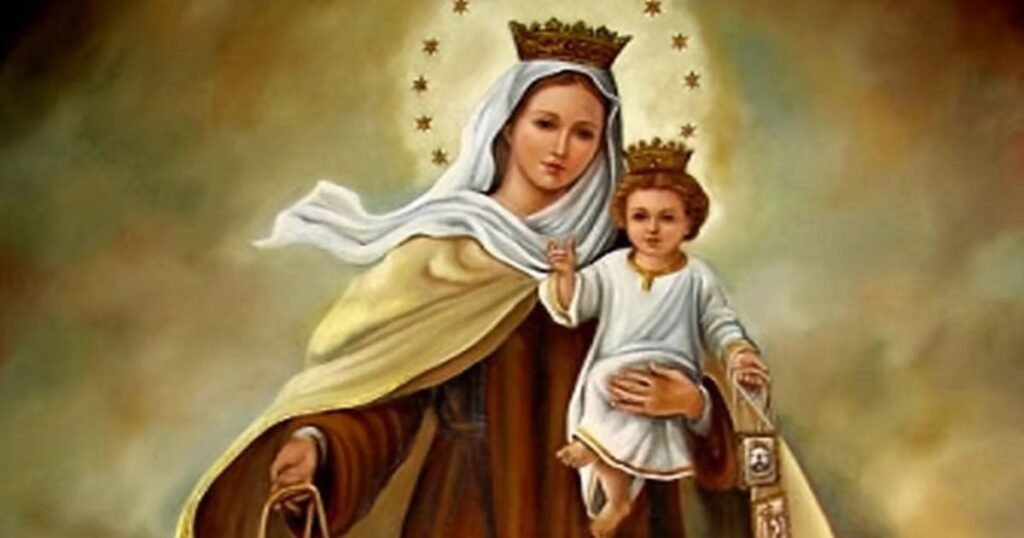
Our Lady of Mount Carmel
Our Lady of Mount Carmel is one of the most venerated Marian devotions in the Catholic world, especially in countries with a Hispanic tradition. Her feast day is celebrated on 16 July and is deeply rooted in maritime and religious communities across Europe and Latin America.
Origin and Meaning
The title “Our Lady of Mount Carmel” comes from Mount Carmel in Israel, whose name derives from the Hebrew Karmel, meaning “garden of God”. On this mountain, the prophet Elijah lived and defended faith in the God of Israel against the priests of Baal. Inspired by Elijah, a group of Christian hermits settled on Mount Carmel around the 12th century, forming the Order of Our Lady of Mount Carmel, known as the Carmelites.
The Scapular and the Promise
According to Carmelite tradition, on 16 July 1251, the Virgin Mary appeared to Saint Simon Stock, superior general of the Order, and gave him the scapular as a sign of protection and salvation for those who wore it with devotion. This garment became a distinctive symbol of the Carmelites and of the faithful who seek the intercession of Our Lady of Mount Carmel.
A Worldwide Devotion
Devotion to Our Lady of Mount Carmel has spread widely:
- Spain: She is the patroness of sailors and of the Spanish Navy. In many coastal towns, such as San Fernando (Cadiz), maritime processions are held in her honour.
- Latin America:
- Chile: She is regarded as the Queen and Patroness of the country, as well as of its Armed Forces and Carabineros.
- Colombia: Patroness of drivers and of the National Army.
- Peru: Patroness of criollo culture and perpetual mayoress of Lima.
- Venezuela: Patroness of the Army and of drivers.
- Bolivia: Patroness of the nation and of its Armed Forces.
Notable Celebrations
- In Spain, especially in coastal towns, maritime processions are held in which the image of the Virgin is carried on decorated boats, accompanied by other vessels and popular celebrations.
- In Peru, the feast of Our Lady of Mount Carmel in Paucartambo is one of the most iconic, declared Cultural Heritage of the Nation, blending traditional dances, masses and processions that draw thousands of the faithful.