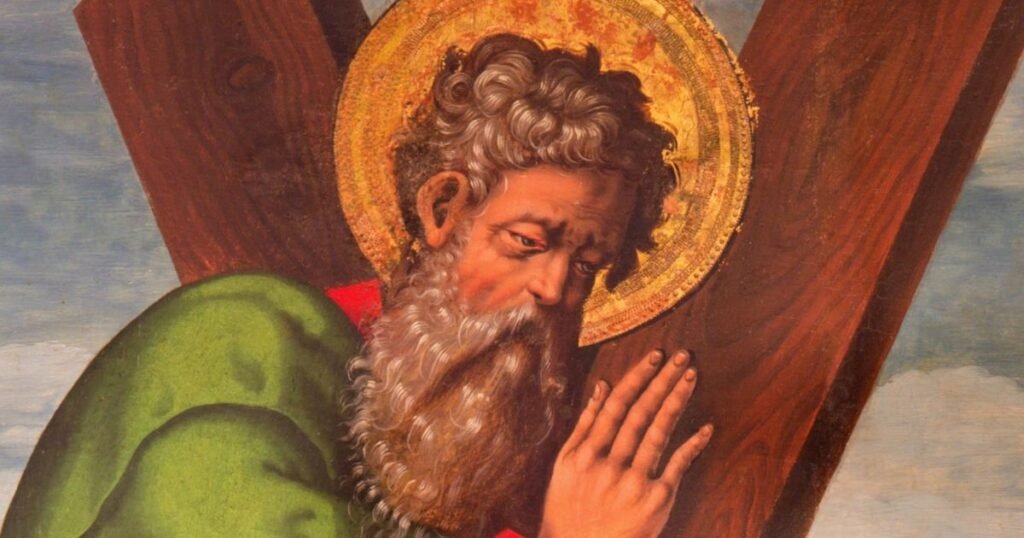
Saint Andrew the Apostle
Saint Andrew the Apostle is a central figure in Christian tradition. Brother of Saint Peter and one of the first disciples of Jesus, Saint Andrew is remembered not only as a tireless evangelist, but also as the founder of the Church in Constantinople. Celebrated every November 30th, his life and legacy have left a deep mark on Christian communities in both East and West. This article explores his history, his role in the Gospels, and the impact of his relics on Christian devotion.
Saint Andrew in the Gospels: Disciple, Evangelist, and Witness to Miracles
His Encounter with Jesus and the Apostolic Call
Saint Andrew was born in Bethsaida, a town beside the Sea of Galilee, and worked as a fisherman alongside his brother Pedro. According to the Gospel of John, Andrés was a disciple of John the Baptist before meeting Jesus. When John pointed to Jesus as the “Lamb of God”, Andrés did not hesitate to follow him, thus becoming the “first called” (Protocletos, in Greek). He was also the one who introduced his brother Pedro to Jesus, marking the beginning of both men’s discipleship.
In the Gospels of Matthew and Mark, it is recounted how Jesus called Andrés and Pedro while they were fishing, promising them that they would become “fishers of men”. This call symbolises the mission of spreading the message of salvation and drawing souls to the faith.
His Part in Miracles and Key Moments
Saint Andrew played a notable role in several episodes recounted in the Gospels. One of the most significant is the miracle of the multiplication of the loaves and fishes. According to the Gospel of John, it was Andrés who pointed out a boy with five loaves and two fish, which Jesus used to feed a crowd of 5,000 people.
Another notable moment occurred when some Greeks wished to meet Jesus. Andrés, together with Philip, arranged the meeting, showing his role as an intermediary between seekers of faith and the Messiah.
Saint Andrew in Christian Tradition
His Evangelising Mission in the East
After the resurrection of Jesus and the event of Pentecost, Saint Andrew undertook his evangelising mission. According to tradition, he preached in regions such as Scythia, Thrace and Greece, even reaching Kiev, Ukraine, and the shores of the Black Sea. These regions recognise him as their patron, owing to his fundamental role in spreading Christianity.
In Constantinople, Saint Andrew established an episcopal see, marking the beginning of what would later become the Patriarchate of Constantinople. This connection has led the Orthodox Church to venerate him as one of its principal saints.
Martyrdom in Patras
Tradition holds that Saint Andrew was martyred in the city of Patras, in Achaea, Greece. He was crucified on an “X”-shaped cross, known as the “Cross of Saint Andrew”. This type of cross, it is said, was chosen at Andrés’s own request, as he considered himself unworthy of being crucified on a cross like that of Jesus. For two days he preached from the cross until his death, showing unwavering faith.
The Relics of Saint Andrew: Symbols of Faith and Unity
The Dispersal and Custody of the Relics
After his martyrdom, the relics of Saint Andrew became objects of veneration. In the year 357, they were moved to Constantinople by order of Emperor Constantine I. Later, during the Crusades, some of these relics were taken to Amalfi, Italy, while others remained in Greece.
The Head of Saint Andrew and Its Return to Greece
The head of Saint Andrew, one of his most venerated relics, was taken to Rome in the 15th century to protect it from Muslim invasions. It remained in St Peter’s Basilica until 1964, when Pope Paul VI returned it to Patras as a gesture of reconciliation with the Orthodox Church. Today, it is kept in Saint Andrew Cathedral in Patras, along with other relics such as fragments of his cross and a finger.
Iconography and Patronage of Saint Andrew
The Cross of Saint Andrew in History and Culture
Saint Andrew is commonly depicted in Christian art crucified on an “X”-shaped cross. This symbol became popular during the Middle Ages and was incorporated into standards, flags and coats of arms, as in the case of the Russian navy and the Duchy of Burgundy. The “Cross of Saint Andrew” is also an emblem present in various flags and Christian traditions.
Saint Andrew as Patron of Nations and Communities
Saint Andrew is the patron saint of countries such as Scotland, Russia, Romania and Ukraine, as well as of various cities and Christian communities. His feast day on November 30th marks the beginning of Advent in many liturgical traditions, highlighting his role as a forerunner of Christ’s message.