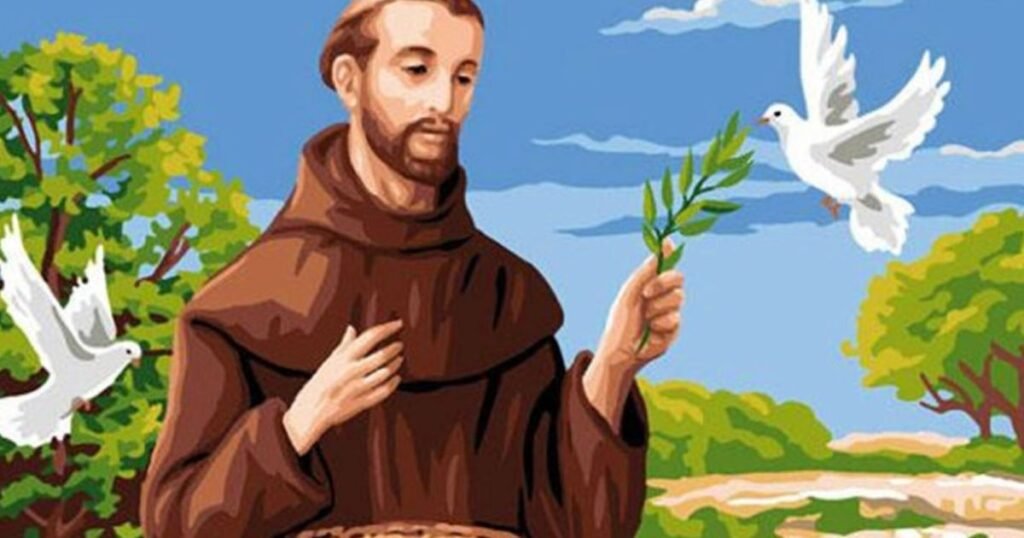
Saint Francis of Assisi: The Saint
Who was Saint Francis of Assisi?
Saint Francis of Assisi is one of those figures who needs no introduction, yet deserves to be rediscovered again and again. He was a man who, leaving behind wealth, comfort and privilege, embraced poverty and nature with an overflowing love. He was born Giovanni di Pietro Bernardone in Assisi, Italy, around the year 1181.
Early years and family
Francisco was born into a well-off family. His father was a prosperous cloth merchant, and his mother, of French origin, influenced his early upbringing. He loved parties, friends and luxury… yes, he was the typical medieval party-loving young man.
From rebellious youth to seeker of God
But something in him changed. An experience of illness and a brief spell in war made him reflect deeply. What was the point of so much wealth if the soul was empty?
The spiritual calling
Francisco’s conversion was not instantaneous. It was a painful, yet liberating, process. He began to have visions, to hear the voice of God in everyday life and… in the most unexpected places.
The total renunciation of material things
One day, in front of the bishop and his own father, Francisco stripped himself — literally — of all his clothes and renounced his inheritance. From that moment on, he only wished to be called “the little poor man of Assisi”.
His relationship with nature
Francisco did not see nature as something separate, but as a sister. Can you imagine speaking to the sun as if it were your brother? Well, he did. And he felt it that way, with his whole heart.
Brother sun and sister moon
In his famous “Canticle of the Creatures”, Francisco sings to the sun, the moon, the wind, the water and even death. Everything was part of the same home: creation.
Animals as part of creation
Legend has it that he preached to the birds and that a fierce wolf became his friend. Miracle or a deep connection with all living things? Perhaps both.
Founding of the Franciscan Order
Francisco did not plan to found a religious order. But others began to follow him. Soon, what we know today as the Order of Friars Minor emerged.
Why was this order revolutionary?
Because it broke the mould. No castles, no power. Only humility, service, brotherhood and joy. They walked barefoot, begged for bread and preached by example.
Rules of Franciscan life
The rule was simple yet demanding: to live the Gospel to the letter. No possessions, no violence, with pure love. And that, although it may sound utopian, transformed the world.
His impact on the Church and the world
Francisco was neither a priest nor a bishop, but his influence was (and still is) immense. He touched the hearts of rich and poor, religious and lay people alike.
Influence on the papacy
Even Pope Innocent III had a vision of Francisco holding up the Church as it was collapsing. Coincidence, or a sign of his prophetic mission?
A global spiritual legacy
Today there are Franciscans all over the world. And not only religious people. His message transcends religions and cultures. Francisco is loved by Christians, environmentalists and pacifists alike.
Miracles attributed to San Francisco
Yes, he was a saint in life. But there are also accounts of miracles after his death.
Stigmata: a divine sign?
He is said to have received the stigmata of Christ: wounds on his hands, feet and side. It was the first documented case. For many, a clear sign of his union with Jesus.
Other extraordinary events
Healings, visions, apparitions… there are numerous accounts of people who experienced the supernatural through his intercession.
Canonisation and liturgical feast
Only two years after his death, he was canonised by Pope Gregory IX. His feast is celebrated on 4 October, and it does not go unnoticed, especially among animal lovers.
San Francisco today
Although he lived in the 13th century, Francisco still speaks to us today with renewed force.
What does he teach us in the 21st century?
He reminds us that happiness lies not in having more, but in needing less. That peace is built through simple gestures. And that every living being deserves respect.
San Francisco and modern ecology
He is the patron saint of environmentalists for a reason. His vision of the Earth as a sister is more relevant than ever. What if we listened a little more to Francisco and a little less to consumerism?
Saint Francis of Assisi
Saint Francis of Assisi was not just another saint. He was a spiritual revolutionary, a lover of life, a dreamer with his feet on the ground and his heart in heaven. He challenges us to look beyond material things, to embrace simplicity, and to live with a radical love that transforms the world.
Frequently Asked Questions (FAQs)
1. Where was Saint Francis of Assisi born?
He was born in Assisi, Italy, around the year 1181.
2. What was San Francisco’s most famous miracle?
Receiving the stigmata of Christ is considered his most notable miracle.
3. What teachings did San Francisco leave us?
Humility, voluntary poverty, love of nature, brotherhood and peace.
4. What was his relationship with animals?
He considered them his brothers and sisters. He spoke to them and protected them.
5. Why is he still so relevant today?
Because his message of love for creation and simplicity is a guide in the face of today’s environmental and spiritual crisis.