Profile
Catedral de Santa Maria de Astorga
The Catedral de Santa Maria de Astorga, located in the city of Astorga, Leon Province, is one of the finest works of Spain’s religious and artistic heritage. Construction began in 1471 and continued into the 18th century, giving it a unique stylistic richness that blends Gothic, Renaissance, Baroque and Neoclassical elements.
History of the Catedral de Astorga
The current cathedral stands on the site of earlier churches, including a pre-Romanesque one and a Romanesque one consecrated in 1069. Construction of the Gothic building began with the east end in 1471, possibly under the direction of Juan de Colonia and his son Simon. In the centuries that followed, Renaissance and Baroque elements were added, such as the south portal and the main facade, respectively.
Architecture of the Catedral de Astorga
West Facade
The main facade, in Baroque style, was built in the early 18th century. It resembles a stone altarpiece and displays rich iconography, including scenes from the Gospel and figures such as the Assumption of the Virgin and the Apostle Saint James. Its two square towers, over 60 meters tall and topped with slate spires, stand out prominently.
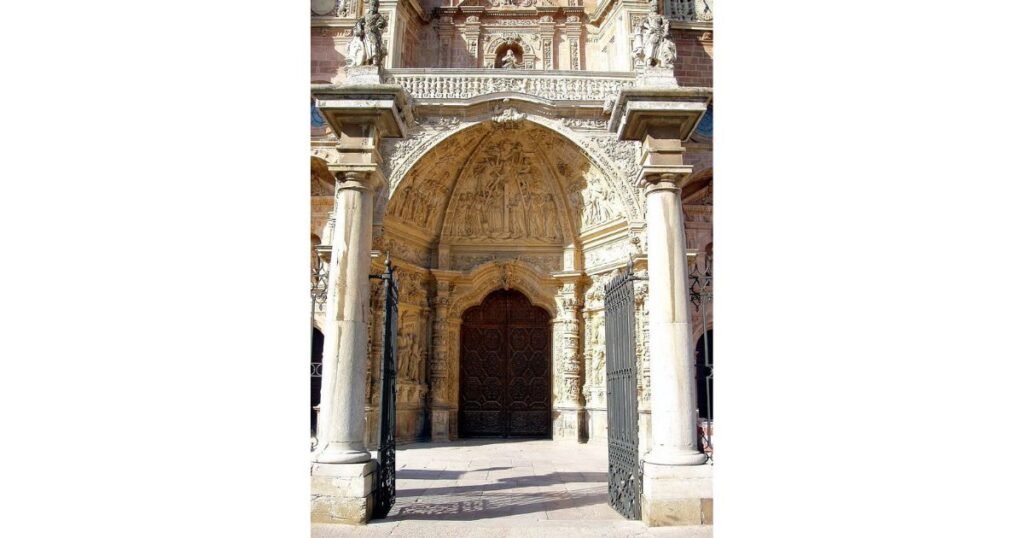
Renaissance Portal
The south portal, created by Rodrigo Gil de Hontanon in 1551, is an outstanding example of Spanish Renaissance work. It consists of two sections and a pediment, with a round arch flanked by columns bearing Plateresque capitals. The tympanum depicts God the Father blessing and holding the orb.
Floor Plan and Nave
The cathedral has a basilica floor plan with three naves built over the Romanesque layout, chapels set between buttresses, and three polygonal apses. The vaults are ribbed, and the pillars supporting them extend upward to merge with the ribs, without capitals.
Main Altarpiece
A crowning work of Spanish Romanism, the main altarpiece was created between 1558 and 1584 by sculptor Gaspar Becerra. It is divided into three tiers and five bays, with sculptures depicting the life of Christ and the Virgin. The figures of the Assumption and the Coronation of the Virgin in the central bay stand out.
Other Altarpieces
- Altarpiece of the Virgen de la Majestad: Located in the smaller apsidal chapel on the Gospel side, it was sponsored by Bishop Alfonso Mejia de Tovar. Its titular image is a 12th-century Romanesque Virgin.
- Altarpiece of Saint Teresa of Jesus: Commissioned to mark the saint’s canonization in 1622, it is Mannerist in style and depicts the saint in the act of writing.
- Altarpiece of Saint John the Baptist: Sponsored in 1655 by precentor Juan Ramos, it features a sculpture attributed to Mateo de Prado, depicting Saint John listening to the word of God.
Choir Stalls
The Renaissance choir stalls, carved in walnut wood, date from the second quarter of the 16th century. They were the work of several woodcarvers, including Juan de Colonia and Nicolas de Colonia. They feature an extensive iconographic program with scenes from the Old and New Testaments.
Organ
The cathedral’s organ, housed in a Baroque case, has 2,830 pipes and three keyboards. It was restored in 1880 by Juan de Amezua and in 1985 by Federico Acitores.
Cloister and Adjoining Buildings of the Catedral de Astorga
The cloister, in Neoclassical style, was built in 1755 by Gaspar Lopez. The cathedral forms a complex that includes the Diocesan Archive, the Chapter Archive, the Museum and the Hospital de San Juan Bautista, founded in the Middle Ages. Almost adjoining it stands the Palacio Episcopal de Astorga, a Modernist work by Antoni Gaudi.
Cultural and Religious Importance of the Catedral de Astorga
The Catedral de Astorga is a fundamental landmark on the Camino de Santiago Frances, embodying the history of Jacobean architecture. It was declared a National Monument in 1931 and, since 2015, has formed part of the World Heritage listing as an associated element of the “Routes of Santiago de Compostela: Camino Frances and Routes of Northern Spain.”
Catedral de Astorga
The Catedral de Santa Maria de Astorga is a sublime expression of Spain’s artistic and spiritual evolution, bringing together centuries of history in a structure that continues to inspire the faithful and visitors alike.
Camino de Santiago Frances >> Leon Province >> Astorga >> Cathedral de Astorga
Map
Sorry, no records were found. Please adjust your search criteria and try again.
Sorry, unable to load the Maps API.