Melide and Japan United by the Camino: Unveiling of the Commemorative Marker for the Shikoku Henro Route
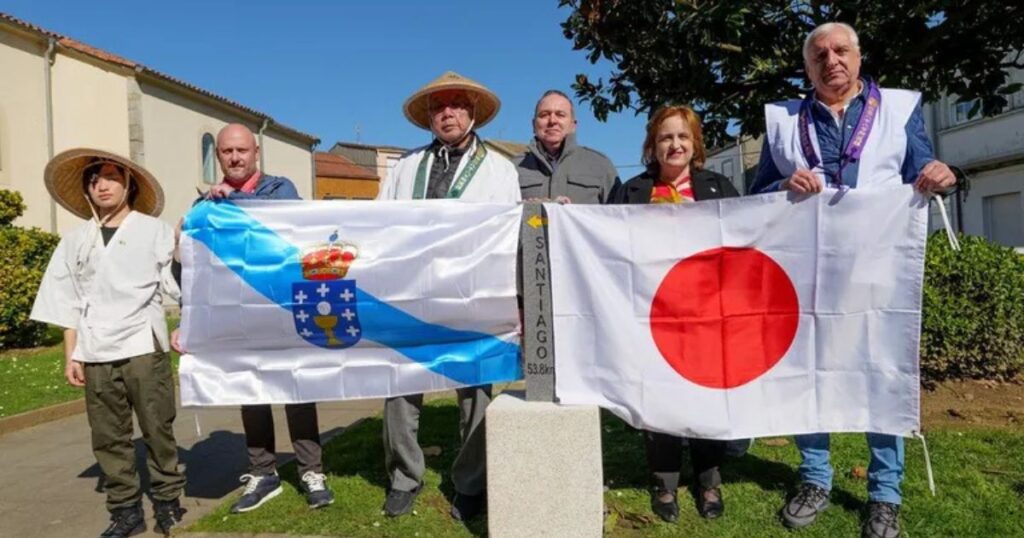
The Galician town of Melide, a strategic point where the Camino de Santiago Francés and the Camino Primitivo meet, held a historic event on 1 March 2025 that strengthens the cultural ties between Galicia and Japan. The installation of a commemorative marker for the Shikoku Henro route, one of the oldest and most emblematic pilgrimages in Japan, formalises the twinning of both routes and establishes Melide as a place of international encounter.
The Shikoku Henro Route: A Thousand-Year-Old Japanese Tradition
The Shikoku Henro is a circular route of 1,200 kilometres founded in the 9th century, passing through 88 Buddhist temples on the island of Shikoku. Considered one of Asia’s most important spiritual pilgrimages, it shares with the Camino de Santiago values of effort, faith, perseverance and hospitality.
The twinning between the two routes, formalised some years ago, aims to strengthen cultural and spiritual cooperation between East and West, encouraging the exchange of pilgrims and spreading the universal values linked to the pilgrimage experience.
Unveiling Ceremony in Melide
The event was attended by prominent figures, including:
- Hirofumi Matsuoka, president of the Japanese body responsible for the Shikoku Henro, who travelled specially to unveil the marker.
- José Manuel Pérez, mayor of Melide, who highlighted the town’s importance as a meeting point for Jacobean routes.
- Olga Iglesias, mayoress of Triacastela and president of the Mancomunidade de Concellos do Camino Francés, who stressed the importance of strengthening the international ties of the Jacobean route.
With this unveiling, Melide joins Triacastela and Sarria, towns that had already installed their own commemorative markers for the twinning with Shikoku.
Melide, a Crossroads of Routes and a Jacobean Symbol
The town of Melide holds a privileged place in Jacobean geography:
- It is the meeting point of the Camino Francés and the Camino Primitivo, making it an essential stop for thousands of pilgrims heading towards Santiago de Compostela.
- Its historical and artistic heritage includes the Romanesque church of Santa María de Melide and the Cruceiro de San Roque (Wayside Cross of Saint Roch), considered one of the oldest in Galicia.
- The town is also famous for its traditional cuisine, with pulpo á feira (Galician-style octopus) as the undisputed star of the pilgrim experience.
The installation of the Japanese marker reinforces this identity, adding an international dimension that establishes Melide as a leading cultural destination.
A Cultural Bridge Between Galicia and Japan
The placement of this commemorative marker is not merely a symbolic gesture, but a far-reaching initiative:
- Mutual recognition: both routes stand as globally recognised models of spiritual and cultural pilgrimage.
- International tourism promotion: the twinning boosts Galicia’s profile in Japan and vice versa, attracting foreign pilgrims.
- A bond between communities: the Galician towns of the Camino de Santiago Francés and the Camino Primitivo are twinned with Japanese temples and cities, strengthening cultural cooperation.
The Future of the Twinning Between the Camino and the Shikoku Henro
The unveiling in Melide is part of a broader effort to raise the profile of the twinning between the Camino de Santiago and the Shikoku Henro. Next steps include:
- Extending the installation of markers to more Galician towns along the Camino.
- Developing joint cultural and academic exchange programmes.
- Building international promotion routes that strengthen the flow of Japanese pilgrims towards Galicia.
Melide as an International Landmark on the Camino
With the installation of the commemorative Shikoku Henro marker, Melide reaffirms its position as a gateway between cultures. At this meeting point of Jacobean routes, Galicia and Japan join hands to build a shared legacy of spirituality, hospitality and cultural cooperation.
The Camino de Santiago and the Shikoku Henro move forward together as universal symbols of pilgrimage, and Melide has become a place where that union takes on tangible form.