Homeless Jesus in Santiago de Compostela: A Symbol of Faith, Solidarity and Reflection
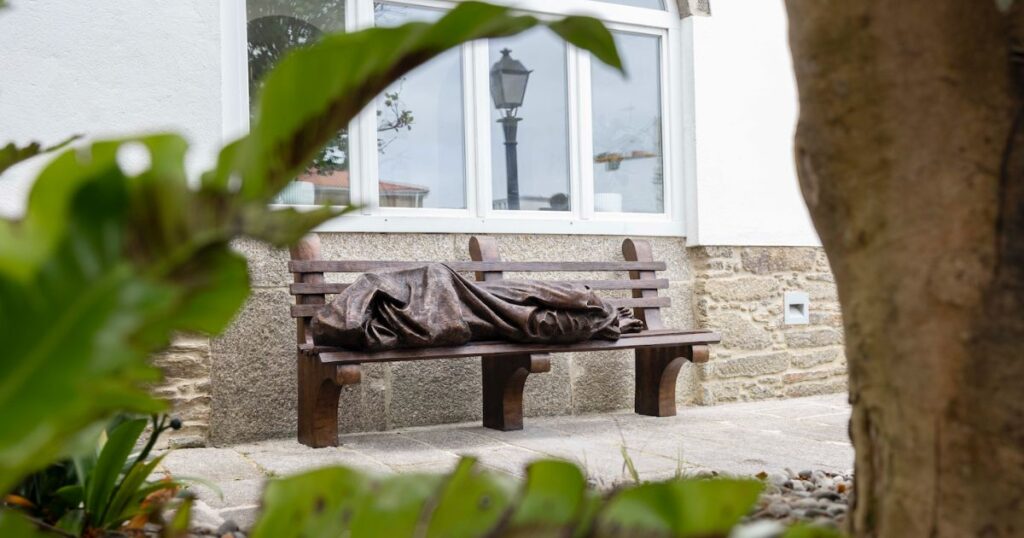
The sculpture “Homeless Jesus”, by the renowned Canadian artist Timothy Schmalz, has found a place of honour in the garden of the Pilgrim’s Reception Office in Santiago de Compostela, the final destination of the Camino de Santiago Francés. This piece, full of deep spiritual and social symbolism, has quickly become an icon for pilgrims and visitors seeking a moment of introspection and connection with the Christian message of compassion and solidarity.
The Powerful Message Behind “Homeless Jesus”
“Homeless Jesus” is not just a work of art; it is a call to empathy. The sculpture shows Jesus lying on a bench, covered by a blanket, his face hidden, with only his bare feet marked by the wounds of the crucifixion revealing his identity.
The piece is inspired by the Gospel of Matthew 25:35-40, a passage that emphasises Christ’s presence in the most vulnerable:
“For I was hungry and you gave me food, I was thirsty and you gave me drink, I was a stranger and you welcomed me, I was naked and you clothed me, I was sick and you visited me, I was in prison and you came to me.”
This message, immortalised in bronze, invites us to recognise the sacred in those who often go unnoticed: the homeless, the marginalised and the forgotten.
A Work with a Global Presence
Since it was created in 2013, “Homeless Jesus” has travelled the world. Today, there are nearly a hundred replicas in iconic cities such as New York, Chicago, Dublin, Rio de Janeiro, Madrid, Barcelona and the Vatican.
Each installation shares the same goal: to prompt reflection and create a space of encounter between those who view the work and the message it conveys.
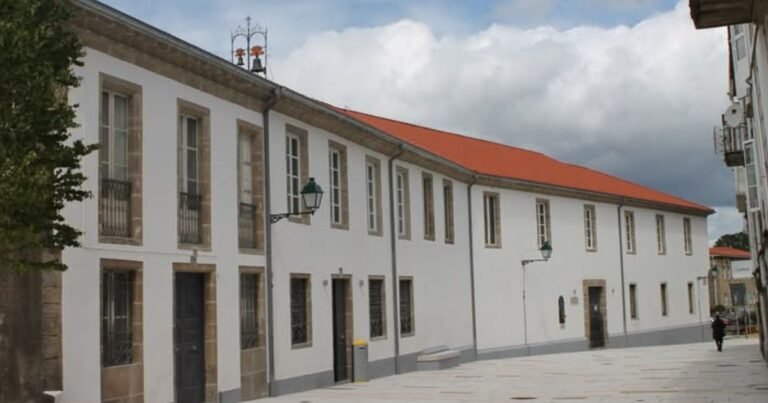
In Santiago de Compostela, the choice of the garden at the Pilgrim’s Office is no accident. It is the place where thousands of pilgrims, after days or weeks of travel, receive their Compostela. Sitting beside the sculpture is a symbolic act that links the experience of the Camino de Santiago with the teaching of welcoming one’s neighbour.
The Art of Timothy Schmalz: Spirituality and Social Commentary
Timothy Schmalz, a figurative sculptor with more than 25 years of experience, has devoted his career to creating works that go beyond the visual. His style combines detail, emotion and biblical narrative, producing pieces that invite viewers to feel part of them.
Among his best-known works are:
- “Angels Unawares”, in St Peter’s Square at the Vatican, dedicated to migrants and refugees.
- “Let the Oppressed Go Free”, a call for freedom and social justice.
- “Be Welcoming”, already present in Melide (A Coruña), inspired by the Letter to the Hebrews.
“Homeless Jesus” stands as one of his most universal creations, uniting sacred art with a quiet yet powerful social critique.
Santiago de Compostela: A Place Full of Symbolism
The arrival of “Homeless Jesus” in Santiago adds a special chapter to the relationship between art, faith and pilgrimage. For many walkers, encountering this sculpture upon completing the Camino de Santiago becomes a transformative spiritual experience.
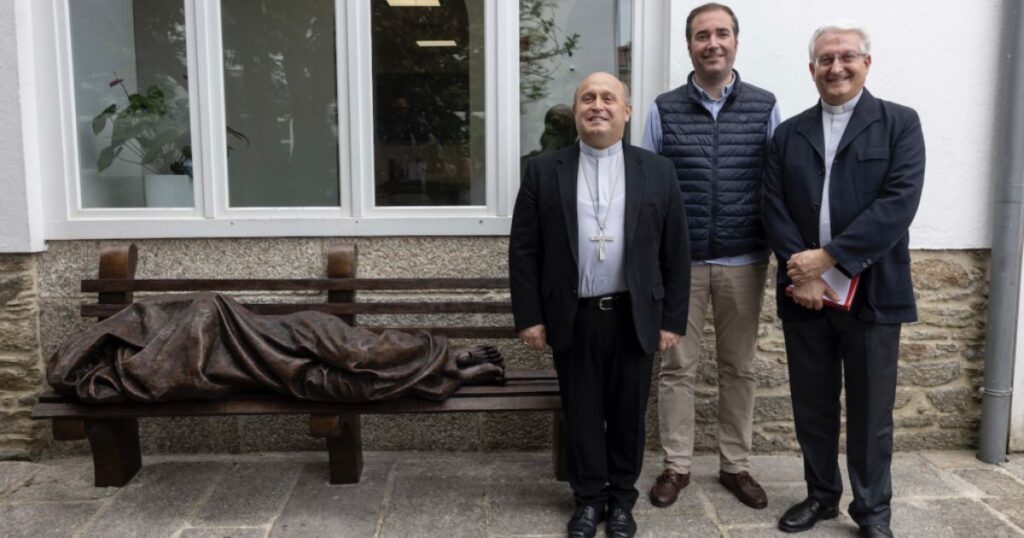
The Archbishop of Santiago, Monsignor Francisco Prieto, noted during his blessing of the work that it is a call to reflection and action, reminding those present that true solidarity “does not stop at words, but becomes a gesture: welcoming, sheltering and covering those who have no roof over their heads.”
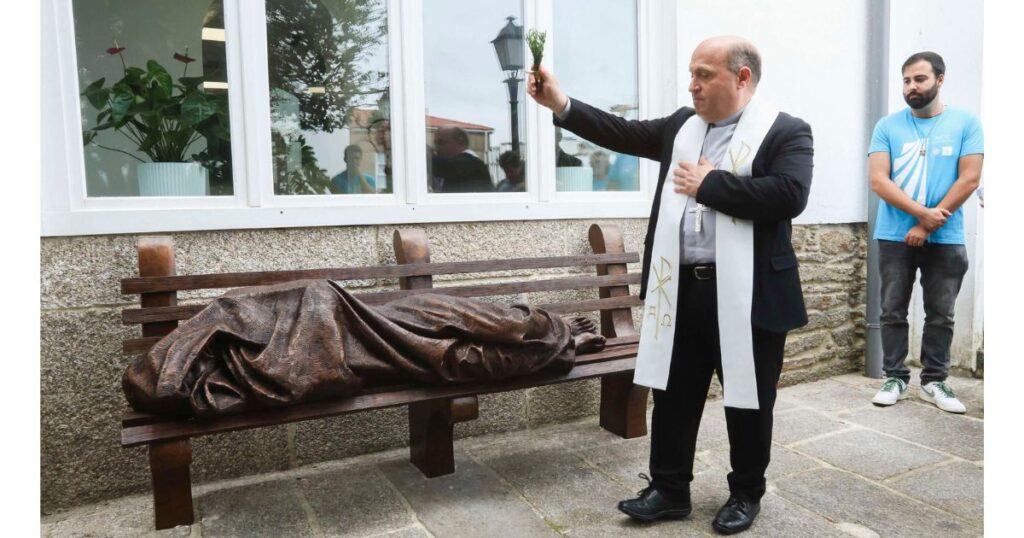
An Invitation to Encounter and Introspection
One of the most meaningful details of the sculpture is that it leaves an empty space on the bench. This is no accident: it is designed so that anyone can sit down beside Jesus, turning the moment into an intimate, personal experience.
This simple gesture reinforces the message that compassion and solidarity begin with closeness — with pausing and recognising the worth of those around us.
Homeless Jesus in Santiago de Compostela
The installation of “Homeless Jesus” in Santiago de Compostela, made possible thanks to the generous donation of Diane and Tim Needles, represents far more than a new addition to the city’s artistic heritage. It is a lasting invitation to live out faith through action, a reminder that every human being deserves dignity and respect.
What’s more, for pilgrims, this work becomes an extension of the inner Camino — that journey of self-discovery and spiritual renewal which ends, symbolically, in the silent company of Christ on the bench.
An Art That Transforms
“Homeless Jesus” is not simply a sculpture; it is a mirror of our society and a call to bring more humanity to how we see one another. In Santiago de Compostela, this message resonates with particular force, reminding every visitor that the true meaning of the Camino is found not only at the destination, but in how we learn to recognise and welcome others along the way.
This meeting of art, spirituality and social commitment confirms that the Camino de Santiago remains, today more than ever, a place of encounter with others, with oneself and with the divine.