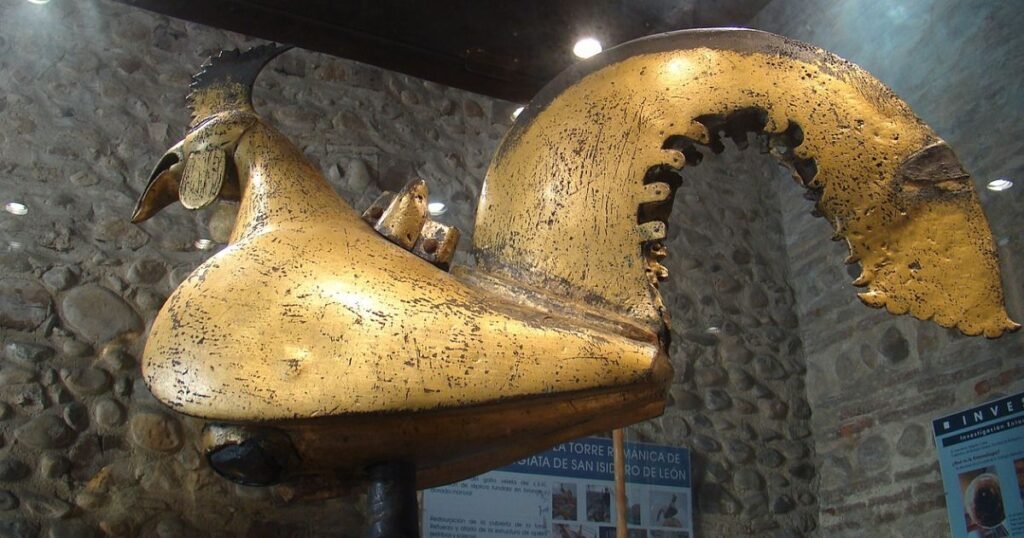
Weathervane Rooster of the Basilica de San Isidoro de Leon
The Basilica of Saint Isidore of Seville in Leon, one of the city’s most important monuments, is home to a unique and mysterious symbol: the weathervane rooster crowning the Torre del Gallo (Rooster Tower). This figure, which for centuries served as a weathervane on the Romanesque tower, has become one of the most representative elements of Leon, but its history is far more complex and fascinating than it might first appear.
This article explores the history of the rooster, the studies carried out on it, and the theories about its origin, revealing how a seemingly simple piece has withstood the passage of time and continues to captivate the imagination of Leon’s residents and visitors alike.
The History of the Rooster of San Isidoro
The Origin of the Rooster on the Tower
The rooster of the Basilica de San Isidoro is a metal figure that for centuries crowned the tower of the temple, an iconic building in the city of Leon. With more than 800 years of history, the rooster has been considered a symbol of the city, although its history is shrouded in mystery. It is known to have been installed on the tower during the 11th century, although there is no specific documentation about its origin or any historical events that would link it to a specific event of the time.
The rooster is a copper piece covered in gold, which originally formed part of a weathervane. This weathervane was made up of three distinct parts: the rooster, a sphere and a cone, which allowed the figure to turn with the wind, acting as a wind direction indicator. Despite its function as a weathervane, the rooster of San Isidoro was not always regarded merely as such, and its symbolism has evolved over time, coming to represent something much greater than a simple meteorological tool.
The Impact of the Rooster’s Restoration
At the beginning of the 21st century, specifically in 2001, the Basilica de San Isidoro underwent an extensive restoration. During this process, the rooster was taken down from its position atop the tower to undergo thorough study. Experts, including archaeologists, historians and restorers, quickly realized they were dealing with a piece of great historical and artistic value.
During the restoration process, it was discovered that the rooster was not a simple ornamental figure, but had a number of features that made it exceptional. Traces of soil and pollen not corresponding to local vegetation were found inside it, leading researchers to speculate that the piece came from a more distant region, possibly from the East, specifically from the Persian Gulf basin.
The Scientific Study of the Rooster of San Isidoro
The Restoration and First Discoveries
In 2001, when the rooster was taken down from its place on the tower, a series of technical studies were carried out to analyze its composition and restore it properly. Through detailed analysis of the material, experts discovered the piece was made of copper coated with an extremely well-preserved layer of gold, which explained its surprising resistance to corrosion over the centuries.
One of the most fascinating discoveries came from analyzing the remains found inside the rooster. By studying the pollen and soil residue found within it, researchers concluded that the plant species did not correspond to the local area, but rather to species native to the East, specifically the Persian Gulf basin. This revelation led historians to propose the hypothesis that the rooster was a piece imported from the East, possibly during the period of the Caliphate of Cordoba.
The Eastern Origin Hypothesis
Scientific studies made it possible to establish an approximate date for the rooster’s manufacture, placing it at the end of the 6th century or the beginning of the 7th century. This coincided with the period of splendor of the Sasanian Empire, which ruled the Persian region at that time. It is known that during the reign of King Khosrow II, the Persians adopted the rooster symbol as an emblem of their power, replacing the crosses that crowned Christian temples with golden roosters. This practice was documented by Byzantine chronicles describing the use of golden roosters with gemstone eyes in temples conquered by the Persians.
Theories on How the Rooster Arrived in Leon
The Rooster as a Symbol of the Kingdom of Leon
One of the most widely accepted theories about the rooster’s arrival in Leon is that it was brought as tribute or war spoils. Some sources suggest the rooster may have been a gift from the Caliph of Baghdad to the Caliph of Cordoba, and that it was taken to Leon as part of the plunder following the conquest of Medina Azahara in 1009. This theory is reinforced by the fact that the rooster shows features typical of Islamic metalwork, indicating it may have been brought from Al-Andalus.
Another theory suggests the rooster arrived in Leon as a symbol of the Leonese victory over the Caliphate of Cordoba. During the 11th century, the Kingdom of Leon had suffered devastating invasions by Almanzor, and the installation of the rooster on the tower may have symbolized the Leonese recovering power over Muslim rule. In this sense, the rooster would have served as a war trophy, a symbol of Christian supremacy over the Muslims.
The Visigothic Inscription and the Rooster’s Cone
One of the most important clues about the rooster’s arrival in Leon is the Visigothic inscription found on the cone that supports the figure. Analysis of this inscription, which dates from the Visigothic period, suggests the rooster was installed on the tower of San Isidoro in the 11th century, probably after the conquest of Toledo in 1085, a key event in the history of the Kingdom of Leon. The inscription contains the word “Berlana”, which refers to a possible craftsman who worked on building the rooster’s support.
In addition, studies of the cone and sphere supporting the rooster revealed that these elements are of Iberian Peninsula origin, specifically from the 12th century. This suggests that the rooster, although of Eastern origin, was adapted and restored on the Iberian Peninsula for use as a weathervane.
The Rooster of San Isidoro Today: A Living Symbol of Leon
The Replica on the Tower and Its Display in the Museum
Today, the original rooster of the Basilica of Saint Isidore of Seville is on display at the Museo de la Colegiata, where visitors can admire its incredible state of preservation and detailed restoration work. The piece has been protected by a glass case to prevent deterioration from exposure to the elements. In its place, an exact replica made of gilded bronze has been placed on the tower, where it continues to serve its symbolic function as an emblem of Leon.
The rooster of San Isidoro is not only a historical symbol, but also holds a prominent place in Leonese culture. It is considered one of the city’s most treasured pieces, and its presence on the Torre del Gallo has inspired countless local legends and traditions. The people of Leon take great pride in their rooster, which has become a cultural icon of the city.
A Symbol That Transcends Time
The rooster of San Isidoro has transcended its original function as a weathervane and taken on a much deeper meaning. It represents the resilience, pride and identity of Leon throughout the centuries. With its mysterious origin and fascinating history, the rooster remains a living symbol of the city’s cultural richness and a testament to the meeting of different cultures throughout history.