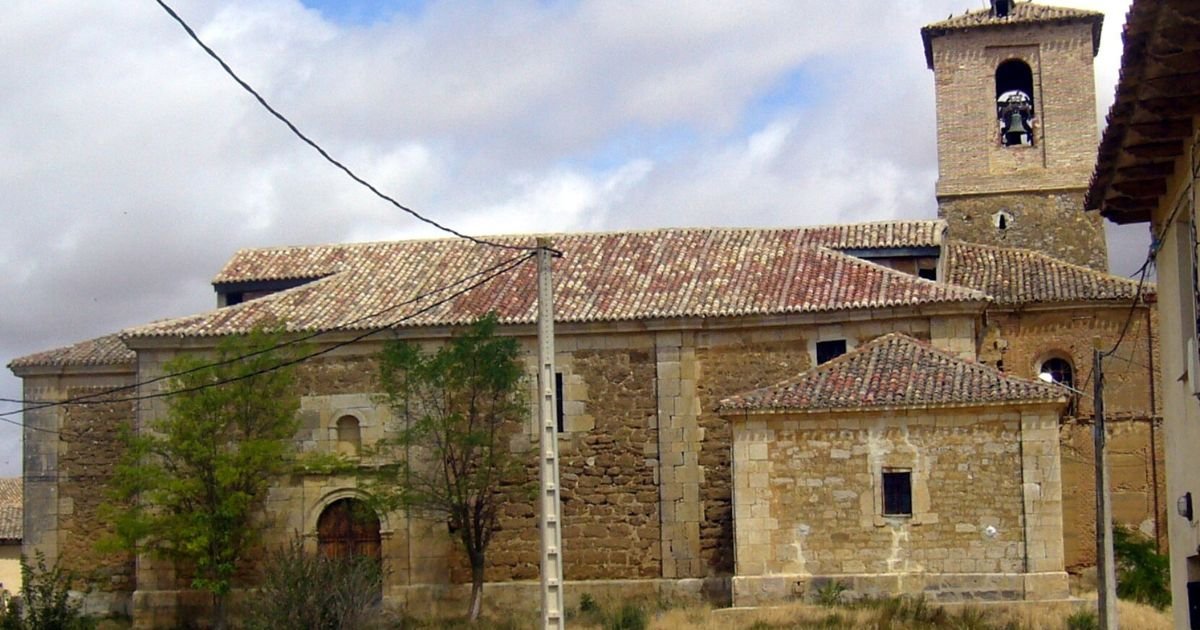


Church of Our Lady of the Purification of Las Cabañas de Castilla
In the heart of Tierra de Campos, within the municipal territory of Osorno la Mayor and just a few kilometers from the Camino de Santiago Frances highway (A-231), stands the Church of Our Lady of the Purification, in the small village of Las Cabañas de Castilla. Located on the ancient Via Aquitania (Ab Asturica Burdigalam) -the Roman road linking Astorga with Bordeaux and which served as an axis for the expansion of the Camino Frances- the church stands as a living testament to faith and rural architecture that has accompanied travelers, shepherds and pilgrims for centuries.
Surrounded by the flat, golden landscape typical of the region, this church, together with the tower-castle of Las Cabañas, forms a landmark monumental ensemble within the historical and cultural itinerary of northern Palencia.
Origins and historical evolution
The Church of Our Lady of the Purification has its roots in the Late Middle Ages, when Las Cabañas de Castilla was a settlement under the lordship of the Castaneda family, who also commissioned the construction of the adjacent castle in the 15th century.
The church was built as the spiritual center of the small farming settlement and remained under the patronage of the Purification of the Virgin, one of the oldest Marian feasts in the liturgical calendar. Over the centuries, the church has undergone various structural interventions and restorations, the most significant being the one carried out in 2003, which recovered features of great architectural and artistic value, such as its tower, ribbed vaults and the heraldic shields preserved inside.
Architecture: a balance between rural Gothic and modern renovations
The church follows the characteristic layout of rural Castilian churches built during the transition between the 15th and 16th centuries.
Its single-nave floor plan with a straight chancel and ribbed vault reveals late Gothic influences, while the materials –rubble masonry and roughly dressed stone reinforced with ashlar at the corners and openings– evoke the sobriety of functional architecture in Tierra de Campos.
The tower, rebuilt in the 18th century, rises above the western wall, with a square section topped by a molded cornice and semicircular windows, which once housed the clock and the bell chamber. The exterior simplicity contrasts with the interior harmony, where the vault ribs and pointed arches set an elegant, spiritual rhythm.
On its main facade, a pointed-arch doorway -framed by sober moldings- provides access to the church. The ensemble is preceded by a side portico, added in more recent times, which shelters the entrance and creates a traditional space of welcome typical of the region.
Interior and artistic heritage
Inside, the church preserves features of notable artistic interest reflecting the devotion and history of the place:
- Gothic ribbed vault: with simple keystones and ribs converging on carved corbels, it forms a balanced, solid structure.
- Main altarpiece: in popular Baroque style, with polychromy in golden and reddish tones, it houses the titular image of Our Lady of the Purification, depicted at the moment of the Presentation of Jesus at the Temple.
- Heraldic shields: one of the side chapels preserves a shield bearing the cauldrons and castles of the Riva-Herrera family and the thirteen roundels of the Bustamante family, a symbol of the church’s former patrons and lords of the town.
- Side chapel of Saint Roch: dedicated to the patron saint of pilgrims and of Las Cabañas, it keeps alive the connection between local worship and the Jacobean route, as Saint Roch is the archetypal protective figure of the Camino de Santiago.
Marian devotion and local identity
The dedication to the Purification of the Virgin (February 2nd) refers to one of the most celebrated mysteries of the liturgical cycle, linked to light and spiritual renewal.
Traditionally, in Las Cabañas de Castilla this feast was the main one on the religious calendar, although over time devotion shifted to Our Lady of the Rosary, whose feast is celebrated on the first Sunday of October, coinciding with the end of the harvest.
Nevertheless, the Purification remains the church’s original symbol and the historical core of local religious life.
Connection to the Via Aquitania
The Church of Our Lady of the Purification stands on a historic pilgrimage route connecting the Northern Plateau with the Cantabrian Coast and the Camino Frances. The ancient Via Aquitania runs through this area, a Roman road known in medieval times as the Carrera Francesa, one of the secondary routes most heavily used by pilgrims coming from Aquitaine and Gascony on their way to Santiago de Compostela.
The church, together with the chapel of Saint Roch and the remains of a pilgrims’ hospital documented in the area, are part of that legacy of rural hospitality, where the traveler found rest, food and faith.
Restoration and conservation
The comprehensive restoration carried out in 2003 consolidated the roofing, walls and tower, in addition to restoring the original aesthetics of the interior. The historical integrity of the materials was respected, integrating new protective elements without altering the authenticity of the building.
Today, the church remains open for worship and continues to serve as a gathering place and living heritage of Las Cabañas de Castilla, integrated into the cultural and tourist circuit of the Camino de Santiago Frances – Via Aquitania.
Monumental and natural surroundings
Visitors can complete their visit to the church with a tour of the heritage ensemble nearby:
- Castle of Las Cabañas de Castilla, a 15th-century fortress associated with the Castaneda family and declared a Site of Cultural Interest.
- Canal de Castilla bridge and Vallarna aqueduct, remarkable examples of 18th-century hydraulic engineering.
- The towpath along the canal, ideal for walking or cycling, connecting to Osorno la Mayor and Lock No. 15.
- The landscape of Tierra de Campos, where the flatness, the color contrasts and the flight of steppe birds create a unique visual experience.
Festivities and traditions
- Feast of Saint Roch (August 16th): procession, pilgrimage and music in honor of the local patron saint, protector of walkers.
- Our Lady of the Rosary (first Sunday of October): celebrates the end of the harvest with mass, dances and a community gathering.
- Purification of the Virgin (February 2nd): the original date of the church’s patronal dedication, with the blessing of candles and light symbolism.
These festivities keep alive the bond between the community, the church and the Camino, reaffirming the town’s spiritual and hospitable identity.
Visiting and access
- Location: Las Cabañas de Castilla, municipality of Osorno la Mayor(Palencia Province, autonomous community of Castilla y Leon.
- Access: from the N-611 or the A-67, take the turn toward Santillana de Campos and Las Cabañas; just minutes from the Canal de Castilla.
- Visiting: free access to the exterior; the interior is open during worship hours and festivities.
- Recommendation: combine the visit with the castle and the Canal de Castilla, or with the Jacobean stage Osorno-Melgar de Fernamental.
Church of Our Lady of the Purification of Las Cabañas de Castilla
The Church of Our Lady of the Purification of Las Cabañas de Castilla is an outstanding example of rural Castilian Gothic architecture and a symbol of the spirituality of the Camino de Santiago along the Via Aquitania. Its sober structure, its noble heraldry and its respectful restoration reveal a history of faith, nobility and landscape that remains alive in every stone.
For the Camino de Santiago traveler, this church offers a peaceful, luminous stop, where art, history and devotion intertwine beneath the vast sky of Tierra de Campos.