Knights Templar
The Order of Poor Fellow-Soldiers of Christ and of the Temple of Solomon (in Latin: Pauperes Commilitones Christi Templique Salomonici), also called the Order of the Temple, whose members are known as Knights Templar, was one of the most powerful Catholic military monastic orders of the Middle Ages. It remained active for just under two centuries.
It was founded in 1118 or 1119 by nine French knights led by Hugues de Payens after the First Crusade. Its original purpose was to protect the lives of Christians making pilgrimage to Jerusalem after its conquest (mainly from the port city of Jaffa). The order was recognised by the Latin Patriarch of Jerusalem, Garmond of Picquigny, who imposed on it the rule of the Augustinian canons of the Holy Sepulchre (Order of the Holy Sepulchre). Within the Templar context, this rule is known as the Latin Rule.
Order of the Templars
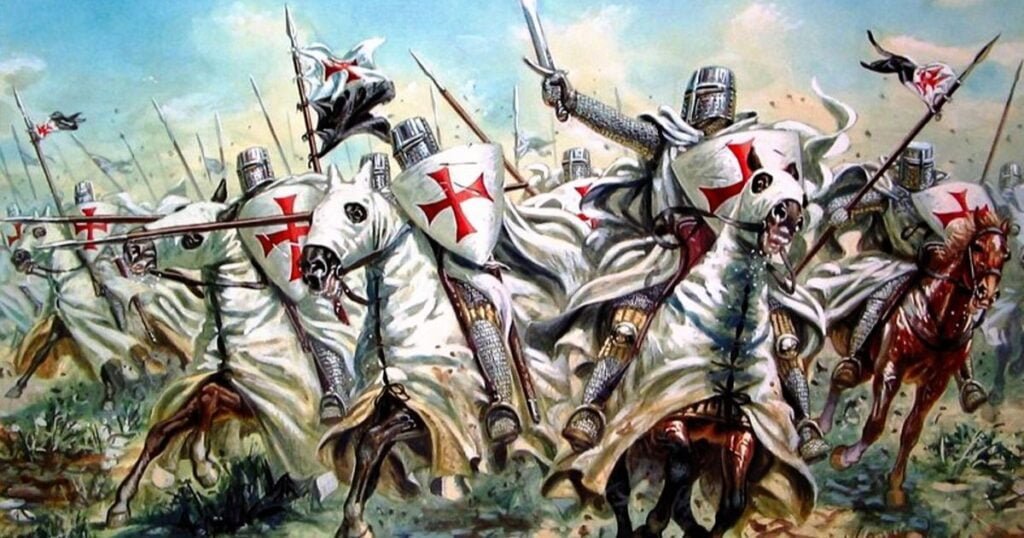
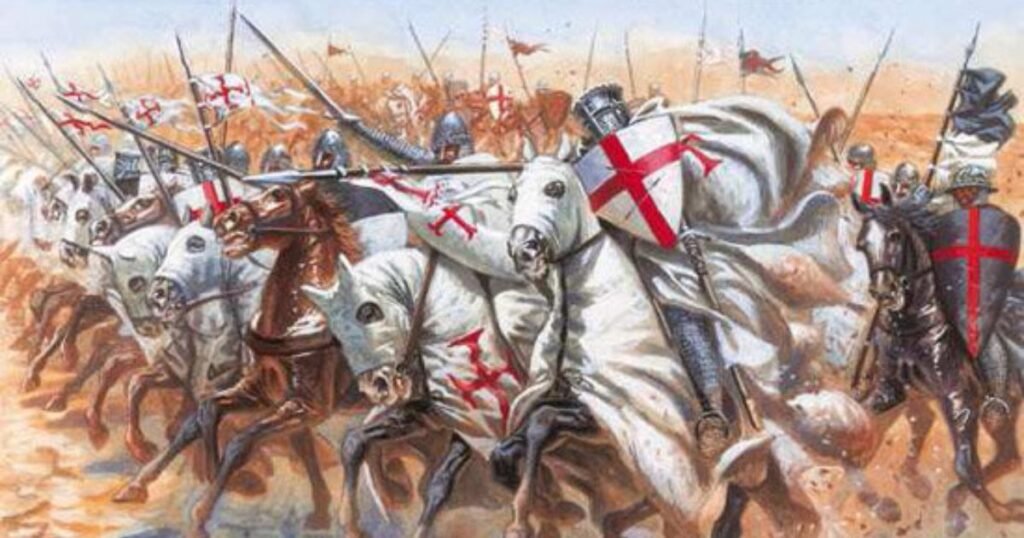
Officially approved by the Catholic Church in 1129, at the Council of Troyes (held in the cathedral of that same city), the Order of the Temple grew rapidly in size and power. The Knights Templar were distinguished by a white mantle bearing a red cross pattee upon it. On 24 April 1147, Pope Eugene III granted them the right to wear the cross permanently; a plain cross, but pattee or fitchee, symbolising the martyrdom of Christ, coloured red, since red was the symbol of the blood shed by Christ, but also of life. The cross was placed on their mantle over the left shoulder, above the heart. Militarily, its members were among the best-trained units taking part in the Crusades. The order’s non-combatant members ran a complex economic structure across the Christian world. They even created new financial techniques that formed an early version of the modern bank. The order also built a series of fortifications across the Mediterranean and the Holy Land.
The Templars’ success was closely tied to the Crusades. The loss of the Holy Land meant the disappearance of the order’s support base. In addition, rumours surrounding the secret initiation ceremony of the Templars bred great distrust. Philip IV of France, heavily indebted to the order and fearful of its growing power, began pressuring Pope Clement V to take action against its members. In 1307, a large number of Templars were arrested, made to confess under torture, and burned at the stake. In 1312, Clement V yielded to Philip IV’s pressure and dissolved the order. Its abrupt suppression gave rise to speculation and legends that have kept the name of the Knights Templar alive to this day.
Background
With the Muslim and Viking invasions brought under control, whether by military means or by settlement, an expansive period began in Western Europe. Agricultural output grew, alongside a rising population. Trade also experienced a new revival, as did the cities.
Religious authority, the common backbone of that region and the only visible one in earlier centuries, had managed to introduce into the warlike medieval world ideas such as the Peace of God or the Truce of God, which steered the ideal of knighthood towards the defence of the weak. It did not, however, reject the use of force to defend the Church. “As early as the late 9th century, Pope John VIII had declared that those who died on the battlefield fighting the infidel would have their sins forgiven. What is more, they would be counted among the martyrs for the faith.”
There was, then, a deep-rooted and intense religious feeling expressed through pilgrimages to holy places, common in the period. In the early 11th century, Rome was gradually replaced, as the traditional destination of pilgrimage, by Santiago de Compostela and Jerusalem. These new destinations were not free of dangers and obstacles, such as highway robbers or heavy tolls demanded by local lords, but religious feeling, combined with the hope of adventure and fabulous riches in the East, drew many pilgrims, who on returning home would tell of their hardships.
Pope Urban II, having secured his position at the head of the Church, continued the reforms of his predecessor, Gregory VII. The Byzantines’ request for help, together with the fall of Jerusalem to the Turks, led Urban II, at the Council of Clermont (in November 1095), to lay out before a great audience the dangers threatening Western Christians and the abuses suffered by pilgrims travelling to Jerusalem. The military expedition proposed by Urban II was also meant to wrest this city from Muslim hands.
The promised spiritual rewards, combined with the thirst for riches, made princes and lords quick to answer the pontiff’s call. Christian Europe moved as one under the cry of Deus vult! (‘God wills it!’), the phrase that opens the speech at the Council of Clermont, in which Urban II called for the First Crusade.
That military expedition culminated in the conquest of Jerusalem in 1099 and the establishment of Latin territories in the region: the counties of Edessa and Tripoli, the principality of Antioch and the Kingdom of Jerusalem, where Baldwin I took the title of king as early as 1100.
Rulings on the Order of the Temple
- 1129 – Acts of the Council of Troyes: Approval of the Rule by the conciliar fathers.
- c. 1130 – De laude novae militiae: Saint Bernard praises the new knighthood and consecrates the Templars.
- 1135 – Council of Pisa: ratification of the Rule and concessions to the Templars.
- 1139 (29 March) – Omne Datum Optimum: Innocent II approves the rule and grants papal protection.
- 1144 (9 June) – Milites Templi: Celestine II provides ecclesiastical protection and encourages donations.
- 1145 (7 April) – Militia Dei: Eugene III authorises them to collect tithes and to have their own burial grounds.
- 1307 (13 October) – Pastoralis Praeminentiae: Clement V orders the arrest of the knights and the confiscation of their property.
- 1308 (12 August) – Faciens Misericordiam: Clement V creates the procedure for prosecuting the Templars.
- 1308 (12 August) – Regnans in Coelis: Clement V summons the Council of Vienne to debate the Templars.
- 1312 (20 March) Council of Vienne: The suppression of the Order is decided.
- 1312 (22 March) – Vox in Excelso: Clement V dissolves the Order of the Knights Templar.
- 1312 (2 May) – Ad Providam Christi Vicarii: Clement V grants the Templars’ properties to the Knights Hospitaller.
- 1312 (6 May) – Considerantes Dudum: Clement V determines the fate of those who confessed and their associates.