Order of the Holy Sepulchre of Jerusalem
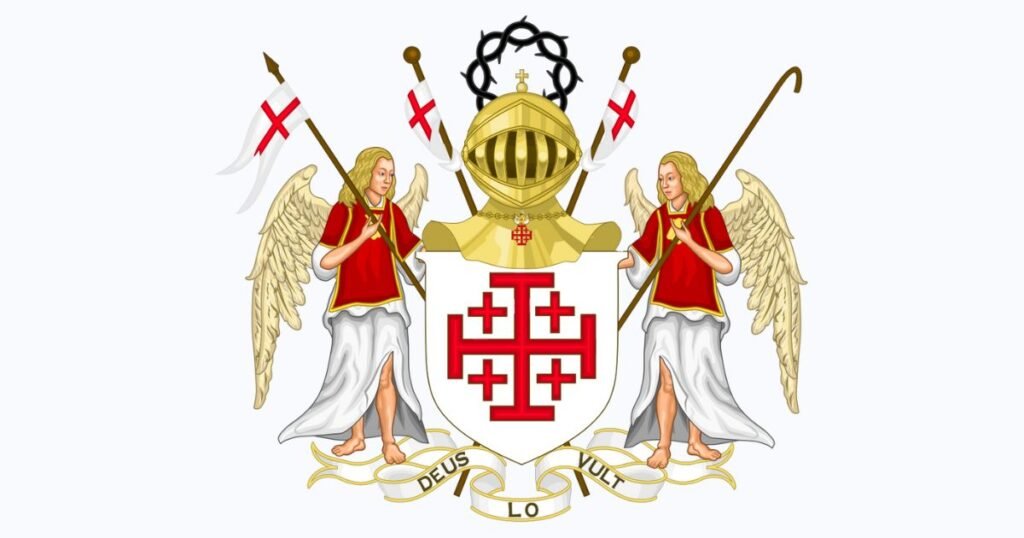
The Equestrian Order of the Holy Sepulchre of Jerusalem, known in Italian as Ordine equestre del Santo Sepolcro di Gerusalemme, is a distinguished order of chivalry of the Catholic Church rooted in a hugely important historical figure: Godfrey of Bouillon. This nobleman was one of the leading figures of the First Crusade, a significant event that took place in the 11th century. According to the most respected studies and views from both the Vatican and Jerusalem, the order began as a kind of confraternity. This confraternity was mixed, meaning it had both clerical members and lay pilgrims. Over time, this community grew and became established around a sacred site of vital importance to Christians in the Middle East, known as the Holy Sepulchre, said to be the place where Jesus Christ was buried. The order’s motto is Deus lo vult, which translates as God wills it.
The Order was founded in the year 1098 by Godfrey of Bouillon, Duke of Lower Lorraine and Protector of the Holy Sepulchre. This came after the initial success of the First Crusade, making it the oldest order of chivalry still in existence today. Its main purpose from the outset was to protect the Holy Sepulchre from the threat of infidels, and to carry out this mission Godfrey of Bouillon organised a group of around 50 brave knights. His brother, Baldwin I of Jerusalem, later underlined the Order’s importance by formally endowing it with its first set of regulations. These regulations were highly influential and served as a model for other orders of chivalry established later, such as the Temple and the Hospital.
Throughout its history, the Order has taken part in several significant events. One of the most notable episodes occurred in the year 1123, when its members fought bravely alongside King Baldwin I of Jerusalem. They also took part in several important sieges, such as the Siege of Tyre in 1124, the Siege of Damascus during the Second Crusade in 1148, and the Siege of Saint John of Acre in 1180, in which they showed their courage and commitment to their cause.
However, circumstances changed drastically in 1187 when the holy city of Jerusalem was captured by the Muslims under Saladin. After this loss, the Order was forced to relocate to Europe, where it expanded into several countries such as Poland, France, Germany and Flanders. From this point on, the Order’s mission changed, focusing mainly on rescuing Christians who had been captured and held captive by the Muslims. In Spain, the Order also came to the fore, taking part in numerous decisive battles that formed part of the Reconquista, a series of military campaigns to recover the Iberian Peninsula from Muslim rule.
Members of the Order have historically been chosen from among the most distinguished and respected members of the European nobility. In more recent times, however, certain requirements of noble birth have been removed for admission to the Order. In 1489, Pope Innocent VIII took an important decision to formally merge the Order into that of the Hospitallers. In some places, however, especially Spain, the Order managed to retain its autonomy and established a special regime within the structure of the Catholic Church. In 1868, Pope Pius IX granted the Order new statutes through the bull titled Cum multa. Today, the Order continues its work, focusing on supporting the Latin Patriarchate of Jerusalem and the faithful who live there. Like the Order of Malta and the Teutonic Order, it still holds a particular and respected honorary status within the Catholic Church community.
History of the Order of the Holy Sepulchre
The Order’s history passes through several phases:
Canonical Phase
This first phase comes before the Order’s official formation. It begins when the mother of Emperor Constantine, Saint Helena, feels a deep devotion to the Holy Places. Constantine, known as “the Great”, was a key figure in the history of Christianity, having established this faith within the Roman Empire in the year 313. Saint Helena, moved by her religious fervour and her wish to honour the Holy Sepulchre, decided to travel to Jerusalem to locate this sacred site, which was revealed to her by a devout Jew named Quirinus.
To honour this sacred location, Saint Helena ordered the building of a magnificent temple in homage to the Glorious Resurrection of Jesus Christ. This temple was raised around Mount Golgotha, where Christ is believed to have been crucified, and Christ’s own tomb, where he was buried. She then established a chapter of Canons, so named for the “canon”, or religious rule, she herself had devised to organise the life and duties of these religious. To ensure the safekeeping and preservation of the Holy Sepulchre, these Canons were helped by several lay brothers, who also took part in this effort. These lay brothers were given a distinctive badge, consisting of a cross made up of five red crosses, in memory of the five wounds Our Lord suffered during his Passion.
However, the split between the Churches led these religious to be regarded as schismatic. This situation was further complicated by the Muslim occupation of the Holy Places in the year 638, which left the Canons in a very precarious existence. Despite these difficulties, they managed to survive until the conquest of Jerusalem by the Crusaders in the year 1099. After this victory, Godfrey of Bouillon took a drastic decision: he expelled them from Jerusalem for being schismatic and replaced them with Latin Canons, who were loyal to Rome.
However, the change in administration was not simply a matter of replacing canons. In keeping with the warlike spirit of the age, Godfrey decided to add a detachment of knights who, together, would form an Order of Chivalry, both religious and military. This was because the protection of the temple of the Holy Sepulchre could not rely on prayer alone. The idea of clergy bearing arms and becoming armed sacristans was problematic and openly clashed with the canons of the faith. Although the war against the infidels who had occupied the Holy Land was considered just and legitimate, there was a firm prohibition on clergy: they could not kill another man with weapons, even in self-defence, on pain of excommunication.
Heroic Phase
The period known as the heroic phase takes place in the Holy Land, more specifically between 1099 and 1247. During this time, the Sepulchre Knights took on the important responsibility of protecting the Holy Sepulchre, one of the holiest sites for Christians, as well as providing military support to the kings of Jerusalem. This relationship was key, since the Sepulchre Knights were directly bound to these kings. Authority over the Order rested chiefly with the Mastership, a post delegated to the Grand Prior of the Sepulchre, who was responsible for the Order’s day-to-day administration and leadership.
It is said that the idea of forming an Order of Chivalry was taken up by Godfrey of Bouillon after the victory at the Battle of Antioch in the year 1098. On that occasion, Godfrey received a proposal to knight several squires who had distinguished themselves in battle through their bravery. However, he promised Gontier de l’Aire that he would wait a little, since he wanted to become a knight only once they had succeeded in conquering the Sepulchre of the Lord.
According to the account of Count Alphonse Couret, the Order of the Holy Sepulchre arose spontaneously after the conquest of Jerusalem by the Crusaders in 1099. This event was marked by a massacre in which the Crusaders, deeply devout Christians, committed acts of violence against Muslim and Jewish men, women and children living in Jerusalem. This act was driven in large part by the Crusaders’ devotion to the Holy Sepulchre.
Godfrey of Bouillon, who was recognised by all as the Protector of Jerusalem, took the initiative of organising religious services at the Holy Sepulchre. He delegated this responsibility to a group of twenty canons of the regular clergy, whose task was to constantly celebrate the divine offices and carry out the Holy Mysteries in honour of that sacred place.
However, simply replacing the canons was not enough. These peaceful monks, who led lives devoted to prayer and fasting, were not equipped to defend the Holy Sepulchre from possible desecration nor to protect the pilgrims visiting this sacred place. The walls of Jerusalem did not offer sufficient protection, especially since the Kings of Jerusalem were often away on military campaigns, far from the capital, and almost never left a garrison in the city. This meant that, in many cases, the city was left unprotected and at the mercy of danger, making a permanent militia necessary. It was essential to form a body of select knights devoted to the protection of Jerusalem, and in particular of the Holy Sepulchre.
The French chronicler Andre Tavin maintains that the Order of Chivalry of the Holy Sepulchre is the first and oldest of all the orders of chivalry created in the Holy Land. Its members, including fratres, canons and knights, stood out as a noble guard watching over and ensuring the protection of the Holy Sepulchre. This drew the attention of numerous princes and lords making pilgrimages to Jerusalem. The Order gained recognition and legitimacy among kings and pontiffs at a time when the Templars (Order of the Temple) had not yet been established, and when the Hospitallers and Lazarists were known only as nursing brothers offering care in their hospitals. Thanks to this early recognition, the Order of the Holy Sepulchre was granted precedence over other orders in all religious and official ceremonies, a privilege it still holds today.
Over a number of years, crusading activity came to a halt, but in the year 1238 a group of Franciscans was admitted into Jerusalem by the Caliph, allowing pilgrimages to resume. These, however, were carried out by small groups of unarmed Christians, who had to pay a toll to enter the city. The truce with the Saracens allowed pilgrimages to the Holy Sepulchre to resume, though no longer with the same solemnity as before. Ceremonies were now carried out discreetly and privately, so as to avoid drawing attention in a city under the control of the infidels. However, once the truce ended, Christians had to leave Jerusalem, which remained under occupation, and return to their home countries in Europe. This gave rise to what were known as Pilgrim Knights. There is also testimony of Christian pilgrims who reached Jerusalem during this period of relative tolerance by the Islamic rulers. In this city, they encountered the Knights of the Holy Sepulchre, giving rise to the group known as the Pilgrim Knights.
From 1238 to 1496, there are numerous records of armed Sepulchre Knights in the presence of the Holy Sepulchre, many of them belonging to the most distinguished families in Europe. In 1279, for instance, Jean de Heusden, a Flemish nobleman, is mentioned. In 1309, Gossin Cabilau, also of Flemish nobility, appears. In 1244, Godefroid de Dive, a French nobleman, stands out, and in 1295 Count Jean X d’Arkel is mentioned, great-grandson of Jean V d’Arkel, who was knighted in 1176. In the year 1325, we find Robert of Namur. This list continues with many other knights, counts and princes from various parts of the Christian world who were knighted as Sepulchre Knights before the tomb of Christ. Through this rite, they received one of the most cherished rewards a Christian knight could hope for, a recognition of their brave journey and of the dangers and hardships they suffered along the way.
Pilgrim Phase
The third phase of the Order’s history unfolds in Europe between 1247 and 1847. Throughout this long period, we see a notable initial fragmentation of the Order, which split into six major Priories established in different European countries. These Priories were Capua in Italy, Calatayud and Toro in Spain, Orleans in France, Miechow in Poland and Warwick in England. This division did not last, however. Owing to the Bull issued in 1489 by Pope Innocent VIII and the schism that took place in England under the reign of Henry VIII, the number of Priories was reduced to just three: Calatayud in Spain, Orleans in France and Miechow in Poland.
In 1484, Pope Innocent VIII was hopeful of organising a great crusade against Islam. This crusade was to be led by D’Aubusson, the Grand Master of the Order of Saint John. To this end, the Pope decided to contribute to the crusade by incorporating the Sepulchre Knights and Lazarists, along with all their assets, into the Order of Saint John of Rhodes. This decision was meant to help the Order recover from the losses it had suffered as a result of the Ottoman siege. The Pope carried out this act through his bull titled “Cum solerti meditatione”, issued on 28 March 1489. This measure, however, provoked protests and disobedience from the kings of Spain, France and Poland, who opposed this new arrangement. Only in the Papal States was the bull fully observed.
On the other hand, thanks to the efforts of King Ferdinand II, known as “the Catholic”, Pope Leo X, through his bull of 29 October 1513, decided to separate the Sepulchre Knights from the union with Rhodes that Innocent VIII had established. In France, this situation was reaffirmed by a decree of the Parliament of Paris, which on 16 February 1547 declared that the bull issued by Pope Innocent VIII was abusive and contrary to the laws of the kingdom, leaving the Order in a difficult position in that context.
Despite this struggle for control of the Order, the situation did not last for many years. In 1496, Pope Alexander V, at the request of Emperor Maximilian I and the kings of Spain and France, considered that the Knights of Malta took a solemn vow of chastity, something the Knights of the Holy Sepulchre did not observe. For this reason, he decided to annul the bull of Innocent VIII and place the Sepulchre Knights under the authority of the Holy See, recognising their dual character as both an equestrian and a pontifical Order.
The Pope proclaimed himself and his successors Grand Master of the Order and granted the Guardian of the Holy Sepulchre, who acted as apostolic vicar in the Holy Land, the power to confer the Order on pilgrims visiting those sacred places. To receive this honour, pilgrims had to make an offering and swear that they were of noble lineage. In this way, the Order’s survival was secured, although the Hospitallers were not made to return the former assets that had been seized in various territories, such as Castile, Portugal and Italy.
Throughout this phase of its existence, the Order retained a strong noble spirit. The Holy See and the kings of the two most influential monarchies in Europe at the time, Spain and France, were locked in constant dispute over control of the Order. Both sides wished to exercise authority over it and to lead its Mastership. Finally, in 1746, the Holy See settled this dispute in its own favour, claiming exclusive control of the Order of Knights of the Most Holy Sepulchre of Jerusalem through a Brief of Pope Benedict XIV, thereby bringing the controversy to an end.
Protective Phase
Today we are in what is known as the fourth phase, a period that began in 1847 and continues to the present day. This period was marked by the signing of an important Concordat, a formal agreement between the Holy See and the Ottoman Sultan, who at the time controlled the Holy Land. This Concordat facilitated the Restoration of the Latin Patriarchate of Jerusalem, a significant event that returned to the Patriarchate its full authority and functions. Immediately after this agreement, the Order of Knights of the Holy Sepulchre was once again discussed, and the recognition of its privileges and the Church’s previous regulations governing the Order were reaffirmed.
It is worth noting that the Holy See also restored the Order of Chivalry of the Holy Sepulchre, recognised for its “great antiquity”. The Pope at the time noted that, according to reliable documents, since the 15th century the Father Guardian of the Holy Sepulchre, residing in Jerusalem, had already been admitting distinguished men as Knights of this Order of Chivalry, thanks to apostolic concessions. This was ratified to ensure the Order could continue to exercise that honorary privilege so characteristic of it.
We mention the Papal Briefs in particular, since in these texts Pope Pius IX consistently refers to the ancient Order of Knights. Years later, ladies too would have the opportunity to join this Order, once their admission was authorised, something that had already occurred in the Order’s earliest periods.
The restoration of the Latin Patriarchate of Jerusalem in 1847, carried out by Pope Pius IX, marked a highly significant step forward, granting the Patriarchate responsibility for governing and administering the Order. From that moment, its members were entrusted with the important task of supporting the work of the Patriarchate, aimed at maintaining and spreading the presence of Christianity in the Holy Land. It was Pius IX himself who issued his Brief Cum Multa on 24 January 1868, establishing a structure of three grades within the Order: Knights, Commanders and Grand Crosses. Regulations governing these categories were also issued. Later, Pope Leo XIII issued his Brief Venerabile Frater Vincentius on 3 August 1888, authorising the Patriarch of Jerusalem to award the Cross of the Order to Ladies, further expanding participation in this venerable institution.
Statutes of the Order of the Holy Sepulchre
The Sepulchre Order, known for its important role in the history of the Crusades and the defence of Christian territory in the Holy Land, was governed by a set of rules that were its own Statutes or Assises. This historical document, which still survives, was commissioned by the French king Louis VII in the year 1149. Its purpose was to set out clear guidelines to serve as a reference for the Confraternity of the Order of the Holy Sepulchre. This Confraternity was formed in France following the model of the Sepulchre Order, and to that end Louis VII drew up Assises similar to those already in place since the Order’s founding in Jerusalem.
Within these Statutes, it stands out that Godfrey of Bouillon, one of the most prominent leaders of the Crusades, reserved for himself the supreme authority over the Order, known as the Mastership. This right, which he exercised, would pass after his death to the Latin Kings of Jerusalem, thereby ensuring continuity in the Order’s leadership in the region.
This document also defines two main categories of members within the Order. The first is made up of the Milites, the Knights, responsible for taking an active part in military defence. The second consists of the Presbyteri, the Canons, who were responsible for the community’s spiritual and liturgical life. Mention is also made of the Viatores, referring to the Pilgrims visiting the holy places. This text establishes that the kings governing the Holy Land could delegate their command to a Tenente, a post ensuring proper organisation and management of the Order.
The duties imposed on the Knights were clear and specific: they were to protect with their weapons, fight enemies and wage war whenever necessary. The Canons, meanwhile, were tasked with praying and celebrating the divine offices in the Church of the Holy Sepulchre, a place of great importance to the Christian faith. Thanks to these rules, the Order maintained a garrison in Jerusalem, exercising its influence and presence for as long as the city was administered by Christians.
Historical chronicles speak of Knights who stood permanent guard before the Holy Sepulchre, a sacred site requiring constant protection. The existence of Custodians, or armed auxiliary guards, is also documented. It is estimated there were around five hundred Custodians, who were to provide support to the army of the Kings of Jerusalem, taking an active part in numerous battles to maintain control of the city.
However, history took a drastic turn with the loss of Jerusalem to Saladin, a moment that marked the destruction of the Latin Kingdom of Jerusalem. This situation stripped the Order of the warlike character it had held until then. Like other military Orders operating in the region, the Sepulchre Order was forced to adapt to the new circumstances in order to fight for its survival.
The Knights of the Holy Sepulchre suffered the most as a result of the loss of Jerusalem. They were forced to abandon their watch over the Holy Places, with no other base to fall back on. Unlike the Templars and Hospitallers, who held strongholds in various locations, all Sepulchre Order installations were located within the holy city itself. With the loss of Jerusalem, these fortifications and buildings, once their home and headquarters, had to be abandoned, a hard blow for the Order and its members.
In Spain, over the years, each of the kingdoms that make it up has shown great devotion to the Holy Sepulchre. This has made pilgrimages to the Holy Land very common among the people of these lands. Many Spaniards, moved by their faith, became Sepulchre knights, travelling on crusades to the holy places to fulfil their religious calling.
The power of this order became so influential that it was compared to that of the renowned Orders of the Temple and the Hospital. In 1131, King Alfonso I, known as the Battler of Aragon, decided to include this order as co-heir alongside those mentioned in his will. This will was intended to distribute his domains, though it should be noted that many Aragonese nobles did not follow these provisions. In exchange for accepting other holdings that would not interfere with the royal line of succession, Count Ramon Berenguer IV of Barcelona granted additional lands in the kingdom of Aragon, mostly in the area of Calatayud, as well as in the Principality of Catalonia. Following this initiative, James I the Conqueror did the same during his campaigns in Mallorca and Valencia, giving the order greater presence and power.
When news of the Order’s restoration became known, several knights met to discuss its future. They decided to send a letter to every Spanish knight whose address they knew, inviting them to a general assembly. Thus, on 27 March 1874, the Spanish assembly of knights of the military order of the Holy Sepulchre was established. This moment marked an important milestone, and Salvador Maria de Ory became the founder and president of the Chapter of Spain and its standing commission.
Over time, and after various developments, on 26 June 1882 this order received the Regium Exequatur from the Ministry of State. Thanks to this recognition, the Spanish Knights of the Holy Sepulchre gained the right to enjoy the same official standing given to knights of other military orders in Spain, to which they were considered equivalent.
In 1899, the Order in Spain achieved a further significant recognition confirming its worth. After the restoration of the Temple of San Francisco el Grande in Madrid was completed, a Royal Order was issued on 21 February 1899. This order allowed the chapter to henceforth hold its meetings and religious functions at that temple. It was also granted the Chapel of Calvary and two further rooms, one for the knights to dress in and another to store their belongings. This agreement was not easy to secure, since even the temple’s own rector’s initial resistance had to be overcome. From that point on, a bond was established between the order and the Church of San Francisco el Grande that endures to this day.
Today, the order’s main seat in Spain is the Real Colegiata del Santo Sepulcro in Calatayud. There, the knights, who are honorary canons of the collegiate church, meet at least once a year to hold their general chapter. The order’s organisation in Spain is divided into two lieutenancies, corresponding to the former crowns of Aragon and of Castile and Leon. Each of these lieutenancies is governed by a lieutenant, a grand prior and a council.
In the Lieutenancy of Western Spain, the current lieutenant is Jose Carlos Sanjuan y Monforte. Since 2022, the grand prior has been His Excellency and Right Reverend Francisco Cesar Garcia Magan, who serves as Auxiliary Bishop of Toledo and Secretary General of the Episcopal Conference. This lieutenancy includes chapters from various regions, such as Andalusia, Asturias, Cantabria, Castile and Leon, Castile-La Mancha, Extremadura, Galicia, the Canary Islands, La Rioja, the Community of Madrid, the Region of Murcia, the Basque Country, and also the autonomous cities of Ceuta and Melilla.
In the Lieutenancy of Eastern Spain, meanwhile, the current lieutenant is Juan Carlos de Balle y Comas, while the grand prior is Lluis Martinez Sistach, Archbishop Emeritus of Barcelona. This lieutenancy is based at the main parish of Santa Ana, in Barcelona, a former monastery that once belonged to the order. The chapters that make it up include those of Aragon, Catalonia, the Balearic Islands, Valencia, Navarra and Andorra.
Pious Work of the Holy Places
The Obra Pia de los Santos Lugares (Pious Work of the Holy Places) is a unique institution forming part of the Spanish Administration. It is marked by a distinctive emblem consisting of five red crosses, the same symbol used by the Order of the Holy Sepulchre of Jerusalem. This historical connection between the two bodies has endured over the years, highlighting the fundamental role each plays in protecting and maintaining the Holy Places, especially the Holy Sepulchre in Jerusalem. Although they now operate independently, the relationship between the Order of the Holy Sepulchre and the Obra Pia de los Santos Lugares is undeniable, and both share this emblem, whose large red cross at the centre, surrounded by four smaller crosses, symbolises the five wounds Jesus Christ bore during his crucifixion.
The current structure of the Obra Pia is governed by Royal Decree 1005/2015, approved on 6 November of that year. Under this Royal Decree, the President of the Obra Pia de los Santos Lugares is the Undersecretary of the Ministry of Foreign Affairs, European Union and Cooperation. This same figure also chairs the Board of Trustees, the collegiate body responsible for managing and directing the Obra Pia. It is worth noting that the Obra Pia de los Santos Lugares is defined as a state entity under public law devoted to non-profit activities, underscoring its altruistic nature and its commitment to causes of great social and cultural importance.
The Obra Pia’s main aim is to foster religious cooperation and provide humanitarian aid. As part of its current activities, the Obra Pia focuses on several key areas. One of its essential functions is to maintain and increase Spain’s presence in the Holy Land region, which involves developing projects and activities that strengthen this connection. The Obra Pia also promotes the study and research of the history of the Spanish presence among the various peoples around the Mediterranean and in the Middle East region, with particular emphasis on events that have taken place in the Holy Land over the centuries. It also plays an important role in humanitarian cooperation and education within this geographic area, working with different organisations and initiatives seeking to improve the lives of local communities. Lastly, the Obra Pia supports the Basilica-Museum of San Francisco el Grande in Madrid, contributing to its upkeep and promotion, reflecting its commitment to culture and historical heritage.
See also: