Our Lady of Roncesvalles
Our Lady of Roncesvalles
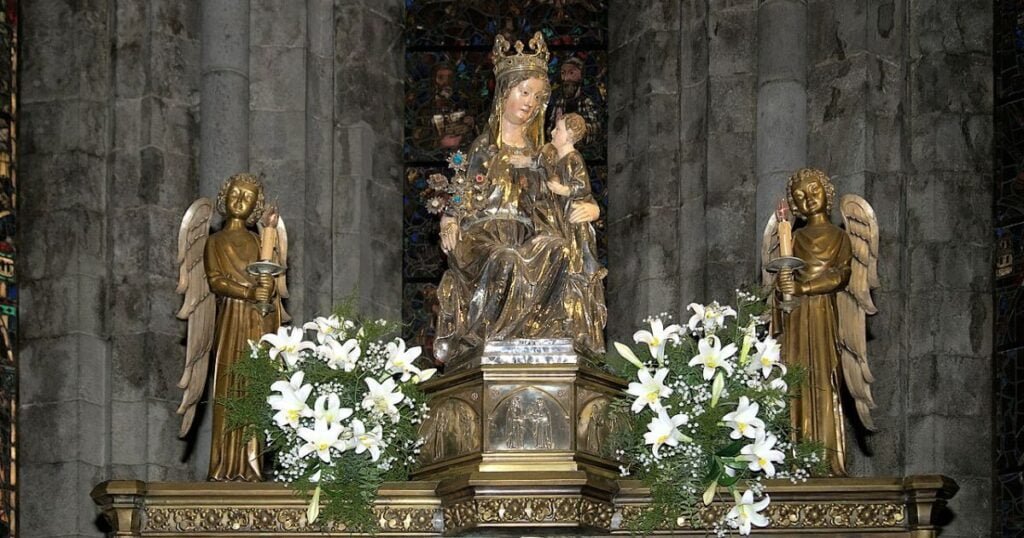
The image of Our Lady of Roncesvalles is a sculpture of the Virgin Mary with the Christ Child, carved in wood in the Gothic style and decorated with silver. It was created in Toulouse during the first half of the 14th century. In the sculpture, Mary is shown seated, looking at the Christ Child, who rests on her left leg. Jesus is held by Mary’s left arm and also seeks her gaze. This depiction differs from the usual ones, in which both mother and child are shown impassively in frontal, symmetrical poses, with Mary serving as a throne for Jesus. The base on which the throne rests is decorated with five reliefs depicting Saint Michael fighting the dragon, San Pedro and Saint Paul, and two angels bearing candles. These reliefs are framed by trefoil pointed arches.
The sculpture is housed in the church of the Real Colegiata de Our Lady of Roncesvalles. Due to its great value, it has been designated a Site of Cultural Interest (Bien de Interés Cultural) under regional decree 65/1999 of 1 March. It is also considered a key piece of art and devotion in Navarra and Lower Navarre (France).
The Carving of Our Lady of Roncesvalles
The sculpture of Our Lady of Roncesvalles stands 90 centimetres tall and was created by carving wood and covering it with a thin sheet of silver. The crown, added in 1960, measures 11.5 centimetres, and the base measures 8 by 24 by 39 centimetres. Carved, polychrome wood was used, covered in silver in its natural tone and in gilded silver, with filigree details, precious and semi-precious stones, and set coloured glass. Its design follows the Gothic style and its authorship is unknown, but it is presumed to belong to the French school and to have been made in Toulouse, France.
On the back of the throne a somewhat blurred inscription can be made out, reading “…[fec]it fieri Thole ad ho[norem]…” (which translates as “…had this made in Toulouse in honour of…”). It is known that there was a close connection between the Hospital de la Caridad de Roncesvalles and that French city. According to Professor Fernández-Ladreda, an expert in Navarrese Marian sculptures, the authorship may be linked to the Master of Rieux, although concrete evidence to support this idea is lacking and no similar works have been found to back it up. It is also thought that this work may have been commissioned by the prior of Roncesvalles, García Ibáñez de Viguria (1327–1346), who also drove the construction of the cloister of the now-vanished hospital and the chapter house known as the Chapel of San Agustín, where he lies buried.
As a French work from the first half of the 14th century, this sculpture is exceptional for combining different materials, since in France the trend of covering wooden images with metal disappeared with Romanesque art. Although it belongs to the Gothic style, it seems to have been adapted more to the tastes and fashions of the place it was destined for than to those of its creator.
As for the innovation of the composition compared with earlier Marian sculptures from Navarra, the position of the head and legs stands out, which were usually frontal and upright, with a fixed gaze and parallel or converging legs. This sculpture breaks with that frontality and symmetry, presenting a depiction of Mary not previously seen in earlier Navarrese Marian sculptures. It is a significant change in the way the sacred figure is depicted.
Legend of Our Lady of Roncesvalles
The legend tells a story linked to the Camino Frances. It is said that a shepherd witnessed a miracle when he saw a stag whose antlers glowed like stars as it drank water from a spring. This magical event led him to approach the animal, and at that moment celestial music was heard that left him astonished. After witnessing this for several nights, he decided to share the news with his neighbours, who later informed the bishop of Pamplona. At first, the bishop did not believe the story, but then an angelic figure confirmed in a dream that what had happened to the shepherd was true. Moved by these revelations, the bishop went to the site with a retinue and ordered digging near the spring. The surprise came when they found a silver image of the Virgin Mary with the Christ Child, shining in the torchlight. It is said that in Roncesvalles there is a Fountain of the Angels near the collegiate church, identified by tradition as the site of these events.
Images Derived from the Our Lady of Roncesvalles
In the history of Navarra, it can be seen that the figure of the Our Lady of Roncesvalles has inspired other similar works, such as the Virgen de Janáriz in Lizoáin, now found in the Church of Santiago in Pamplona, specifically in the Chantrea district. Other examples can be found in depictions of the Virgin in places such as Artanga (Urraúl Alto), Turrillas (Izagaondoa) and Urroz de Santesteban (Alto Bidasoa). All of these depictions join the figure of the Virgen del Tesoro in Roncesvalles, which stands out for preserving two unique features of the original model: its metallic covering and the detailed decoration of its throne.
Devotion to Our Lady of Roncesvalles
Devotion to Our Lady of Roncesvalles, known as the Queen of the Pyrenees, is very prominent in the region, with a large number of followers in Navarra. In spring, over several consecutive Sundays, she is visited by numerous pilgrims from nearby towns in Spain, and in September the same happens with pilgrims from French towns.
The image of the Virgin was officially crowned on 8 September 1960. It has been the subject of detailed studies and is considered “the oldest image in Navarra for which descriptions have been preserved”. This venerated figure has a rich history that has been the subject of thorough analysis over the years.
Our Lady of Roncesvalles
| Origin | ||
|---|---|---|
| Country | Spain | |
| Autonomous community | Navarra | |
| Town | Roncesvalles | |
| Sanctuary | Real Colegiata de Our Lady of Roncesvalles | |
| General information | ||
| Veneration | Catholic Church | |
| Feast day | 8 September | |
| Patron saint of | Pilgrims of the Camino de Santiago | |
| Date of the image | 14th century | |
| Style | Gothic art | |