Our Lady of the Assumption / Assumption of Mary / Assumption of the Virgin
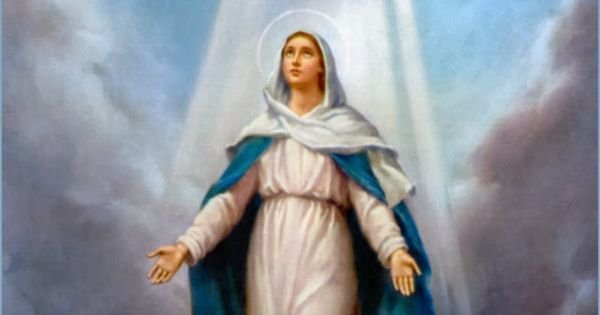
The Assumption of Mary or Assumption of the Virgin is the belief, according to the tradition and doctrine of the Catholic Church, that the Virgin Mary, the mother of Jesus Christ, having completed the course of her earthly life, was taken up body and soul into Heaven. It should not be confused with the Ascension, which refers to Jesus Christ himself.
This event is called Assumptio Beatae Mariae Virginis (Assumption of the Blessed Virgin Mary) by Catholics, whose doctrine was defined as a dogma of faith (a truth that cannot be doubted) by Pope Pius XII on 1 November 1950. The Catholic Church has celebrated this feast in honour of Mary in the East since the 6th century and in Rome since the 7th century. The feast is celebrated on 15 August.
History of Our Lady of the Assumption
Earliest liturgical references to Our Lady of the Assumption
The first official reference to the Assumption is found in the Eastern liturgy; in the 4th century the feast of The Remembrance of Mary was celebrated, commemorating the entry of the Virgin Mary into Heaven and referring to her assumption. In the 6th century this feast was called the Dormitio (κοίμησις, koimesis) or Dormition of Mary, marking the end of her earthly life and her assumption into Heaven. In the 7th century the name changed from «Dormition» to «Assumption».
Apocryphal accounts of Our Lady of the Assumption
Apocryphal accounts of the Assumption of Mary appear from approximately the 4th and 5th centuries. These include the Liber Requiei Mariae and the Six Books Dormition Apocryphon. Other notable later apocrypha based on these include De Obitu S. Dominae, attributed to Saint John. It is also found in the book De Transitu Virginis, falsely attributed to Saint Melito of Sardis, as well as in a spurious letter attributed to Saint Dionysius the Areopagite.
The most widely circulated of the «Assumptionist gospels» and one of the oldest in the Byzantine East is the Book of Saint John the Evangelist, the Theologian. This and other apocryphal writings had great influence on various homilies and writings by Eastern orators, such as John of Thessalonica, John of Damascus, San Andrés of Crete and Saint Germanus of Constantinople, among others. Although they had, and have, no historical character, the Catholic Church saw in these writings the theological substance that already existed, of which the accounts were embellished expressions.
Our Lady of the Assumption in the West
Due to political and linguistic factors, since relations with the East were tense and Greek was not yet widely mastered, the doctrine of the Assumption of Mary was not developed until the 12th century, when the treatise Ad Interrogata appeared, attributed to Saint Augustine, which accepted the bodily assumption of Mary. Saint Thomas Aquinas and other great theologians declared themselves in its favour.
In the 16th century, Pope Saint Pius V, when reforming the Breviary, removed the citations from the «Pseudo-Jerome» and replaced them with others that defended the bodily assumption.
Pope Benedict XIV described the doctrine of the Assumption as pious and probable, but without yet declaring it dogma.
The influence of the book known as the Pseudo-Jerome, which questioned whether Mary was assumed into Heaven with or without her body (while still maintaining the belief in her incorruption), gave rise to doubts as to whether the bodily assumption was included in the celebration of the feast. This was compounded by another book that enjoyed fame among convents and chapters, called the Martyrology, by the monk Usuardus (who died around the year 875), which praised the reticence of the Church of that era, which preferred not to know «the place where, by divine command, this most worthy temple of the Holy Spirit and our Lord God lies hidden».
The Dogma
In 1849 the first petitions reached the Holy See from bishops asking that the Assumption be declared a doctrine of faith; these petitions increased over the following years. When Pope Pius XII consulted the episcopate in 1946 through the letter Deiparae Virginis Mariae, the affirmation that it should be declared dogma was almost unanimous.
On 1 November 1950 the apostolic constitution Munificentissimus Deus was published, in which the Pope, based on the tradition of the Catholic Church, taking into account the testimonies of the liturgy, the belief of the faithful guided by their pastors, the testimonies of the Fathers and Doctors of the Church, and with the consensus of the bishops of the world, declared the Assumption of the Virgin Mary to be a dogma of faith:
Therefore, after we have repeatedly raised our supplicant prayers to God and invoked the light of the Spirit of Truth, for the glory of Almighty God who bestowed his special favour upon the Virgin Mary, in honour of her Son, the immortal King of the ages and conqueror of sin and death, to increase the glory of that same august Mother, and for the joy and rejoicing of the whole Church, by the authority of our Lord Jesus Christ, of the blessed Apostles Peter and Paul, and our own, we proclaim, declare and define it to be a divinely revealed dogma: that the Immaculate Mother of God, ever Virgin Mary, having completed the course of her earthly life, was assumed body and soul into heavenly glory. Apostolic Constitution Munificentissimus Deus, 1 November 1950
Our Lady of the Assumption
| Venerated in | Catholic Church |
|---|---|
| Temple | former Abbey of the Dormition of the Virgin Mary |
| Feast day | 15 August |
| Patroness of | Arcahueja (Leon Province) Asunción (Paraguay) Casabindo (Argentina) Cutervo (Perú) La Asunción (Venezuela) Granada (Nicaragua) León (Nicaragua) Juigalpa (Nicaragua) Ocotal (Nicaragua) Elche (Alicante) Pego, Alicante, (España) Chacas (Perú) Peñafiel (Valladolid) Pinos del Valle, Provincia de Granada (España) Vigo Pontevedra, (Galicia) (España) Letur, Albacete, (España) La Nueva Guatemala de la Asunción (República de Guatemala)(Chiquimula) (Guatemala) Estepa, Sevilla, (España) Departamento de Oruro (Bolivia) Pinto, Madrid, (España) Albaricoques, Níjar, Almería, (España) Las Negras, Níjar, Almería, (España) Ferreras de Arriba, Zamora, (España) Ciudad Cayey (Puerto Rico) Villanueva de Azoague, Zamora, (España) Aguascalientes (México) Chilpancingo (México) Cupilco, (Tabasco, México) Tacotalpa, (Tabasco, México) Soyatitán (Chiapas, México) Santa María Malinalco, Azcapotzalco (Ciudad de México) Milpa Alta (Ciudad de México) Popayán y la Diócesis de Zipaquirá (Colombia) Mora (Costa Rica) Ourol, Lugo, Galicia, (España) Bacerac, (México) Diócesis de Los Teques (Venezuela) |
See also: