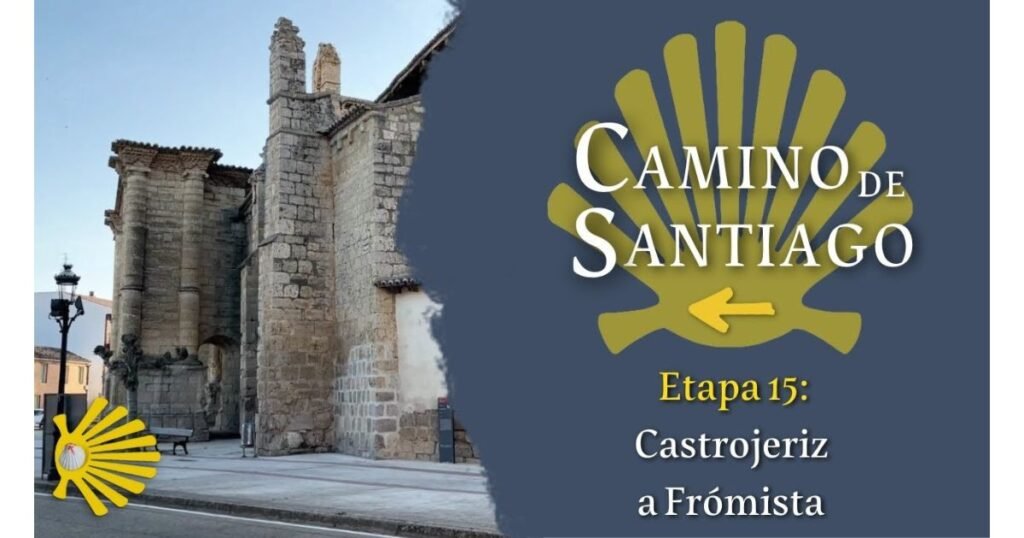
Video Stage 15: Castrojeriz to Frómista | Camino Frances with Jhonatan Barrios
Video Stage 15: Castrojeriz to Frómista | Camino Frances with Jhonatan Barrios
Jhonatan Barrios shares Stage 15 of the Camino Frances, running from Castrojeriz to Frómista, a 25 km stretch. This leg was part of a journey made between 26 April and 26 May 2022.
In the video, Jhonatan shows his journey through this Stage 15 towards Frómista, where he had the chance to see the longest village on the Camino Frances, as well as visit other villages with very distinctive histories.
Stage 15: Castrojeriz to Frómista with Jhonatan Barrios
Jhonatan Barrios on Stage 15 of the Camino Frances
The Camino de Santiago is more than just a walk; it is a transformative experience, both physically and spiritually. Along its routes, pilgrims discover breathtaking landscapes, villages steeped in history, and the chance for deep reflection. Jhonatan Barrios, an experienced pilgrim, shares his experience on stage number 15 of this iconic journey, which runs from Castrojeriz to Frómista, a 25-kilometre stretch full of challenges and rewards.
Leaving Castrojeriz: The Adventure Begins
A Peaceful Dawn
Although most peregrinos prefer to set off before dawn to avoid the scorching sun, Jhonatan Barrios chooses to start his day at 7:40am. Already having a reservation secured at his next destination allows for a more relaxed start. With the sun behind him, Barrios bids farewell to Castrojeriz, leaving behind a small village full of charm and history. The calm of the morning lets him enjoy the scenery without rushing, a blessing for someone who needs to look after his shin, already sore from the effort of previous days.
The Challenge of the Cuesta de Mostelares
Stage 15 is known for one of its most demanding stretches: the climb up the Cuesta de Mostelares. This steep ascent tests the endurance of any pilgrim. Even so, Jhonatan Barrios, despite the pain in his foot, is not deterred. As he climbs, the landscape transforms, offering spectacular views of the Castilian plain. The reward on reaching the top is twofold: the satisfaction of having overcome the physical challenge, and the panoramic view of everything covered so far, with Castrojeriz now far behind in the distance.
Descent towards Tierra de Campos
After the tough climb, the descent comes as a relief. This stretch, known as the collada of the Camino Frances, is described in the Códice Calixtino as the Tierra de Campos, the breadbasket of Spain. On this vast plain, pilgrims come across fields of wheat, barley and sunflowers, a golden landscape stretching as far as the eye can see. Barrios notes the lack of trees on this part of the route, a fact that heightens the intensity of the sun as the morning goes on. Fortunately, there are small resting points, such as the old pilgrim hospital of San Nicolás del Puente Fitero, where walkers can rebuild their strength.
Crossing the Puente Fitero: A Journey Through History
A Bridge with Centuries of History
One of the standout moments of this stage is crossing the Puente Fitero, also known as Puente Ítero. This medieval bridge, spanning the river Pisuerga, is a tangible reminder of the commitment that medieval kings, such as Alfonso VII of León, had to maintaining and improving the pilgrimage routes. Built in the 12th century, the Puente Fitero has witnessed the passage of countless pilgrims over the centuries, and today remains a crucial point on the Camino de Santiago. Jhonatan Barrios crosses this bridge with the same reverence as those who did so before him, aware of its historical importance.
A Rest in Ítero de la Vega
After crossing the Puente Fitero, the route takes pilgrims to Ítero de la Vega, a small village offering a break in the day’s journey. During the Middle Ages, this village was not directly on the main route, but today it has become a service point for pilgrims. Barrios mentions how the services available in this village have been a blessing for walkers, who can enjoy a simple meal before continuing their journey. However, Barrios himself notes the limited food options here, which leads him to continue on towards his next destination.
On the Way to Boadilla del Camino: A Journey of Reflection
An Endless Landscape
The stretch from Ítero de la Vega to Boadilla del Camino offers pilgrims an almost endless landscape of golden fields. This section of the Camino de Santiago is ideal for reflection, as the monotony of the scenery allows the mind to wander. Jhonatan Barrios uses this part of the route to rest mentally, letting his thoughts flow freely as he moves towards his next stop. In the distance, Boadilla del Camino comes into view, a small village with a rich Jacobean history.
A Break in Boadilla del Camino
Boadilla del Camino is a small town that, despite its size, was an important service point for pilgrims in the 14th century. It had two hospitals and three churches, showing how important it was for walkers of the time. On arrival, Jhonatan Barrios takes a moment to rest and explore the town. Among the points of interest is the Gothic rollo, a pillar symbolising the town’s jurisdiction. Also notable is the church of Santa María de la Asunción, an impressive example of 16th-century Gothic architecture.
Arrival in Frómista: End of the Stage
A Village with Deep Historical Roots
The last part of the day’s journey brings pilgrims to Frómista, a village which, during the Middle Ages, was known as “Frómista del Camino“. Its name comes from the Latin “fromentum”, meaning wheat, reflecting the region’s agricultural importance. On reaching Frómista, Barrios feels relieved to have completed another stage, but also excited to explore this place full of history.
The Canal de Castilla: Engineering and Natural Beauty
Before entering the centre of Frómista, pilgrims must cross the Canal de Castilla, an 18th-century feat of engineering that connected various points across Castilla y León. This canal, with its locks and surrounding scenery, is a reminder of the region’s rich industrial history. Barrios crosses one of the locks, marvelling at the infrastructure and the calm radiating from the water.
A Rest in Frómista
Once in Frómista, Jhonatan Barrios heads to the hostel where he will spend the night. This hostel, converted from an old house, offers the facilities pilgrims need. After a long day of walking, Barrios takes a moment to treat a blister on his right foot, caused by friction built up over the day. Despite these minor physical discomforts, Barrios feels satisfied to have successfully completed stage number 15.
The Transformation of the Camino
The Camino de Santiago is an experience that challenges both body and mind. Through its stages, pilgrims like Jhonatan Barrios discover not only breathtaking landscapes and a rich history, but also their own inner strength. Each stage is one more step towards personal transformation, a journey that, although difficult, is deeply rewarding. Stage 15, with its challenges and rewards, is a clear example of the beauty and the difficulty of the Camino de Santiago. Barrios, like many before him, continues his journey with his sights set on the Catedral de Santiago, in Santiago de Compostela, aware that every step brings him closer to his final destination, both physical and spiritual.