
What to see in Boadilla del Camino?
The name and its origins
The name «Boadilla» is usually linked to the Latin bovata, pasture land for oxen, a memory of a livestock tradition. The suffix «del Camino» needs no explanation: the village has lived from the pilgrim route since its earliest centuries.
Its first written mention dates from 950, in the fuero of Melgar de Suso, which lists it among the places resettled by Fernando Armentalez on behalf of Count Fernán González, the great driving force of independent Castile.
Heritage
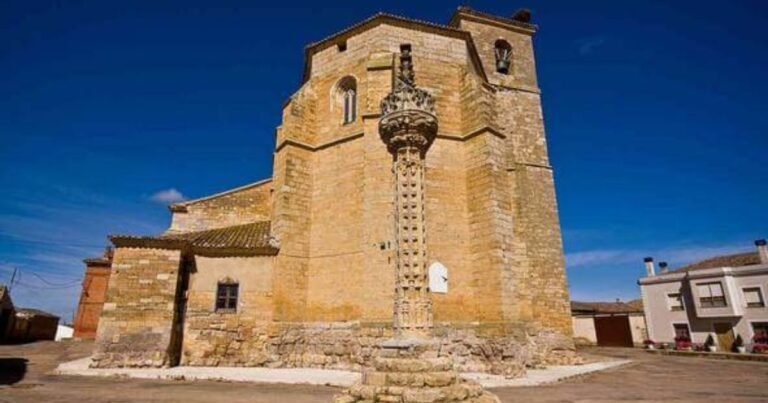
Church of Santa María de la Asunción
Built in the 16th century on a Romanesque church, it has been a Historic-Artistic Monument since 1981. It has three naves, a Renaissance altarpiece, a 14th-century Gothic Calvary and a 13th-century Romanesque font.
The jurisdictional column
Next to the church stands the village’s jewel: a 15th-century Gothic rollo, a stone column symbolising the town’s own jurisdiction granted by Henry IV. It is 7.60 metres tall and carved with scallop shells, angel figures and other Camino motifs; many consider it the most beautiful in Spain.
The Canal de Castilla
The Canal de Castilla, a great work of the Enlightenment, passes through Boadilla with its northern branch. Lock number 16, built to overcome the difference in level, is a good example of 18th-century hydraulic engineering, and its towpath is the one the pilgrim follows to Frómista.
Boadilla on the Camino
Boadilla is a very pleasant stop for pilgrims: the private hostel «En el Camino», with its garden, is open almost all year and is one of the best remembered on the Palencia stretch.
The Fuente Vieja and the washhouses
The Fuente Vieja, with its wheel mechanism, is a classic stop to cool off; beside it the washhouses have been rebuilt in memory of the old ones.
Dovecotes
The square-plan dovecotes, so typical of Tierra de Campos, recall the importance that pigeon breeding once had in the rural economy.
Population and economy
With about 115 residents, Boadilla lives from the land: of its 2,800 arable hectares, some 1,900 are cereal and 850 irrigated, and livestock, mostly sheep, numbers around 3,100 head.
In short
Boadilla del Camino is a small gem of the Camino Frances: a unique Gothic column, a church with history, the Canal de Castilla on its doorstep and a welcome that invites you to stay.
| Country | Spain | |
|---|---|---|
| Autonomous community | Castile and León | |
| Province | Palencia Province | |
| Comarca | Tierra de Campos | |
| Judicial district | Palencia | |
| Location | 42°15′N 4°21′O | |
| Altitude | 765 m | |
| Area | 28.66 km² | |
| Population | 115 inhabitants (2024) | |
| Density | 4.08 inhab./km² | |
| Postal code | 34468 | |
| Website | www.boadilladelcamino.es | |