Profile
Castillo de Sarracin in Vega de Valcarce
The Castillo de Sarracin rises on a natural promontory overlooking the valley of the Valcarce River, near Vega de Valcarce, in the El Bierzo region, Leon Province. This site, of great scenic and historical value, lies just a few meters from the route of the Camino de Santiago Frances, right before the climb toward the legendary hamlet of O Cebreiro, already in Galicia.
Surrounded by native forests, centuries-old paths and remnants of traditional Bierzo architecture, the castle stands as one of the great monumental landmarks of the final Leon stage of the Camino, a stone testament that serves as a symbol of vigilance, defense and spirituality.
History of the Castillo de Sarracin
The history of the Castillo de Sarracin dates back to the 10th century, though it was between the 12th and 13th centuries that it gained its greatest strategic importance. First documented in 1214, its original construction is believed to have been sponsored by the Order of the Temple, at a time when Christian control over the pilgrim routes to the Cathedral of Santiago de Compostela in the city of Santiago de Compostela was being consolidated.
Its main purpose was to protect passage through the Valcarce valley, ensuring the safety of pilgrims crossing this mountainous region at a time when raids and dangers were common. The castle also served as a point for collecting tolls and monitoring cross-border trade.
Over time, it passed into the hands of various noble families linked to the Kingdom of Leon and the nobility of El Bierzo, including the Lords of Valcarce, cementing its role as a seigneurial fortress and symbol of feudal authority.
Architecture of the Castillo de Sarracin
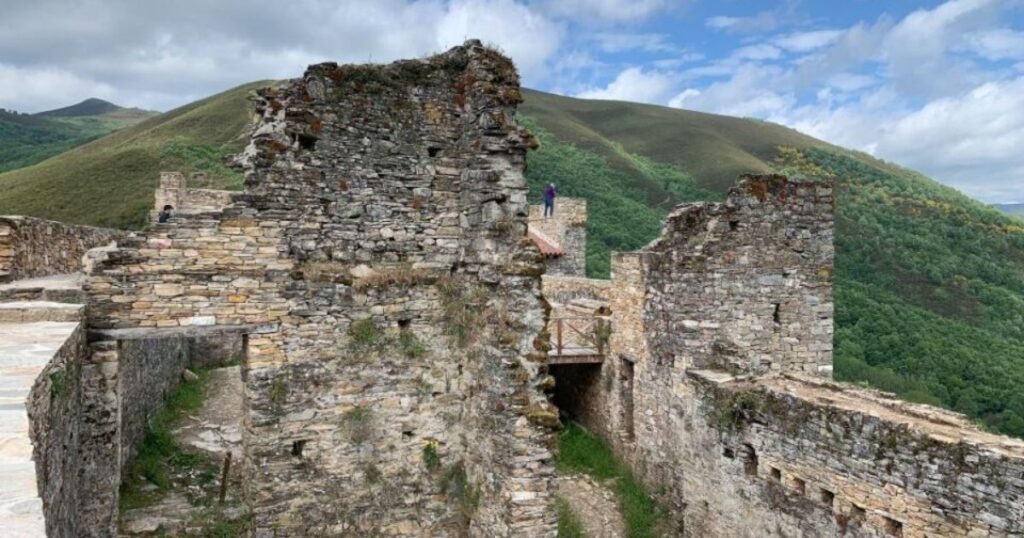
The Castillo de Sarracin was built on a steep hill with panoramic views over the valley, giving it strong defensive value. Its floor plan, irregular and shaped by the terrain, is organized around a perimeter wall enclosing the upper precinct and a parade ground.
The remains preserved today include sections of wall, semicircular towers, foundations of residential chambers and storage areas. The masonry used is local stone, perfectly blended into the natural surroundings, which has allowed the basic structure to remain recognizable despite the passage of time.
Although in a state of stabilized ruin, the castle has undergone cleanup, signage and conservation work, making it easier to visit and understand.
A Privileged Viewpoint Over the Camino de Santiago
From the top of the Castillo de Sarracin, visitors get one of the most impressive views of the entire Leon stretch of the Camino de Santiago Frances. The panorama takes in the Valcarce valley, the villages of Vega de Valcarce, Ambasmestas and Ruitelan, as well as the paths winding through the mountains toward Lugo Province in Galicia.
The castle holds not only historical value, but also scenic and symbolic significance. For pilgrims, it represents the threshold between the stage of physical and inner preparation and the imminent climb to O Cebreiro, a spiritual turning point on the Camino.
Access to the Castillo de Sarracin
The Castillo de Sarracin is reached via a signposted trail starting from the center of Vega de Valcarce. The route, of low difficulty and around 1 km long, winds through native trees and old farming walls. Along the way, information panels explain the site’s history, architecture and Jacobean context.
Admission is free and unrestricted year-round. No reservation or guide is required, though interpretive tours can be arranged with local guides specializing in medieval history and Bierzo heritage.
Ties to the Order of the Temple and Medieval Spirituality
One of the features that make the Castillo de Sarracin distinctive is its presumed connection to the Order of the Temple, renowned for its role as protector of pilgrims and guardian of sacred sites during the Middle Ages.
According to tradition, this castle was part of a network of Templar fortresses that secured passage along the Camino de Santiago. Its orientation, location and design follow the strategic principles of this order, which combined defensive architecture with religious symbolism.
Although no conclusive evidence confirms this affiliation, its Templar attribution has been defended by numerous historians and is part of the cultural lore of the Camino.
Cultural and Heritage Importance of the Castillo de Sarracin
The Castillo de Sarracin has been declared a Bien de Interes Cultural (Property of Cultural Interest) for its historical, architectural and symbolic significance. Its presence along the Jacobean route reinforces the heritage character of the Camino, declared a World Heritage Site by UNESCO, and enriches the traveler’s experience.
For visitors, it offers a space to connect with history, a place where time seems to stand still and where the stones speak of battles, watchfulness, faith and hospitality.
Recommendations for Visitors
- Make the climb at sunrise or sunset, for the best light and a peaceful setting.
- Wear suitable footwear for a mountain trail.
- Take a few minutes to take in the landscape and reflect on the site’s symbolism along the Camino.
- Check with the Vega de Valcarce Tourist Office about guided tours and special events.
- Bring water and avoid visiting during the hottest hours of summer.
Castillo de Sarracin
The Castillo de Sarracin is not merely a stone ruin; it is a monument full of meaning, a spiritual lookout guarding the route to Santiago. It bears witness to an era when faith and protection went hand in hand, when every tower, every wall and every step had a purpose.
Today, it remains a silent guardian of the Camino, reminding those who cross it that history, too, is walked, and that true strength lies in the perseverance, humility and spirit of those who follow the path.
The Castillo de Sarracin is more than a ruin: it is a beacon of history right along the Jacobean route. Here, stone and landscape together tell the story of centuries of faith, war and hope.
Frequently Asked Questions (FAQs)
Where is the Castillo de Sarracin located?
In Vega de Valcarce, in the El Bierzo region (Leon), right along the Camino de Santiago Frances.
How do you get to the castle?
Via a signposted trail starting from the center of the village. It is a short, accessible walk.
Is it open to the public?
Yes. Admission is free and unrestricted year-round.
What is its state of preservation?
It is a stabilized ruin, but the remains allow visitors to understand its original structure and enjoy its surroundings.
Are guided tours organized?
Yes, on specific dates. It’s best to check with the Vega de Valcarce Tourist Office.
Camino de Santiago Frances >> Leon Province >> Vega de Valcarce >> Castle de Sarracin
Map
Sorry, no records were found. Please adjust your search criteria and try again.
Sorry, unable to load the Maps API.