





Molinaseca on the Camino
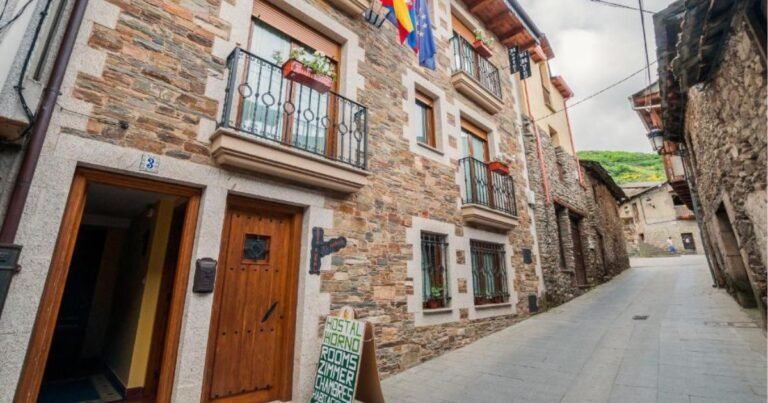
After the hard descent from El Acebo, the pilgrim enters Molinaseca over the medieval Pilgrims’ Bridge, across the Meruelo river. In summer the weir beside the bridge becomes a natural pool where many take a dip. Calle Real, with mansions bearing coats of arms and balconies, leads to the way out towards Ponferrada. It is one of the most beautiful stops on the Camino Frances in El Bierzo.
What to see in Molinaseca?
The town is protected as a Historic Ensemble, and in 2021 its status as a Site of Cultural Interest was reinforced.


The municipality
At 588 metres above sea level and covering almost 80 km², the municipality of Molinaseca brings together several villages:
- Molinaseca, the town.
- Onamio and the MSP settlement.
- El Acebo.
- Riego de Ambrós.
- Paradasolana.
- Castrillo del Monte, almost uninhabited.
It is just 7 km from Ponferrada, on the route of the Camino Frances.
Origins and mining
Already in Roman times there were mining works in the Santa Marina area. Mining returned centuries later with iron mines documented in the early 17th century and, in the 20th, with coal.
The Middle Ages
In the Middle Ages the town belonged to lords linked to the church of Santiago and had hermitages and hospitals for pilgrims. Several still remain:
- Sanctuary of Nuestra Señora de las Angustias, at the entrance, beside the Camino.
- Hermitage of Santa Marina.
- Hermitage of the Hospital.
- Hermitage of San Roque, on the way out.
The 17th-century parish church of Saint Nicholas of Bari overlooks the village from a height.
The Early Modern and modern era
During the Peninsular War Molinaseca was the seat of the Junta Superior de León in 1809. In 1821 it belonged to the short-lived province of Villafranca, and from 1833 it returned to that of León.
The Pilgrims’ Bridge
The seven-arched Pilgrims’ Bridge is the image of Molinaseca: a Romanesque bridge, rebuilt several times, around which the town grew.
In short
Molinaseca is the reward for the descent from the mountains of León: a bridge, a river to cool off in and a Calle Real to stroll along. One of the jewels of the Camino Frances.
| Country | España | |
|---|---|---|
| Autonomous Community | Castilla y León | |
| Province | Leon Province | |
| Comarca | El Bierzo | |
| Judicial District | Ponferrada | |
| Location | 42°32′17″N 6°31′11″O | |
| Elevation | 588 m | |
| Area | 79.63 km² | |
| Settlements | El Acebo, Castrillo del Monte, Molinaseca, Onamio, Paradasolana y Riego de Ambrós | |
| Postal code | 24413 (El Acebo, Molinaseca y Riego) 24398 (Castrillo, Onamio y Paradasolana) | |
| Dialling code | 987 | |
| Patron saint | Saint Nicholas of Bari | |
| Website | molinaseca.es | |