Profile
Puente Medieval de Larrasoaña
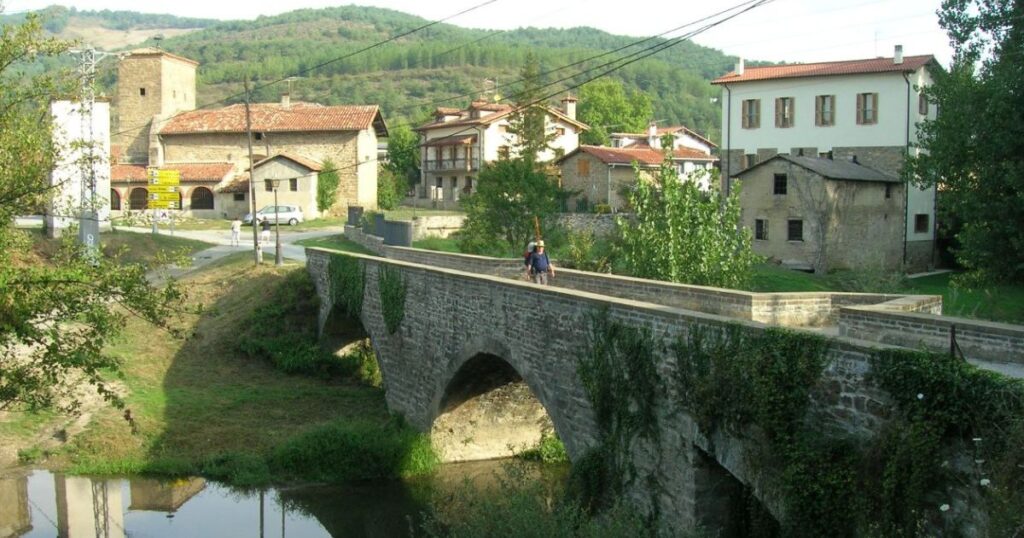
The Larrasoaña bridge, also popularly known as the Bridge of the Bandits, is an impressive stone structure dating from the medieval period, set over the Arga River in the charming Esteribar valley. This bridge is located in the small but significant town of Larrasoaña, part of the province of Navarra, on the Camino de Santiago Frances. Its nickname, Bridge of the Bandits, comes from a time when parts of the surrounding road were frequented by bandits who waited for pilgrims to ambush or rob them, taking advantage of the vulnerability of those traveling the route.
The Puente de Larrasoaña is not only an important tourist attraction, but also a significant point on the Camino de Santiago Frances, one of the most recognized and walked pilgrimage routes in Europe. This bridge lies just after the Bridge de la Rabia, located in the nearby town of Zubiri. Throughout history, this bridge has served as a key crossing for walkers setting out on their journey to Santiago de Compostela, offering not only safe passage but also a place to enjoy the beautiful landscapes surrounding the area.
Built using techniques typical of medieval architecture, the Puente de Larrasoaña stands out for its two large flattened arches, a semicircular arch, and two cutwaters with triangular and polygonal shapes. This bridge is not only a remarkable feat of engineering, but was also once a required crossing for merchants and pilgrims traveling through the region. Its strategic location made it a crucial meeting point where the deputies or councilors of the valley would gather. Although attempts were made to use other places to host these meetings, since 1833 Akerreta has been established as the fixed meeting place for the representatives of the 28 villages that make up Esteribar.
The founding of Larrasoaña dates back to 1174, when King Sancho the Wise granted a group of Franks who had settled near the Larrasoaña area, later known as Larrasoinzar, a charter similar to the one granted to the Burgo de San Saturnino, located in the city of Pamplona. This charter was intended to encourage the settlement of a population whose main activity would be trade, in a place with a strategic geographic position, located at the center of the valley, right on the Camino de Santiago and on routes connecting both sides of the Pyrenees.
Originally known as Hiriberri, the town adopted the name Larrasoaña in the 13th century, reflecting its evolution over time. From at least the 14th century, this town had representation in the Cortes of Navarra, and also became host to several of these assemblies, underscoring its importance in the region’s political and social history. In fact, Larrasoaña was an independent municipality for many years, but in 1928, as part of an administrative reorganization, it was integrated into the municipality of Esteribar, marking a new chapter in its long, rich history.
Camino de Santiago Frances >> Navarra >> Larrasoaña >> Bridge de Larrasoaña
Map
Sorry, no records were found. Please adjust your search criteria and try again.
Sorry, unable to load the Maps API.