



Collegiate Church of Our Lady of the Apple Tree Castrojeriz
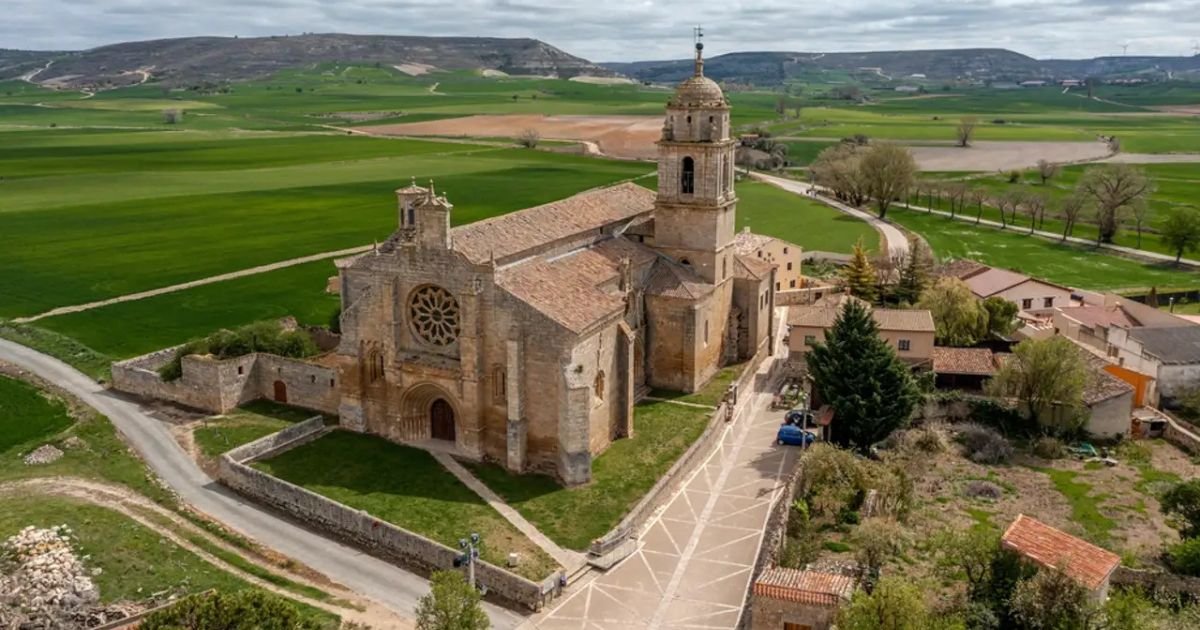
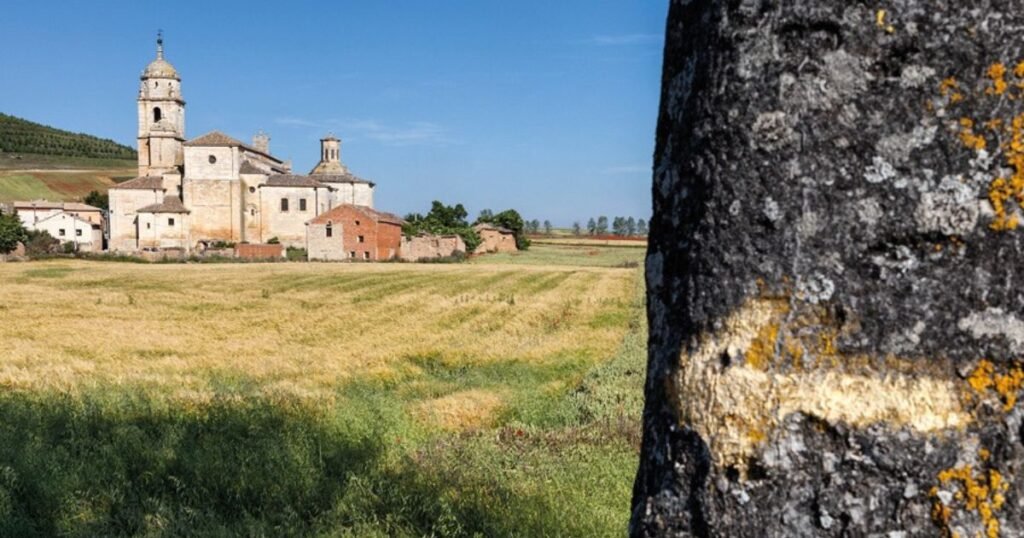
The Collegiate Church of Our Lady of the Apple Tree -also known as Santa Maria del Manzano– is located in the Jacobean town of Castrojeriz (Burgos Province, Castilla y Leon), at the foot of the hill crowned by the Castrojeriz Castle and right on the route of the Camino de Santiago Frances. Declared a Site of Cultural Interest on April 25, 1974, it is part of the inventory associated with the 2015 UNESCO extension (“Routes of Santiago de Compostela: Camino Frances and Routes of Northern Spain”). Construction of the current church began in 1214 at the initiative of Berenguela of Castilla, daughter of Alfonso VIII and mother of Fernando III.
From medieval abbey to seigneurial collegiate church: a historical summary
Documentary tradition links the site to an early medieval foundation with privileges granted by Count Garcia Fernandez (974), a key figure in the resettlement of the Odra-Pisuerga corridor. Over the centuries, the institution went through decisive stages:
- 11th-12th centuries: affiliation with San Millan de la Cogolla and, later, a link to Burgos Cathedral during the reign of Alfonso VII.
- 1173: secularization and the abandonment of the Benedictine rule.
- 1214: the Gothic building campaign under Berenguela of Castilla.
- Late 15th-16th centuries: partial renovations (vaults, rose window).
- 18th century: a major building campaign (chancel, tower, roofing, sacristies, the Chapel of the Virgin of the Apple Tree, the counts’ crypt and the choir), involving the architect Juan de Sagarvinaga.
Exterior architecture: doorways, tower and a masterful rose window
The building, made of well-squared ashlar, offers a layered reading of styles:
- Western doorway (Gothic): a splayed arch with archivolts and roll moldings resting on bases and capitals with plant motifs. On the jambs, two 13th-century sculptures depict the Virgin Mary and the Archangel Gabriel beneath canopies.
- Rose window: a standout feature of the main facade; it depicts God giving a blessing surrounded by the apostles, with symbols of the Evangelists, angel heads and the donor’s coat of arms.
- South doorway (Renaissance): forms the side entrance in a Classicist style.
- Tower: a reinforced Romanesque base with a bell chamber added in 1746.
- Chancel: the original apse disappeared in the 18th century and was replaced by a spacious rectangular main chapel.
Interior space: three naves, Gothic light and Romanesque memory
The floor plan has three naves and five bays, with the central nave -about 17 m high- raised above the side aisles in a 2:1 ratio. Although the overall style is Gothic, late Romanesque transverse arches survive in the minor naves, underscoring the stylistic transition. The stone vaults create a unified rhythm well suited to liturgical use and the display of altarpieces.
Altarpieces and painting: Mengs, Maella and Bayeu on the Camino de Santiago
The collection of furnishings preserves an exceptional catalogue:
- Older altarpieces: Christ Crucified (late 16th c.) and Saint James the Apostle (17th c.).
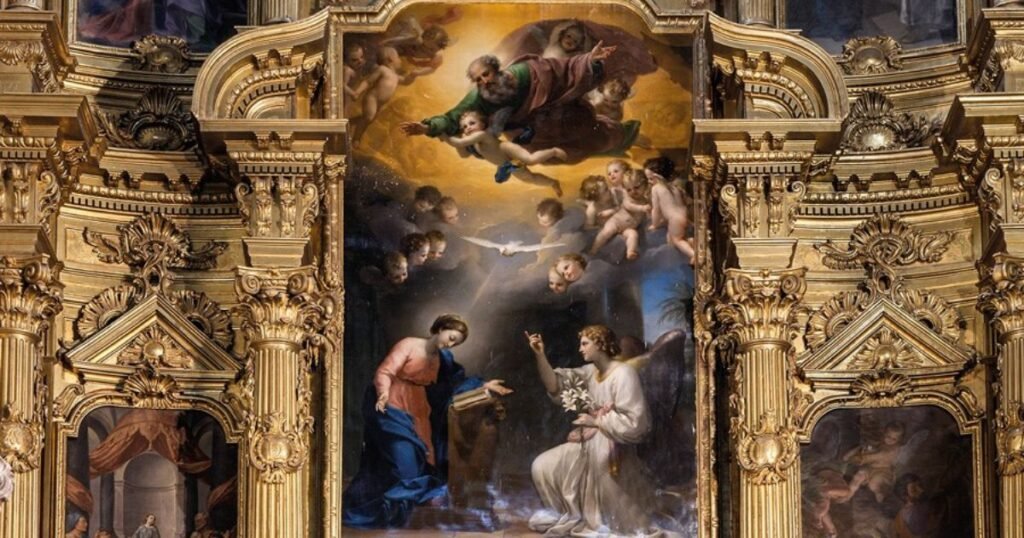
- Main altarpiece (1760, sponsored by the Counts of Ribadavia): a pictorial cycle featuring The Annunciation -a work by Anton Raphael Mengs– and scenes attributed to his pupils Mariano Salvador Maella and Francisco Bayeu (the Visitation, the Nativity, the Presentation, Jesus among the Doctors, topped with Saint John the Baptist).
- Upper choir (ca. 1776): finely carved choir stalls, a lectern and a closing Renaissance grille.
- Neoclassical organ (ca. 1790): an instrument with a sober case and a liturgical sound.
- Trascoro (rear choir screen): a canvas of Our Lady of the Cherries, attributed to Pieter Pourbus.
Chapel of the Virgin of the Apple Tree: devotion and Castilian Baroque
The Chapel of Our Lady of the Apple Tree (18th c.), the work of Juan de Sagarvinaga, brings together:
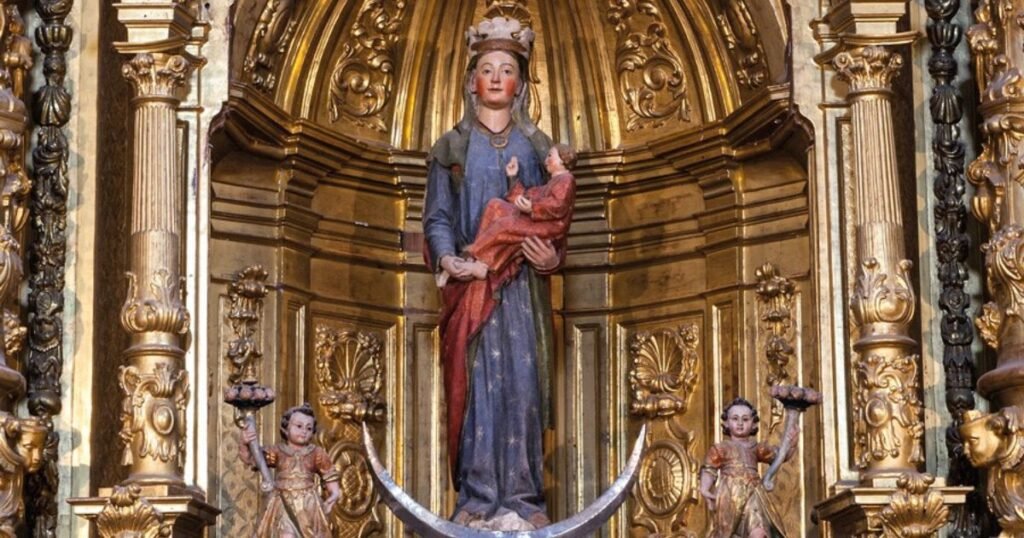
- A central Baroque altarpiece gilded by Martinez del Barranco (a pupil of Mengs), housing the titular image.
- Side altarpieces attributed to Francisco Diez de Mata, with sculptures from the now-vanished Monastery of San Anton.
- Image of the Virgin of the Apple Tree: a polychrome stone carving; the Virgin, wearing a starred blue tunic and a gathered mantle, holds the Child in her left arm while caressing his bare foot with her right hand; a cameo with a “T” on her chest and a royal crown underscore her iconography.
- The Cantigas de Santa Maria of Alfonso X, which mention Castrojeriz (nos. 242, 249, 252 and 266), a literary testament to its devotional prestige.
The tomb of Queen Leonor of Castilla: a courtly memory
Next to the baptistery, a Gothic tomb is preserved, attributed to Leonor of Castilla (1307-1359), daughter of Fernando IV and sister of Alfonso XI, who was murdered in 1359. The tomb -located in 1970 by the Grupo de Mision Rescate- features a female recumbent effigy and is related to other funerary works from the mid-14th century. Documentary tradition places its original location next to the Gospel side of the main altar, with a later move when the counts’ crypt was built in the 18th century. However, alternative claims exist (the Seu Vella of Lerida and Las Huelgas of Burgos).
Recommended visiting route
- Western facade: take in the rose window and the sculpted Annunciation on the jambs.
- Naves and vaults: the Romanesque-Gothic transition, the rhythm of pillars and capitals.
- Main altarpiece: the 18th-century pictorial program centered on Mengs.
- Choir and organ: the musical setting and historic ironwork.
- Chapel of the Virgin of the Apple Tree: the titular image and Baroque gilding.
- Tomb of Queen Leonor: funerary iconography and courtly context.
- An outdoor walk toward the pilgrim street, continuing on to San Anton and a panoramic view of the castle.
Parish museum: a Jacobean treasure
The complex houses a museum aimed at pilgrims and visitors, with wooden statuary (medieval pieces including notable 14th-century carvings), metalwork, books and sacred painting. The collection offers a quick overview of the region’s religious art in dialogue with the Camino de Santiago.
Visiting and photography tips
- Light: morning for the interior (softly filtered through the rose window and openings), afternoon for facades and textures.
- Attire: comfortable footwear; respect for the liturgy during service hours.
- Surroundings: combine with San Anton (2 km) and a climb to the castle for 360-degree views.
- Access: in the town center of Castrojeriz, on foot from the pilgrim street; local signage available.
Key facts
- Location: Castrojeriz (Burgos, Castilla y Leon)
- Styles: Gothic with Romanesque survivals; Renaissance and Baroque renovations
- Timeline: construction begun in 1214; major renovations in the 18th century
- Protection: Site of Cultural Interest (1974); associated element in the 2015 UNESCO extension
Church of Our Lady of the Apple Tree Castrojeriz
The Church of Our Lady of the Apple Tree Castrojeriz brings together, in a single site, the essence of the Camino de Santiago Frances: soaring Gothic art, courtly memory and a Marian devotion with a literary echo in the Cantigas. Its construction -between Romanesque heritage and Baroque renovations- offers a complete journey through eight centuries of history, from Berenguela of Castilla’s original building campaign to the 18th-century pictorial program centered on Mengs. Located at the foot of the castle hill and just steps from the pilgrim street, a visit here lets you combine heritage and landscape in a single day: a three-nave interior, the main altarpiece, the Chapel of the Virgin of the Apple Tree and the tomb attributed to Queen Leonor, before continuing on toward San Anton or climbing the hill. Those who walk through Castrojeriz and stop at the Collegiate Church understand, with quiet clarity, why this landmark is one of the most significant churches on the Jacobean route across the Castilian plateau.