
The ensemble sits between the slopes of Mount San Cristóbal and Mount Miravalles, and the bridge is its reason for being. In the Middle Ages it became an obligatory crossing for pilgrims on the Camino Frances, who had no other easy way to cross the Ulzama before Pamplona.
The route came from Roncesvalles, down the Erro valley and through Esteríbar to Huarte, and from there skirted Mount Miravalles to cross this bridge. The place still does its job today: the old hospital now works as a hostel and is a meeting point for those keeping the pilgrimage alive on the way to the Cathedral of Santiago in Santiago de Compostela.
History of Trinidad de Arre
It is surprising how little is known about its origins. There are no documents on the ensemble before the 16th century, it does not appear in the long list of hospitals in the will of Theobald II, where Roncesvalles does, and nothing suggests that any religious order ran it. The only earlier record is a very brief testamentary bequest from 1422.
What is documented is that it was supported by two confraternities, one ecclesiastical and one lay, distinguished not by the social class of their members but by where they came from. According to a ruling of 1697, the lay one brought together residents of Pamplona, Villava and the Ezcabarte valley, and the ecclesiastical one clergy and lay people from the Cuenca de Pamplona and places such as Oláibar and Odieta. The two merged in 1886, as recorded in the first article of the constitutions approved on 2 December that year.
In 1891 a house was built against the south facade, almost completely hiding the Romanesque portal. Since then you have to step into an atrium to see it, and the ensemble looks quite different from the original.
What to see in Trinidad de Arre?
Bridge, basilica and tower form a very unusual ensemble, one of the most photogenic sights on the way into Pamplona.
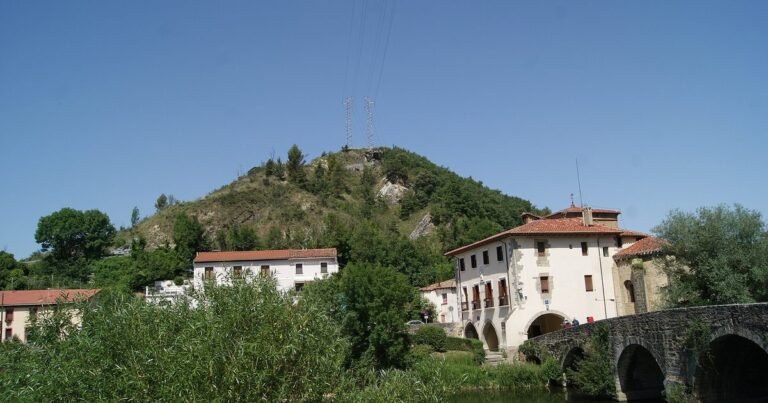
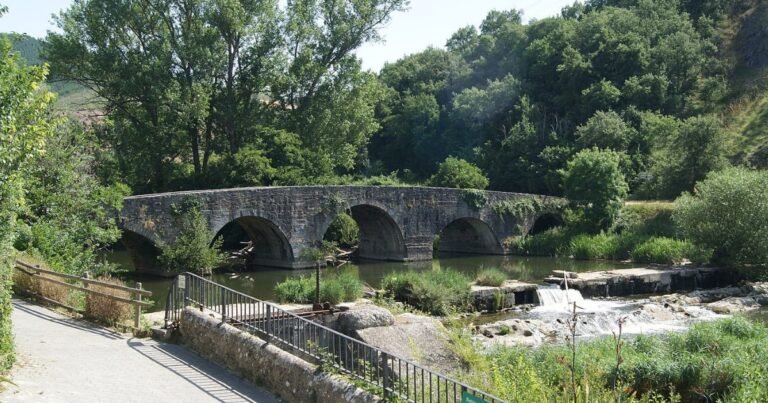
The basilica is a good example of rural Romanesque from the first half of the 13th century: a single nave, a tower beside the chancel and a semicircular apse reinforced with buttresses and pierced by two splayed round-arched windows, that is, windows that widen towards the outside. Under the present roof you can still make out the original covering of stone slabs, and the eaves keep plain, undecorated corbels that add to its simple feel.
The portal opens with a sharp-edged round arch and three archivolts, the central one decorated with a sawtooth pattern, under a moulded drip-stone. It has clearly been retouched several times, but it keeps its Romanesque character.
The brick tower at the west end probably replaced an older one of a different material, one of the many changes the ensemble has accumulated over the centuries.