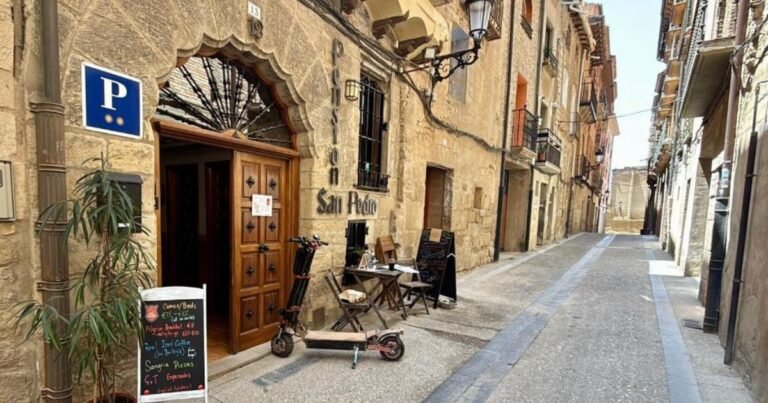
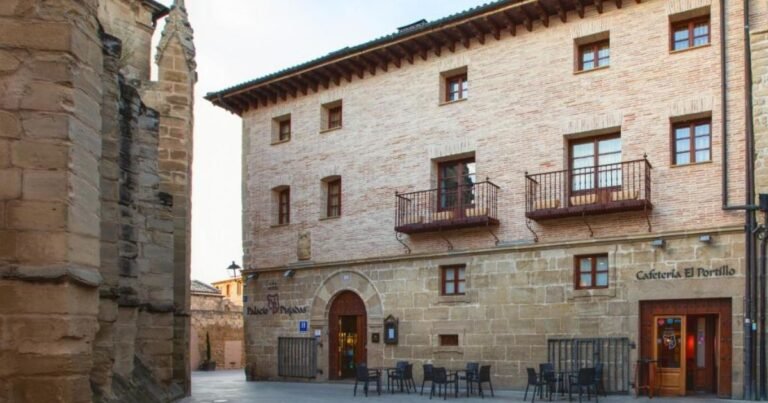


Viana on the Camino Frances
Viana is the last Navarrese stop on the Camino Frances before entering La Rioja, and its position has always made it a meeting place for pilgrims.
The old town has everything a walker needs: hostels, bars, shops and restaurants where Navarrese and Riojan cooking meet, perfect for getting your strength back before the last stretch to Logroño.
What to see in Viana?
Heritage of Viana
Walls and old town
Stretches of wall, gateways and towers survive from its medieval walled precinct. Walking through the old town means going from square to square among stone Renaissance and Baroque mansions, many with a coat of arms on the facade.
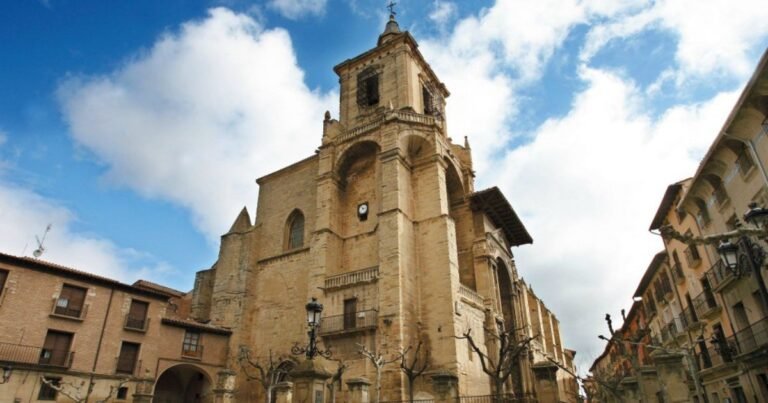
Church of Santa María de la Asunción
The town’s great monument: a Navarrese Gothic church built between 1250 and 1312 and later enlarged, with a huge Renaissance south portal counted among the most beautiful of the Spanish Renaissance. Cesare Borgia, who died fighting in the service of the King of Navarre, is buried here.
Church of San Pedro
Only ruins remain of this 13th-century Gothic church, but they are among the most evocative images of medieval Viana, next to a viewpoint over the plain.
The founding of Viana
Sancho VII the Strong founded Viana on 1 February 1219 as a stronghold to guard the border with Castile. Its importance earned it in 1630 the title of Most Noble, Most Illustrious and Loyal City of Viana, Head of the Principality of the Kingdom of Navarre.
It still keeps much of its medieval layout, with remains of the 13th-century walls, cobbled streets and many houses bearing coats of arms.
Geography of Viana
The municipal area, of almost 79 km², spreads across the Estella depression, from the hills in the north to the plains in the south, beside the Ebro river.
- Altitude of the town: 505 m.
- Highest point: Alto de los Bojes, 836 m.
- Lowest point: by the Ebro, to the south, 345 m.
These differences in height make for a varied landscape: vineyards and open fields on the flat and hill country good for walking and watching wildlife.
Rivers and natural areas
Several streams coming down from the Sierra de Codés, such as the Longar, the Valdearas or the Palomeras ravine, cross the municipality on their way to the Ebro.
To the south there is an endorheic lagoon, used for irrigation and protected as a nature reserve, very interesting for watching birds on passage.
The climate of Viana
The climate is continental with Mediterranean influence, that of the Ebro riverlands:
- Cold winters, with frost and little snow.
- Dry summers, hot at midday and cooler at dusk, when the cierzo wind blows.
Between 1982 and 2004 the average temperature was 13.8 °C, with extremes of 47 °C and -10 °C, and about 442 mm of rain a year: take water and sun protection in summer.
Wine and food
Viana lies within the Rioja Qualified Designation of Origin, so wine tourism has plenty to offer here: family and modern wineries make reds, whites and rosés.
On the table you will always find:
- Menestra with garden vegetables.
- Stuffed peppers and lamb in chilindrón sauce.
- Artisan cured meats and cheeses.
What to do in Viana
Viana is a good starting point for several routes:
- Walls and palaces: a walk through the heritage of the old town.
- Hiking and mountain biking in the Sierra de Codés.
- Wine route through the wineries and vineyards of the area.
- Viana–Logroño Camino stretch: short, flat and one of the busiest on the Camino.
Practical information
- Population: about 4,400 inhabitants.
- Altitude: 505 m.
- Road distances:
- Logroño: 9 km
- Estella: 37 km
- Pamplona: 81 km
- Vitoria: 64 km
- How to get there: by road from Logroño, Pamplona or Vitoria, with quick access to the AP-68 and N-111.
Viana, farewell to Navarre
Border history, vineyards, mountains, good food and plenty of Camino atmosphere: Viana brings together almost everything the pilgrim has found in Navarre and sees them off at the gates of La Rioja.
It is worth arriving with time to explore its old town at leisure.
| Country | Spain | |
|---|---|---|
| Autonomous community | Navarra | |
| Province | Navarra | |
| Merindad | Estella | |
| District | Estella Occidental | |
| Judicial district | Estella | |
| Location | 42°30′54″N 2°22′18″W | |
| Elevation | 469 metres (min: 360, max: 836) | |
| Area | 78,62 km² | |
| Founded | 1219 | |
| Population | 4,413 inhab. (2024) | |
| Density | 56.13 inhab./km² | |
| Demonym | vianés, vianesa | |
| Predominant language | Non-Basque-speaking area | |
| Postal code | 31230 | |
| Twinned with | La Brède (France) | |
| Patron saint | Mary Magdalene | |
| Patron saint (female) | Santa María | |
| Website | viana.es | |