Manjarín today
At about 1,460 metres, in the municipality of Santa Colomba de Somoza, Manjarín is an uninhabited village on the way down from the Cruz de Ferro. For pilgrims on the Camino Frances it is one of the most unusual stops on the route, because of the refuge that kept the place alive for decades.
History
Its origins are usually linked to the resettlement of the mountains of León in the 9th and 10th centuries and to the work of Gaucelmo, the hermit who founded the Foncebadón hospital at the end of the 11th.
Like Foncebadón, Manjarín was born out of hospitality: there was a hostel here for pilgrims crossing Mount Irago, one of the hardest passes on the Camino.
Manjarín and the Camino
For centuries, pilgrims heading to the Cathedral of Santiago in Santiago de Compostela found shelter here in the middle of the mountains, where snow and fog are frequent.
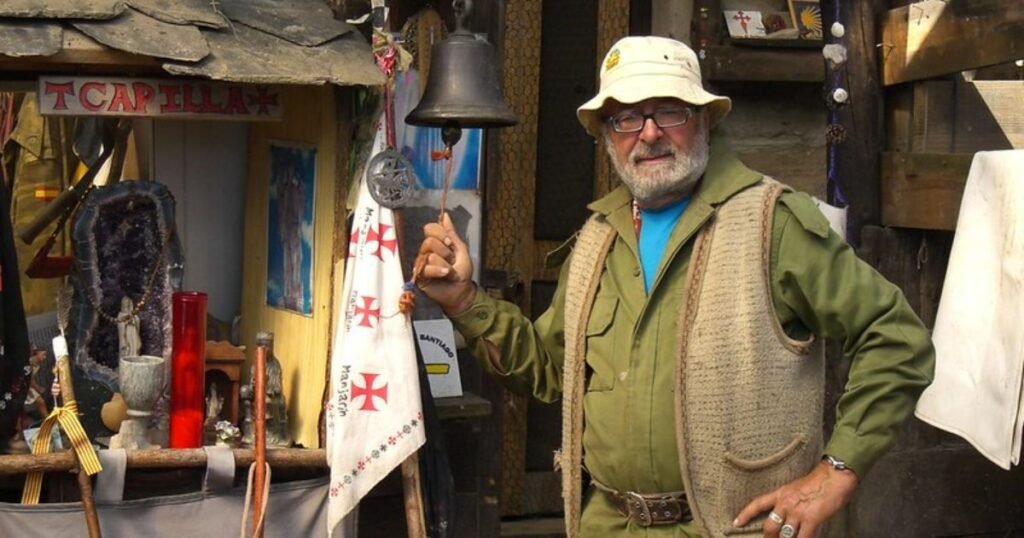
After it emptied in the 20th century, the village came back to life in 1993 with the refuge of Tomás, who presented himself as «the last Templar»: a rustic hostel with no electricity or running water, with a bell to welcome walkers, flags from all over the world and signs showing the distances to far-off cities. The refuge closed in 2022.
The landscape
Manjarín lies on the side of Mount Irago that drains to the Sil, among slopes of heather and broom, with very hard winters that explain why the village was abandoned.
There are remains of Roman gold mining in the area.
Heritage and devotions
Among the ruins lingers the memory of its dedications, Saint Roch and Our Lady of the Assumption, and of its role as a place of welcome on the border between the Maragatería and El Bierzo.
Abandonment
Like so many mountain villages in Leon Province, Manjarín emptied in the mid-20th century because of its isolation and lack of services.
What remains today
Although the refuge no longer operates, the place is still a much-remembered waypoint: the ruins, the signs and the view of the mountains make many pilgrims stop for a few minutes.