
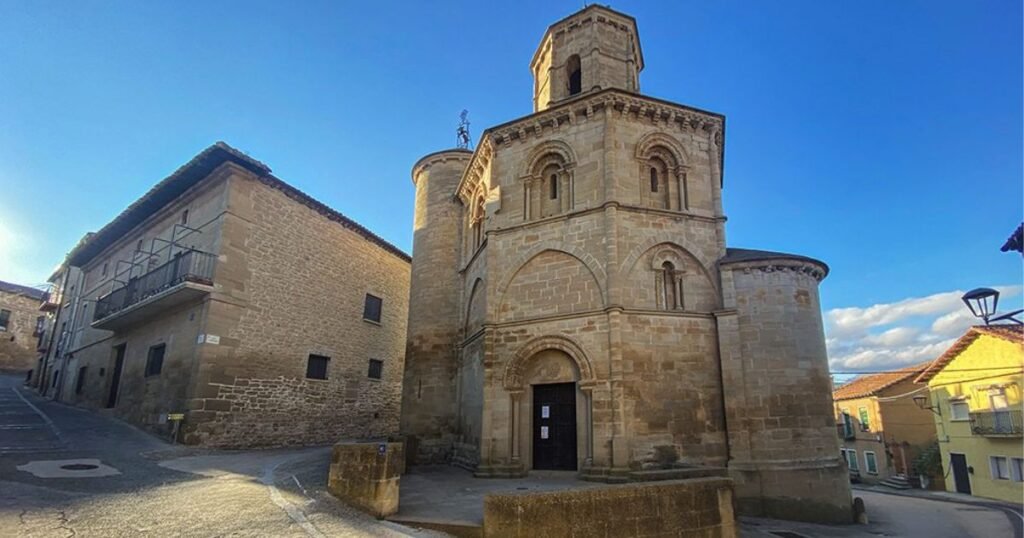


Church of the Holy Sepulchre of Torres del Río
The Church of the Holy Sepulchre is a Christian temple located in the municipality of Torres del Río, in the region of Navarra. This building has an octagonal shape, meaning its floor plan has eight sides, and it stands out for its interior, which features a ribbed dome, known in architecture as a crucería vault. This dome is one of the most unique and distinctive architectural features found in this temple. Although the church is not very large, its importance lies in the fact that it is a clear example of the Navarrese Romanesque style that developed during the 12th century.
The temple stands in a strategic location, on the Camino de Santiago Frances, the pilgrimage route to the tomb of Saint James the Greater at the Cathedral of Santiago de Compostela. It also stands halfway along the road connecting the city of Estella with Logrono, specifically along the N-111 road. This location gives it added value, as it is a passage point for many pilgrims and visitors travelling this historic route. In recognition of its historical and cultural importance, the church was declared a Historic-Artistic Monument in 1931, underlining its heritage value and the need to preserve it for future generations.
History of the Church of the Holy Sepulchre, Torres del Río
The church’s origin is linked to the Order of the Temple, having been built between 1160 and 1170. This period was significant for Templar commanderies, which commonly adopted a circular floor-plan design. This design was conceived as a tribute to the famous Church of the Holy Sepulchre located in Jerusalem, a place of great reverence and significance for the Templars. However, not all Templar churches strictly followed this circular shape, and a variety of buildings existed that did not have a polygonal plan such as the one mentioned.
Regarding the origin and purpose of centrally-planned churches, as well as their historical roots, a debate has arisen within the scientific community. This debate centres on trying to clarify and understand the motivations and meanings behind these architectural structures.
Inside the church, the corbels play a crucial role, as they are the starting point for the thrust of eight intersecting arches, forming a figure reminiscent of a star. This design gives rise to a central octagon inscribed within a circle decorated with interlacing, a characteristic feature of the artistic style of the period. In addition, the vault used is of a Hispano-Islamic type, which has led to numerous specialised studies suggesting a notable influence from the domes found in the mihrab of the Mosque of Cordoba, another architectural jewel of the Iberian Peninsula.
These architectural features point to an influence that could be attributed to builders of Mudejar origin, a style that developed in medieval Spain and combined Christian and Muslim elements. All of this results in one of the most representative examples of what is known as Mudejar Romanesque, which flourished in the late 12th and early 13th centuries.
The lantern found in the temple was built after the main structure of the building was completed. In 1914, the temple was presented to the scientific community for the first time, and from that moment on it began to be part of historical studies, thanks to an article published in the Bulletin of the Commission of Historical and Artistic Monuments of Navarra. The first analyses carried out on the building suggest that its origin is linked to the Order of the Holy Sepulchre, an institution that played an important role in history. Because of the importance of these analyses and the temple’s cultural relevance, it was declared a Historic-Artistic Monument in 1931, highlighting its heritage value and its significance in the historical context.
Over the years, the church has undergone several architectural restorations, carried out in different stages. The first of these restoration phases took place between 1960 and 1964, a period in which important improvements and repairs were made to preserve the structure and artistic values of the temple. Then, in 1993, another restoration was carried out, which was especially significant, as it coincided with the celebration of the Jacobean Holy Year, an event that attracts numerous pilgrims and visitors. These restorations have not only helped keep the building in good condition, but have also allowed more people to learn about and appreciate its history and artistic beauty.
Church of the Holy Sepulchre Torres del Río
| Location | ||
|---|---|---|
| Country | Spain | |
| Division | Torres del Río | |
| Address | Torres del Río, Navarra | |
| Coordinates | 42°33′08″N 2°16′17″W | |
| Religious Information | ||
| Worship | Christian | |
| Diocese | Monastery of Irache | |
| Order | Order of the Holy Sepulchre | |
| Use | church | |
| Dedication | Holy Sepulchre | |
| Building History | ||
| Construction | 12th century | |
| Architectural Data | ||
| Type | Romanesque | |
| Style | Mudejar architecture | |
| Monument Identifier | RI-51-0000756 | |
| Year of Listing | 3 June 1931 | |