
History of Itero del Castillo
Itero del Castillo has always been border land: the Pisuerga, which runs past its municipality, separated the old kingdoms of Castile and León, so for centuries the place was somewhere to pass, to keep watch and to meet. Already in the Middle Ages it appears in documents as «Fitero del Castiello», and it soon had houses to take in pilgrims.
The village grew around the castle that gives it its name, of which a crenellated tower survives among the houses. Its job was to guard the river crossing at the Itero bridge, which the Camino crosses a little further on.
What to See in Itero del Castillo?
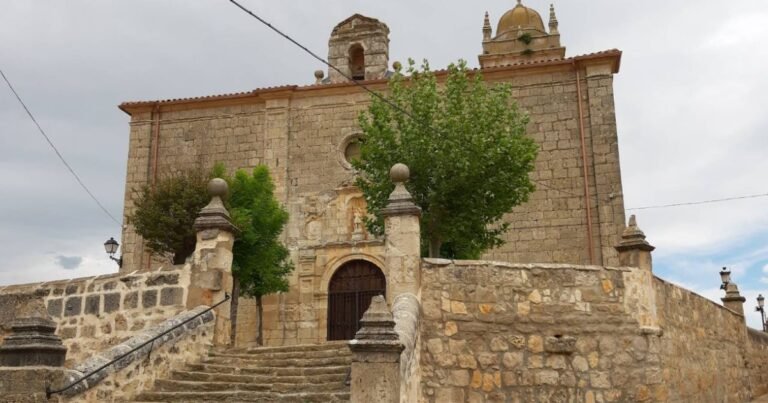

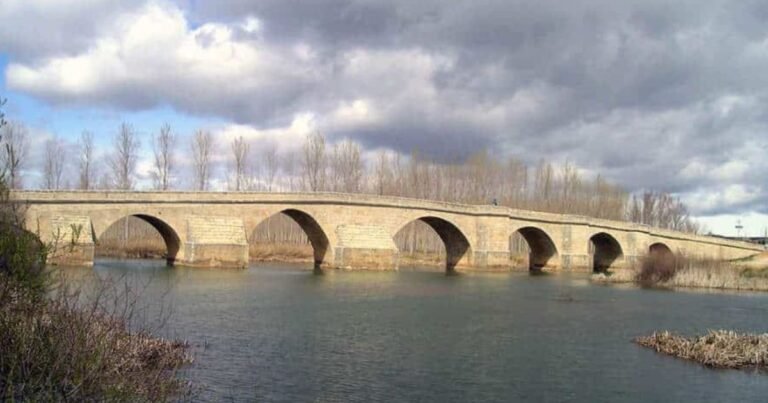
The Itero bridge
The great monument of the area is the Fitero Bridge, a medieval work of eleven arches over the Pisuerga linking Itero del Castillo, in Burgos Province, with Itero de la Vega, in Palencia Province. Much restored over the centuries, tradition attributes it to Alfonso VI, and for the pilgrim crossing it means changing province and entering Tierra de Campos.
Beside the bridge stands the hermitage of San Nicolás, the remains of a hospital founded in 1160 that an Italian confraternity of Saint James now runs as a hostel, with no electricity and the ritual of washing pilgrims’ feet. The whole setting, with the river, the poplar groves and the cereal fields, is among the most photogenic on this part of the Camino.
The castle
What remains of Itero castle is above all its tower, of stone, crenellated, with a pointed doorway and a twin window. It played a part in the border struggles between Castile and León and later watched over the traffic on the river and the Camino.
It is a good place for a quiet stop to take in the Pisuerga valley, the farmland and the line of the Camino disappearing westwards.
Hospitality and festivities
With few residents all year round, the village offers pilgrims a simple, friendly welcome, far from the crowds of other stages.
The main festivities are held for Saint Peter, on 29 June, with a procession, music and a communal meal, and it is not unusual for passing walkers to join in.
Landscape and nature
Itero del Castillo lies in the transition between the Burgos uplands and the plains of Palencia. Fields of wheat, barley and sunflowers reach down to the banks of the Pisuerga, where you can see waterfowl, storks and kites.
The stretch that crosses it is one of the quietest on the Camino Frances, ideal for walking without hurry.
Recommendations
- Cross the Fitero Bridge early in the morning, when the mist rises from the river.
- Walk up to the castle tower and look at the landscape from the village.
- Go into the church of San Pedro, if it is open.
- Try the local cooking and chat with the residents.
- For a different experience, sleep in the San Nicolás hostel, beside the bridge.
In short
Itero del Castillo is the farewell to Burgos: a border tower, a medieval bridge and a hermitage-hospital that still takes in pilgrims as it did centuries ago. Crossing the Pisuerga here is one of those moments that mark the passage from one land to another.
| Country | Spain | |
|---|---|---|
| Autonomous community | Castile and León | |
| Province | Province of Burgos | |
| Comarca | Odra-Pisuerga | |
| Judicial district | Burgos | |
| Location | 42°17′21″N 4°14′39″O | |
| Elevation | 783 m | |
| Area | 16.91 km² | |
| Population | 71 inhabitants (2024) | |
| Density | 4.85 inhab./km² | |
| Postal code | 09107 | |
| Website | www.iterodelcastillo.es | |