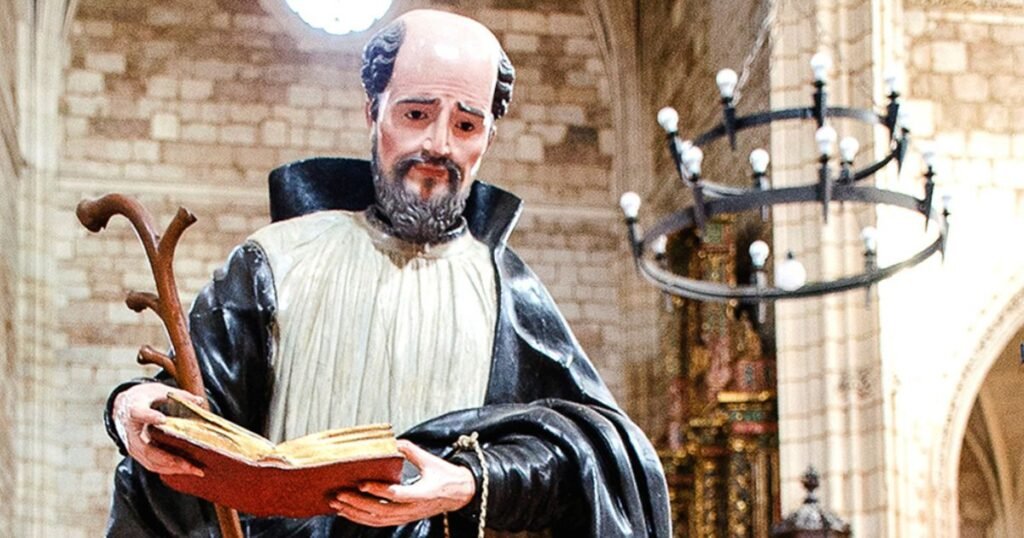
Saint John of Ortega, born Juan de Quintanaortúño in the Burgos Province between 1050 and 1080, is an emblematic figure in Spain’s religious and cultural history. A disciple of Saint Dominic (Saint Dominic of the Causeway), he devoted his life to improving the infrastructure of the Camino Frances, making it easier for pilgrims to travel towards the Cathedral of Santiago de Compostela in the city of Santiago de Compostela. His legacy lives on in the monastery that bears his name and in the many works he undertook on behalf of travellers.
Origins and Formation of Saint John of Ortega
Birth and Family Background
Juan de Quintanaortúño was born in the village of the same name, in the province of Burgos, around the year 1080. The son of the knight Vela Velázquez and Estefanía, he grew up in an environment combining nobility with religious devotion. From a young age he showed an inclination towards the spiritual life and service to others.
Saint John of Ortega, Disciple of Saint Dominic of the Causeway
In his youth, Juan became a disciple of Saint Dominic of the Causeway, a renowned builder and benefactor of pilgrims on the Camino de Santiago. Under his tutelage he acquired knowledge of building bridges, churches and causeways, skills he would later apply in his own works.
Pilgrimage to Jerusalem and Promise to San Nicolás de Bari
Journey to the Holy Land
After his master’s death in 1109, Juan set out on a pilgrimage to Jerusalem in 1112, seeking to deepen his faith and find inspiration for his future works. This journey marked a turning point in his life, reinforcing his commitment to helping pilgrims.
Shipwreck and Vow
On his way back, the ship he was travelling on was caught in a violent storm that brought it to the brink of shipwreck. In the midst of the danger, Juan called upon Saint Nicholas of Bari, promising to build a chapel in his honour if he survived. Having survived the ordeal, he kept his promise by erecting a hermitage in the Montes de Oca, an area known for its danger due to the presence of bandits.
Founding of the Monastery of Saint John of Ortega
Building Infrastructure for Pilgrims
Committed to the safety and wellbeing of pilgrims, Juan de Ortega dedicated himself to building and improving infrastructure on the Camino de Santiago. He completed the causeway between Nájera and Burgos, a project begun by his master, and built bridges in towns such as Logroño, Nájera, Santo Domingo de la Calzada, Belorado, Cubo de Bureba and Agés.
Establishment of the Monastery
Around 1138, he founded the monastery of San Nicolás, which would in time become known as the Monastery of Saint John of Ortega. Located in the Montes de Oca, this monastery offered shelter and assistance to pilgrims, establishing itself as a key point on the Way of St James.
Legacy and Recognition
Patronage of Building Surveyors
In recognition of his work building and improving infrastructure, Saint John of Ortega was proclaimed patron saint of building surveyors and technical architects in Spain in 1971. This honour highlights his contribution to works that made travel easier for thousands of pilgrims over the centuries.
Miracle of the Light
One of the most notable phenomena associated with the monastery is the “miracle of the light”. During the equinoxes, a ray of sunlight enters through a window of the church, illuminating a capital depicting the Annunciation. This event, the result of a precise combination of architecture and astronomy, attracts numerous visitors and worshippers every year.
Celebrations and Traditions
Annual Pilgrimage Festival
Every 2 June, the anniversary of his death in 1163, a pilgrimage festival is held in honour of Saint John of Ortega. Neighbouring communities take part carrying banners and processional crosses, paying tribute to the saint whose life was devoted to serving pilgrims and improving the Camino de Santiago.
Saint John of Ortega
Saint John of Ortega is a central figure in the history of the Camino de Santiago. His dedication to building infrastructure and hostels for pilgrims has left an indelible mark on the Way of St James. His legacy endures in the works he undertook and in the traditions that, centuries later, continue to honour his memory.