Camino Frances Stage Route: Roncesvalles – Zubiri (21.4 km)
This stage of the Camino de Santiago Frances descends from Roncesvalles to Zubiri through the Erro and Esteribar valleys, among beech woods, oak groves and mountain meadows. It is 21.4 kilometers of moderate difficulty: the climbs to the Alto de Mezkiritz (924 m) and the Puerto de Erro (803 m) are offset by a long final descent, often muddy, down to the Puente de la Rabia, the symbol of Zubiri. It is a day of forest walking, much gentler than crossing the Pyrenees the day before, but with slippery footing when it rains.
KM 0
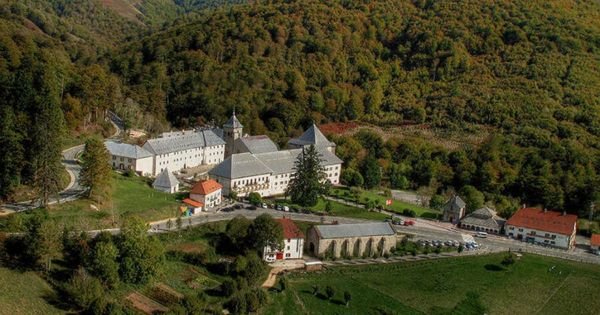
Roncesvalles
Leaving Roncesvalles, on the right-hand side of the road, a dirt path follows through a forest of oak, beech and box trees, always just a few meters from the road.
3 km

Burguete
The route crosses Burguete (Auritz) along the main street and, after passing the church, turns right by a bank branch. It crosses a stream and climbs a forest path up to a paved track that descends toward Espinal.
6.5 km
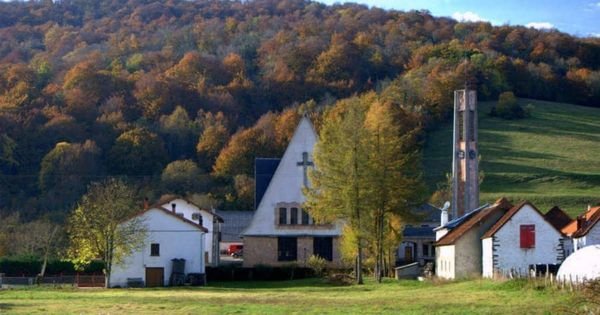
Espinal
The route crosses the village and takes a track to the left, climbing. At Alto de Mezkiritz (924 m) it crosses the N-135 and descends through a magnificent beech forest via the Camino de Sorogain.
11.7 km

Viscarret-Guerendiain
The route runs alongside the N-135 road, which it later crosses to descend toward Lintzoain.
13.4 km

Linzoain
A steep climb up to 850 m, followed by nearly flat tracks. At the Puerto de Erro (803 m) it crosses the N-135 and passes by the Venta del Puerto. A continuous descent toward Zubiri follows.
21.4 km
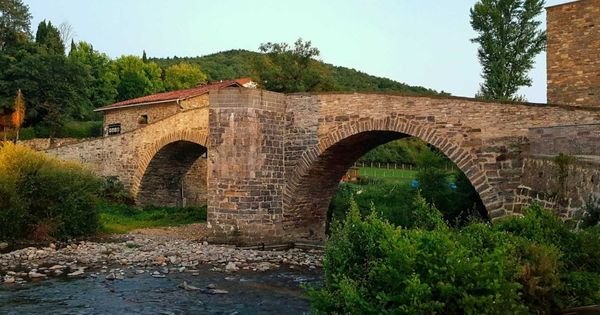
Zubiri
To enter Zubiri you cross the Puente de la Rabia over the Arga river; legend says that anyone who walks around it three times cures animals of rabies.
Roncesvalles – Zubiri: Complete Guide
Stage Profile: Distance, Elevation and Difficulty
Stage 2 is 21.4 kilometers and takes about 5 to 5.5 hours on foot. The elevation change is moderate: from Roncesvalles (about 950 m) the route climbs to the Alto de Mezkiritz (924 m) and, after descending to Viscarret, to the Puerto de Erro (803 m), before a continuous descent down to Zubiri (about 525 m). Overall it adds up to around 300 meters of climbing and over 600 meters of descent.
In terms of distance and gradient it is a low-to-moderate difficulty stage, but it has one tricky section: the descent from Puerto de Erro to Zubiri, rocky with loose stones and roots, which turns very muddy in the rain. That is where most of the day’s slips and twisted ankles happen; trekking poles help a lot.
The route runs almost entirely along forest tracks and dirt paths under beech trees, with very little asphalt and plenty of shade: a good stage for hot days and a poor one right after rain. There are bars and fountains in Burguete (km 3) and Espinal (km 6.5); beyond that there are no reliable services until Zubiri, except for the seasonal Venta del Puerto at Alto de Erro. The N-135 road runs alongside the stage almost the whole way, with bus stops in Burguete, Espinal and Zubiri in case you need to cut the day short.
Forests of the Erro and Esteribar Valleys
This stage is, above all, a walk through Atlantic mountain forest. Leaving Roncesvalles, oak and box dominate; as the route gains height toward Mezkiritz and Erro, the beech forest takes over, turning the hillsides ochre and red in autumn and filtering a very particular green light in spring. The Camino de Sorogain, the old drovers’ track followed after the Alto de Mezkiritz, is one of the most beautiful stretches of the entire Camino Frances.
Burguete (Auritz) also carries a distinctive literary weight: Ernest Hemingway stayed here summer after summer between 1924 and 1929 to fish trout in the Irati river, and turned the village and his days of fishing into the setting of his novel The Sun Also Rises (1926). The hotel where he stayed still keeps his room and a piano bearing his signature.
The end of the stage is marked by the Puente de la Rabia in Zubiri, a two-arched medieval bridge over the Arga river. Relics of Santa Quiteria, patron saint against rabies, were once venerated at its central pillar; hence the custom of walking animals three times around the pillar to cure or protect them. The name Zubiri itself means “the town of the bridge” in Basque (zubi, bridge).
What to See: Monuments and Heritage
Roncesvalles (starting point): the 13th-century Gothic Royal Collegiate Church of Santa Maria, with the tomb of Sancho VII the Strong, the cloister, the Chapel of Santiago, and the Silo of Charlemagne. Usually visited at the end of Stage 1. — Burguete/Auritz: a street-road lined with grand houses bearing coats of arms and wide wooden eaves, the Church of San Nicolas de Bari (16th century), and the memory of Hemingway. — Espinal/Aurizberri: a new town founded by Teobaldo II of Navarre in 1269; the Church of San Bartolome and houses with the lauburu carved into their facades.
Alto de Mezkiritz (924 m): a stone marker with a relief of the Virgin of Roncesvalles beside the Camino. — Puerto de Erro (803 m): the old Venta del Puerto, a stopping point for muleteers and pilgrims for centuries. — Zubiri: the Puente de la Rabia over the Arga, with the central pillar of the Santa Quiteria relics.
A Bit of History
The Erro and Esteribar valleys were, for centuries, a route for muleteers and smugglers between Alta and Baja Navarra; the mountain-pass inns — Erro, Mezkiritz — offered shelter, food and fresh horses. Espinal was founded as a “new town” resettlement created by the Crown of Navarre in the 13th century to secure and populate the Camino. In 1813, during the Peninsular War, these same passes saw troops cross in what became known as the Battle of the Pyrenees.
In the 20th century, Burguete became world-famous through Hemingway and his summers fishing on the Irati. The approach to Zubiri, by contrast, is announced by the magnesite factory built in 1943 next to the village: its industrial estate suddenly breaks the forest atmosphere of the whole stage.
Local Food
Navarrese mountain cooking: shepherd’s migas, roast lamb and kid, txistorra sausage, and above all trout — often “a la navarra”, stuffed with ham — in memory of the ones Hemingway used to fish on the Irati. In autumn, wild mushrooms (onddo, perretxiko); year-round, sheep’s cheeses from the valley, curd and quesada. To finish, a homemade pacharan. Burguete and Espinal have grill restaurants and pilgrim menus, and many albergues offer communal dinners.
Practical Tips
The final descent into Zubiri is the tricky part: loose stone, roots and mud. In rain or dew, take extra care and use trekking poles. — Fill up on water in Espinal (km 6.5): there are about 15 km with no reliable services until Zubiri. — This is a short stage: many pilgrims continue on to Larrasoana (+5.5 km) or all the way to Pamplona. If you stop in Zubiri, book ahead in high season: availability is limited and fills up fast.
The N-135 runs parallel to almost the entire route; if the forest path is impassable or there is a storm, you can walk along the road shoulder or take the Pamplona–Roncesvalles bus line from Burguete, Espinal or Zubiri. — In autumn, the beech forests of Mezkiritz and Erro are at their best: set off early to make the most of the light. — Zubiri has a small supermarket, a pharmacy with limited hours, and an ATM; do not expect more services until Pamplona.
Services and Accommodation by Village
Listings published in our guide for the villages on this stage. Viscarret-Guerendiain does not yet have accommodation or heritage listings in the guide.
Roncesvalles
Hostels
Accommodation
Churches
Burguete
Hostels
Accommodation
Churches
Espinal
Hostels
Accommodation
Churches
Linzoáin
Churches
Zubiri
Hostels
Accommodation
Churches