Camino Frances Stage Guide: Los Arcos – Logroño (28 km)
This stage of the Camino Frances runs from Los Arcos to Logroño over 28 kilometres, closing out the crossing of Navarre. Along the way: the octagonal jewel of the Santo Sepulcro church in Torres del Río, the walled town of Viana — where Cesare Borgia is buried — and, after crossing the Ebro on the Puente de Piedra, the entrance to the Rioja capital and its famous Calle del Laurel.
KM 0
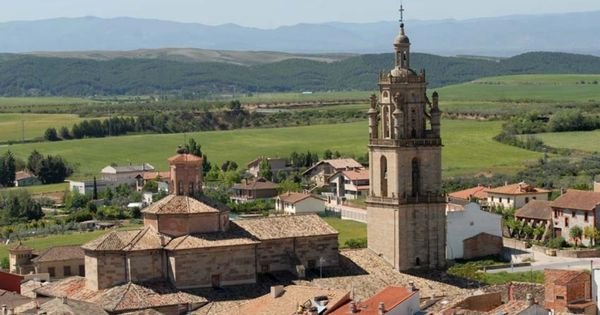
Los Arcos
The route leaves Los Arcos over the bridge across the Odrón river and the old royal road. After a stretch of gentle ups and downs through vineyards, it reaches Sansol.
7 km

Sansol
A village perched on a small hilltop, with the baroque church of San Zoilo. The path drops into the Linares river ravine and, after barely a kilometre, climbs back up to Torres del Río.
7.8 km
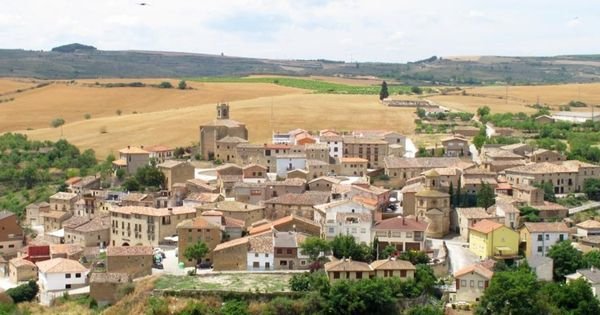
Torres del Río
Worth a stop: the Santo Sepulcro church, a 12th-century octagonal Romanesque building related to the one in Eunate, with a crossed-rib dome inspired by the Córdoba mosque. The path climbs out of the village towards the Alto de Cornava, into the longest and loneliest stretch of the stage.
18.4 km

Viana
The last Navarrese town on the Camino, walled and stately. In front of the Renaissance doorway of the Santa María church lies Cesare Borgia, who died here in 1507; next to it, the ruins of San Pedro, now a viewpoint over the Ebro valley. The path descends towards La Rioja.
28 km

Logroño
The route crosses the Ebro on the Puente de Piedra and enters Logroño’s old town. On Calle Ruavieja, the pilgrims’ fountain; nearby, the church of Santiago el Real with its large relief of the mounted Apostle and, at its feet, a game-of-goose board carved into the pavement. A step away, the lively Calle del Laurel.
Los Arcos – Logroño: Complete Guide
Stage profile: distance, elevation and difficulty
Distance: 28 km, one of the longer stages of the first week. Walking time: 6.5–7.5 hours. Elevation: roughly +350 m and –430 m. Difficulty: moderate, more for the distance than the terrain. The ground rolls gently through vineyards as far as Viana; after that, a long descent towards the Ebro and an urban approach into Logroño that can feel tedious. Many pilgrims split the stage at Viana (18 km) or extend the previous stage as far as Sansol or Torres del Río. By bike it’s manageable except for traffic on the way into the city.
From Navarre to La Rioja: the Ebro and the wine
This stage crosses the border between two regions and two landscapes. As far as Viana we’re still in the Navarre of rolling hills and knolls; after that the great Ebro valley opens up and the vineyards multiply: we enter the Rioja of wine, which takes its name from the Oja river. The river is crossed on the Puente de Piedra, rebuilt in the 19th century over the medieval bridge, opening onto an old town made for pilgrims, with Calle del Laurel as its culinary hub.
What to see: monuments and heritage
The Santo Sepulcro church in Torres del Río is, along with the one in Eunate, the finest example of an octagonal church on the Camino: a central plan, a lantern tower, and a crossed-arch dome reminiscent of the Córdoba mosque. In Viana: the town walls, the Renaissance doorway of Santa María, the tomb of Cesare Borgia, and the ruins of San Pedro. In Logroño: the Puente de Piedra, the church of Santiago el Real (an equestrian Santiago Matamoros with a game-of-goose board at its feet), the twin-towered baroque Co-Cathedral of Santa María de la Redonda, the Gothic church of San Bartolomé, and the pilgrims’ house.
A bit of history
Viana was a Navarrese stronghold facing Castile; at the foot of its castle, Cesare Borgia — son of Pope Alexander VI, then in the service of the King of Navarre — died in an ambush in 1507. Logroño was a crossroads fought over by Navarre, Castile and Aragon; the Fuero de Logroño, granted in 1095 by Alfonso VI, became a model charter for resettling dozens of towns across northern Spain. A local tradition links the game of goose to the Camino’s stonemasons and pilgrims, said to have encoded its stages and dangers on the board.
Food and drink
We enter La Rioja: patatas a la riojana (potatoes with chorizo and choricero pepper), menestra riojana vegetable stew, lamb chops grilled over vine cuttings, stuffed peppers, and above all, wine from the Rioja D.O.Ca. In Logroño, Calle del Laurel and Calle San Juan are packed with dozens of pintxo bars: grilled mushrooms, patatas bravas, the ham «zapatilla» sandwich, or the «matrimonio» pintxo. Save room for the evening.
Practical tips
If you’re feeling tired, consider splitting the stage at Viana. There are fountains and bars in Sansol, Torres del Río and Viana; the Torres del Río – Viana stretch (about 10 km) is the loneliest, with a couple of short climbs. The approach into Logroño through industrial estates and avenues drags on: be patient. The city has plenty of hostels (municipal, the parish of Santiago, private ones) but demand is high too — booking ahead is a good idea. And don’t leave without walking Calle del Laurel.
Services and accommodation by town
Listings published in our guide for the towns along this stage.
Los Arcos
Hostels
- Hostel Casa Arqueña Los Arcos
- Hostel Casa de la Abuela Los Arcos
- Hostel Los Arcos
- Hostel Municipal Isaac Santiago
Accommodation
Churches
Sansol
Hostels
Accommodation
Churches
Torres del Río
Hostels
Accommodation
Churches
Viana
Accommodation
Churches
Logroño
Hostels
- Hostel Albas Logroño
- Hostel Logroño Centro
- Hostel Municipal de Logroño
- Hostel Saint Nicholas Logroño
- Hostel Santiago Apóstol Logroño
- Hostel Winederful Hostel & Café Logroño
Accommodation
- Hotel Eurostars Fuerte Ruavieja Logroño
- Hotel Los Bracos Logroño
- Hotel Mercure Carlton Rioja
- Hotel NH Logroño Herencia Rioja
- Hotel Sercotel Portales Logroño
Churches