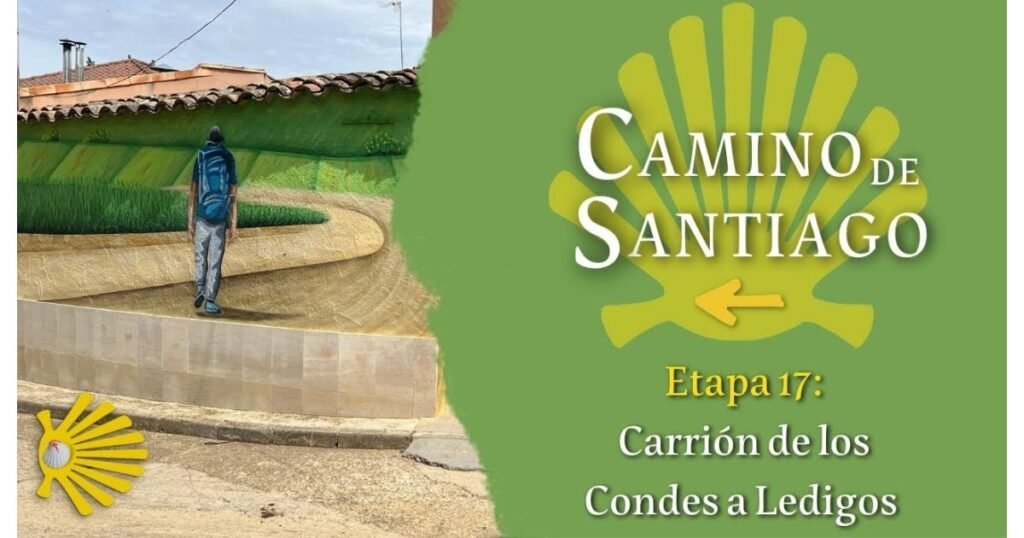
Video Stage 17: Carrión de los Condes to Ledigos | Camino Frances with Jhonatan Barrios
Video Stage 17: Carrión de los Condes to Ledigos | Camino Frances with Jhonatan Barrios
Jhonatan Barrios shares in detail his experience during Stage 17, from Carrión de los Condes to Ledigos, covering 23 kilometres in total. This particular stretch was part of a longer journey spanning 26 April to 26 May 2022.
During this stretch, Jhonatan documented his journey in a video that captures what it was like to walk 17 kilometres in a straight line, without passing a single village or fountain, which was a considerable mental challenge. Although his initial goal was to reach Terradillos de los Templarios, Jhonatan decided to stop in the village before it, Ledigos. It was a moment of reflection and a change of plans in his experience on the Camino Frances.
Stage 17: Carrión de los Condes to Ledigos with Jhonatan Barrios
A Dawn in Carrión de los Condes
The day began early for Jhonatan Barrios, who left behind the Espíritu Santo hostel in Carrión de los Condes. This hostel, known for its hospitality, had been a warm and welcoming refuge after a long previous stage. With dawn breaking on the horizon, Jhonatan set out to face stage number 17 of the Camino de Santiago, one of the most challenging, not because of any technical difficulty, but because of the immense solitude awaiting him. On this stretch, he would cover 23 kilometres towards Ledigos, with a 17-kilometre straight stretch without seeing a single village along the way.
Anticipating the Solitude of the Road
As Jhonatan pressed on, he became increasingly aware of just how unique this stage was. In the first few kilometres, the Camino Frances stretched out like an endless ribbon across the vast Castilian plain. The scenery, though simple, offered a serene beauty, with golden fields and the occasional whisper of wind through the trees. However, the real challenge was the complete absence of civilisation for 17 kilometres. Pilgrims who had completed this stage before him warned him about the monotony of the stretch and the need to be well prepared, not only physically, but mentally too.
Taking the advice of other pilgrims on board, Jhonatan made sure to carry enough water and food for the stretch. He also loaded his device with his favourite playlist, knowing music would be his faithful companion during the long hours of walking through the solitude of the plain.
The Legacy of the Counts and the History of Carrión
As he walked, Jhonatan could not help but reflect on the rich history steeped in every corner of the Camino. Carrión de los Condes, the starting point of this stage, is a place laden with history. The town’s name refers to the Counts Gómez Díaz and his wife Teresa, who, in the 11th century, were key benefactors in building vital infrastructure for pilgrims, including a hospital and a bridge over the río Carrión.
Jhonatan crossed that very bridge, a testament to the influence of these nobles, who built not just a physical bridge, but also a bridge across time, connecting generations of peregrinos who, like Jhonatan, have passed through here for centuries. This bridge, along with the Real Monasterio de San Zoilo, declared a site of cultural interest in 2002, are reminders of how devotion and service to pilgrims have been a common thread throughout the region’s history.
The Challenge of the Solitary Straight
After leaving historic Carrión de los Condes behind, Jhonatan entered the most feared section of the stage: the endless straight. The first few kilometres passed without much difficulty. However, as the sun rose higher in the sky, the reality of the isolation began to set in. The Castilian plain, though beautiful, lacked the distractions Jhonatan had found on other stages of the Camino.
In the distance, all that could be seen was field after field, occasionally broken up by small groves offering pilgrims a moment’s shade. Despite the flat terrain, the walk grew increasingly gruelling due to the lack of landmarks. Every step seemed identical to the last, and the monotony of the scenery tested Jhonatan’s mental endurance.
Calzadilla de la Cueza: An Oasis in the Desert
Finally, after several hours of walking, Jhonatan spotted the first village in kilometres: Calzadilla de la Cueza. This small enclave became an oasis for him and the other pilgrims on the same stretch. Here, Jhonatan stopped to recharge. The village, though small, offered what walkers needed to rest and prepare for the final kilometres of the stage.
The rest in Calzadilla was brief but revitalising. After a break to eat and drink something, Jhonatan felt ready to tackle the final six kilometres separating him from Ledigos, his final destination for the day.
Arrival in Ledigos: The End of Stage 17
After setting off again, Jhonatan completed the final kilometres with a mix of tiredness and satisfaction. Although the terrain remained monotonous, being so close to the end of the stage gave him a new burst of energy. When he finally reached Ledigos, the small village welcomed him with its characteristic calm and peaceful atmosphere. Despite his initial wish to carry on to Terradillos de los Templarios, about three kilometres further, Jhonatan decided that was enough for one day.
Staying at the Albergue La Morena
In Ledigos, Jhonatan stayed at the private hostel La Morena, an option that, although not part of his original plan, turned out to be the perfect place to rest and recover. The hostel, with its cosy atmosphere and well-kept facilities, offered everything pilgrims needed to relax after such an intense day. Jhonatan treated himself to dinner at the hostel’s restaurant, enjoying the comforting food on offer.
The village of Ledigos, though small, has its own charm. The parish church of Saint James the Apostle is a notable point of interest, especially for its three depictions of Saint James: the pilgrim, the apostle, and the Moor-slayer. This church is a symbol of the deep connection between the Camino de Santiago and the Christian tradition, a reminder to pilgrims of the spiritual meaning of their journey.
Reflection and Preparation for the Next Stage
That night, as he rested at the hostel, Jhonatan reflected on the stage he had completed. The solitude of the road, although challenging, had also offered him a chance for introspection. Every step he took brought him closer to Santiago de Compostela, and every stage completed was a personal victory in his spiritual and physical journey.
Jhonatan knew that the Camino de Santiago was not just a test of physical endurance, but also a journey of self-discovery. The long hours walking alone gave him time to reflect on his life, his goals, and the purpose of his pilgrimage. Stage 17, with its desolate scenery and endless stretch, had been a metaphor for life itself: sometimes the road is long and lonely, but in the end, there is always a destination, a place of rest and reflection.
The Magic of the Camino: Between History and Spirituality
The Camino de Santiago is much more than a physical route; it is a journey through time, history and the soul. Every stone, every village, every bridge has a story to tell, a lesson to offer the pilgrims who choose to walk it. For Jhonatan Barrios, Stage 17 was a reminder of the power of the human spirit to overcome solitude and monotony, and of the importance of preparation, both mental and physical, in facing the challenges life presents.
The Importance of Preparation and Community on the Camino
Although the Camino de Santiago is, in many ways, a personal journey, it is also a deeply communal experience. Pilgrims, although they often walk alone, are part of a global community that shares a common goal: reaching the Cathedral of Santiago de Compostela in Santiago de Compostela. In moments of difficulty, such as the long, lonely kilometres of Stage 17, knowing that others have walked the same road and overcome the same challenges offers immense comfort and motivation.
Jhonatan, like many other pilgrims, found that preparation was the key to facing the challenges of the Camino. From carrying enough water and food to making sure he had a playlist to keep his spirits up, every detail mattered. However, he also learned that the Camino is unpredictable and that, sometimes, plans have to change. His decision to stay in Ledigos rather than continue on to Terradillos de los Templarios was an example of how flexibility and the ability to adapt are essential skills on the Camino, and in life.
Stage 17 of the Camino de Santiago was, for Jhonatan Barrios, an experience of solitude, reflection and self-discovery. As he prepared for the next stage, he knew that every day on the Camino offered him new lessons and challenges, but also new opportunities to grow and get closer to his final destination.
The Camino Frances is a journey that transcends time and space, a road that unites people of all cultures and beliefs in a common quest. For Jhonatan, as for many others, it was a test of endurance and faith, but also a celebration of the beauty and meaning of life.